How Do Birds Fly In Flocks: The Science Explained
Birds fly in flocks by following a few simple rules: keep a safe distance, match nearby birds, and stay connected to the group. No single bird usually directs every turn. Instead, each bird reacts to its neighbors, and those small reactions spread through the flock in seconds.
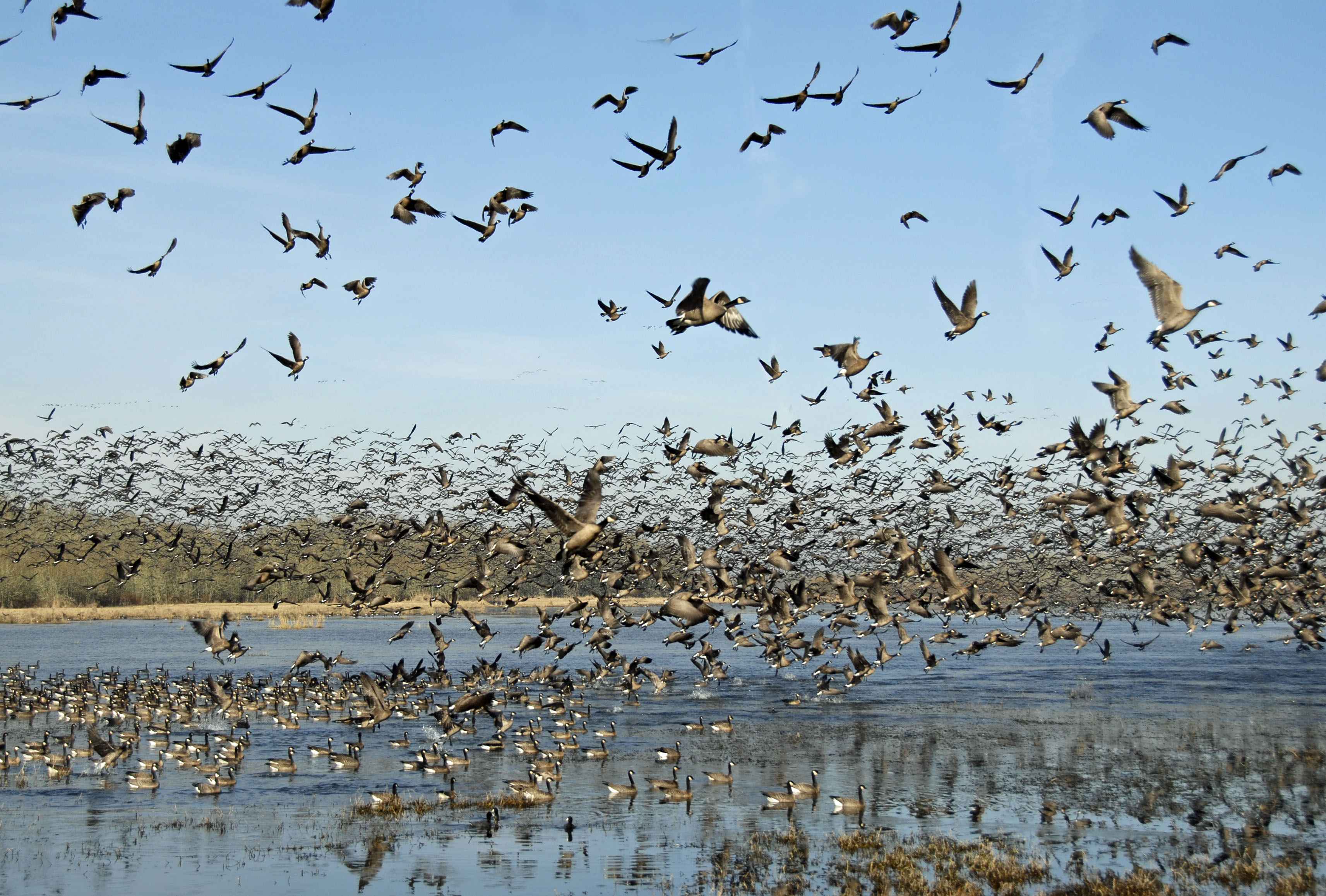
Across the United States, you can see this in Canada geese over wetlands, shorebirds along the Atlantic coast, blackbirds over Midwestern fields, and starling murmurations at dusk. Their flight may look like one large, thinking shape, but it comes from many birds making quick local decisions.

How Birds Coordinate Their Flight
Birds in a flock coordinate through sight, sound, and fast changes in body position. Each bird watches nearby flock members and adjusts its speed, direction, and spacing.
Most flocking behavior follows three basic rules:
- Separation: Avoid flying too close to another bird.
- Alignment: Match the direction and speed of nearby birds.
- Cohesion: Stay close enough to remain part of the group.
These rules are often called boids rules, after a computer model created by Craig Reynolds in 1987. The model showed how lifelike group movement could emerge without a central leader. Real birds use more complex senses and behaviors, but the basic idea helps explain how a flock turns as one.
A bird does not need to track every member of the flock. It mainly responds to a small neighborhood around it. When one bird banks left, nearby birds see the change and bank left too. Their neighbors then react, creating a wave of movement through the group.
This is why a flock can change direction almost instantly. The signal does not need to travel from a leader to every bird. It passes from bird to bird.
Do birds follow a leader?
Sometimes they do, but not always. Many flocks have no fixed leader. Each bird responds to nearby members, so leadership can shift as the group moves.
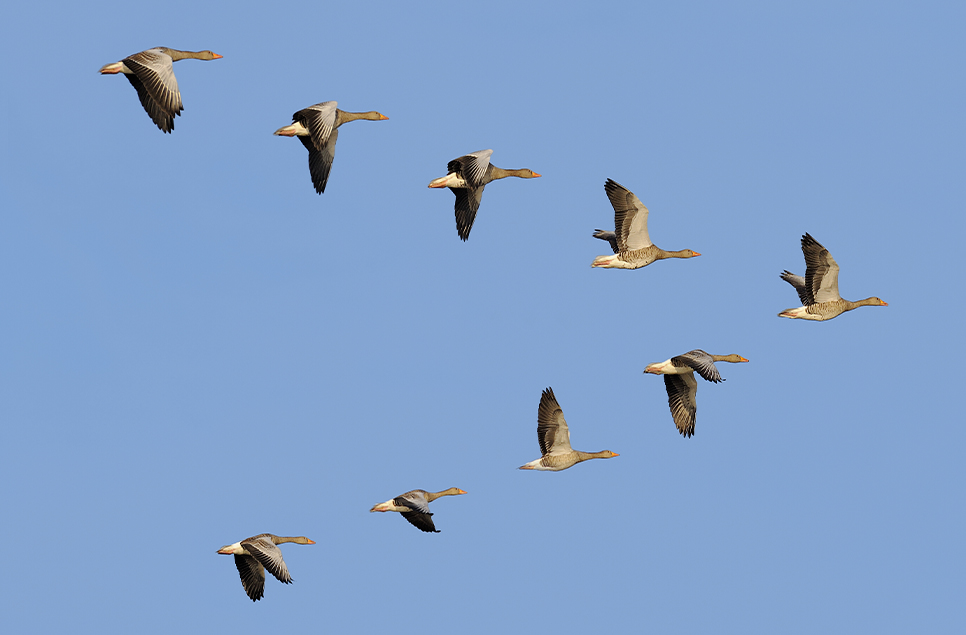
Some groups do have clear roles. In a V-shaped formation, for example, birds take turns flying at the front. The lead position creates more work, so birds may rotate positions during a long flight.
Flock behavior also depends on species, age, experience, and the reason for flying. A family group may follow an older bird, while a large starling flock may move through local interactions with no visible leader.

Why Do Birds Fly Together?
Birds form flocks because group flight can improve survival, feeding, communication, and travel. The exact benefit depends on the species and situation.
Protection from predators
A flock gives many birds more eyes to scan for danger. A predator, such as a hawk or falcon, may also find it harder to target one bird when many birds move together.
Large groups can create a confusing visual pattern. This effect is sometimes called the confusion effect. It does not make birds immune to attack, but it may reduce a predator’s chance of choosing and catching one target.
Some flock members also use alarm calls. A bird that spots danger can warn the others, causing the group to rise, tighten, scatter, or change direction.
Better access to food
birds may find food more efficiently in groups. One bird can flush insects, locate a food patch, or reveal a predator. Other birds then benefit from the discovery.
Flocks can also help birds track changing resources. This matters for species that search across large areas for seeds, insects, fish, or fruit.
However, group feeding has a cost. More birds may compete for the same food. A flock is most useful when the benefits of finding food or avoiding danger outweigh the competition.
Social learning
Young birds can learn routes, feeding sites, calls, and danger signals from older birds. This is especially useful during migration.
A flock may also help birds maintain social bonds. Some species travel with relatives or familiar group members, while others join large mixed groups for safety or feeding.
More efficient travel
Certain birds reduce the energy needed for flight by using the air movement made by birds ahead of them. This is most clear in geese and other large birds that fly in a V formation.
A bird behind and to the side of another bird may use an upward-moving part of the air called an upwash. This air can provide extra lift. The trailing bird still has to flap and control its body, but it may spend less energy than a bird flying alone.
The benefit is not the same for every position. The front bird does not receive the same lift from another bird ahead. That is one reason birds may rotate positions during long flights.

How Do Birds Avoid Collisions?
Birds avoid collisions by combining spacing, vision, reaction time, and flexible flight paths. They do not follow a rigid grid.
Each bird keeps a personal safety zone around its body. If another bird enters that space, the bird may slow down, speed up, roll, rise, or move sideways.
Birds also watch the direction of nearby birds, not just their location. A bird moving toward it requires a faster response than a bird drifting away.
Their eyes support this task in several ways:
- Birds have a wide field of view.
- Many species can track nearby movement well.
- Birds can make rapid changes in wingbeat and body angle.
- Their nervous systems process motion quickly.
- Flight muscles allow fine control in three dimensions.
Birds may also use calls or wing sounds to maintain contact, especially when visibility is poor. Sound does not replace vision, but it can help a group stay connected.
Why do birds sometimes fly very close together?
Close spacing can help a flock respond as one group. It may also increase protection from predators or improve the aerodynamic benefit of formation flight.
Still, birds do not always fly at the same distance. Spacing changes with:
- Wind speed and direction
- Bird size and wing shape
- Predator attacks
- Light and visibility
- Flock density
- Whether the group is feeding, migrating, or escaping
A dense starling murmuration and a loose line of migrating geese use different spacing rules. The same species may also spread out during calm travel and tighten during a sudden threat.
How Do Starling Murmurations Work?
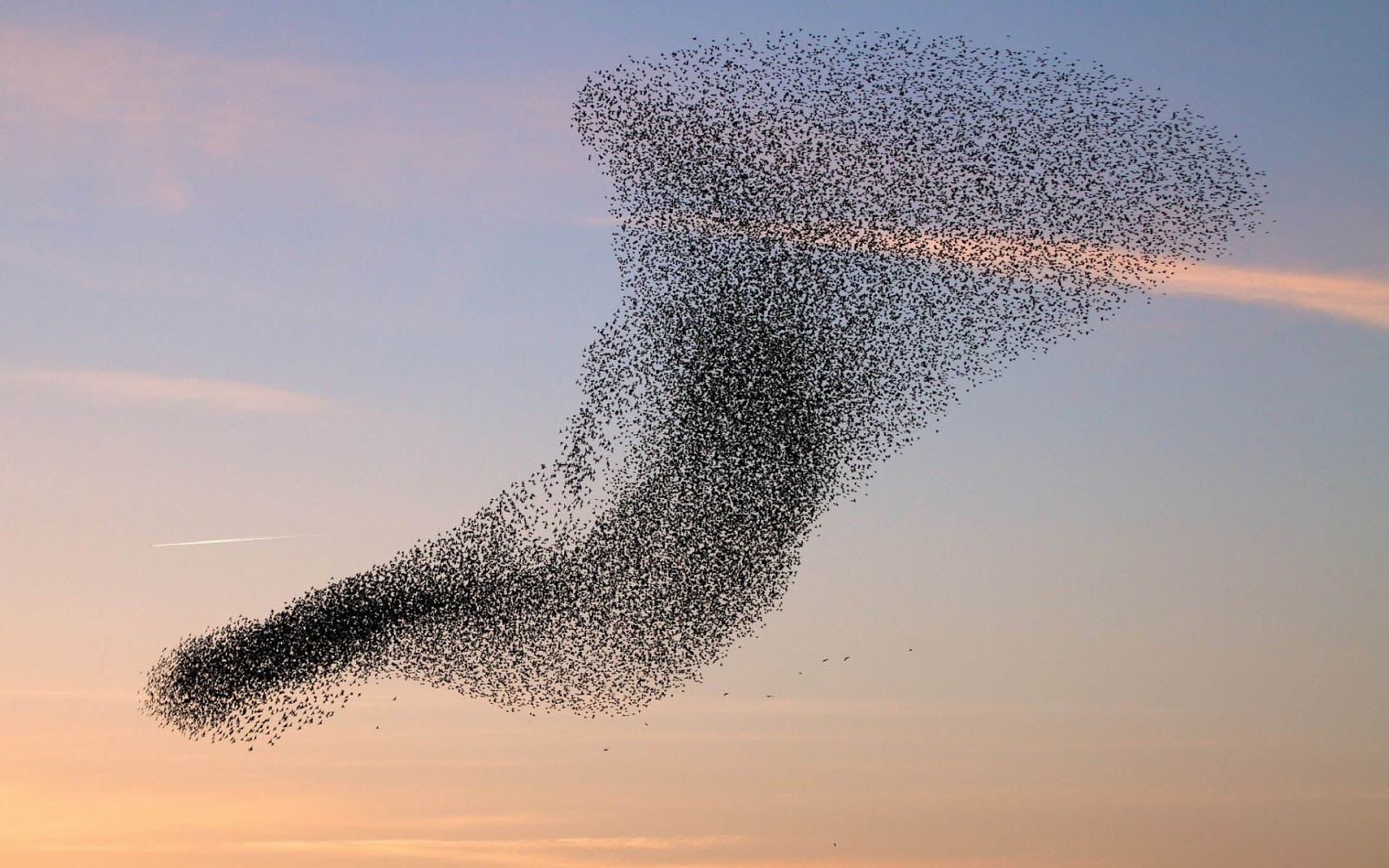
A starling murmuration is a large group of starlings that twists, expands, and contracts in the sky. These displays often occur near evening roosts, including areas in the United States where large numbers of starlings gather.
A murmuration does not move because one bird gives every command. Instead, each starling responds to nearby birds. Research on European starlings found that birds tend to respond to a limited number of close neighbors rather than to every bird in the flock.
This local response helps the group stay coordinated while allowing it to change shape quickly. A small movement may spread through the group like a ripple across water.
Starlings also use flock movement when predators are nearby. Rapid turns and shifting shapes may make it harder for a falcon to isolate one target. The display is beautiful, but it is also linked to survival.
Why does a murmuration look like one moving organism?
The flock moves as a group because each bird adjusts to nearby changes. The result is called emergent behavior. This means that a large pattern forms from many simple interactions.
No individual bird needs a complete map of the flock. It only needs enough information about nearby birds to keep its place and respond to movement.
The pattern can look planned because the rules are repeated many times across the flock. Similar effects occur in fish schools, insect swarms, and some human crowds.
Why Do Geese Fly in a V Formation?
Geese often fly in a V formation because the arrangement can reduce the effort needed by birds behind the leader. The formation also helps birds see one another and communicate during migration.
A goose creates air movement as its wings beat. Near the wingtip, the air can move upward in a way that helps a following goose generate lift. By flying behind and to the side, the following goose may gain an aerodynamic advantage.
Research on northern bald ibises, a close relative of geese in the broader formation-flight discussion, found that birds adjusted their positions and timing to benefit from the air produced by birds ahead. Research on migrating geese has also examined how birds use formation flight during long journeys.
The front position remains demanding. When the lead bird tires, another bird may move forward. This rotation spreads the work across the group.
A V formation is not always the best choice. Birds may abandon it when:
- They face strong crosswinds.
- They are taking off or landing.
- They are avoiding a predator.
- They are searching for food.
- They are traveling in a small family group.
- They need to follow a narrow route.
The formation can also become uneven. Real birds do not fly in a perfect geometric V at all times.

Do All Birds Fly in Flocks the Same Way?
No. Flock behavior varies widely among bird species. A goose, starling, pelican, and sandpiper have different body shapes, flight styles, habitats, and social needs.
| Bird group | Common flock pattern | Main advantage or function |
|---|---|---|
| Geese and cranes | V formation or angled lines | Travel efficiency and communication |
| Starlings and blackbirds | Dense, shifting groups | Predator avoidance and social roosting |
| Shorebirds | Tight, fast-moving waves | Predator response and group travel |
| Pelicans | Lines or loose formations | Travel and possible energy savings |
| Hawks and eagles | Soaring groups | Use of rising air, not usually close flocking |
| Ducks | Lines, groups, or loose formations | Migration, feeding, and protection |
Birds also change flock patterns during the day. A group may spread out while feeding, gather when a predator appears, and form a line during migration.
Not every group of birds in the sky is a flock in the same sense. Birds may gather because they share a food source, a roost, or a migration route without coordinating every movement.
Some birds also fly alone for much of the year. Territorial species may defend an area and avoid close contact except during breeding or migration.

How Do Birds Navigate as a Flock?
Birds navigate with a mix of inherited ability, memory, environmental signals, and social information. A flock may use landmarks, the Sun, stars, Earth’s magnetic field, wind patterns, and knowledge learned from older birds.
The group does not necessarily contain one bird with a complete route map. Navigation can emerge from several birds contributing information.
Birds may compare their direction with nearby flock members. If one bird begins to drift, others can correct the movement. This helps the flock stay together even when wind pushes the group off course.
Migration is not always a single uninterrupted journey. Birds may stop at feeding and resting sites. They may also change altitude, route, or speed as weather and food conditions change.
Young birds often gain experience by traveling with older birds. This can help them learn where to stop and how to respond to local conditions.
Scientists still do not know every detail of how different species combine individual navigation with group decisions. The answer likely varies by species, flock size, and migration distance.

What Happens When a Flock Is Attacked?
When a predator approaches, a flock may tighten, scatter, rise, dive, or turn sharply. The response depends on the predator, the species, and the location of the attack.
A flock may use several defensive strategies:
- Alarm calls: Warn nearby birds.
- Rapid turns: Make it harder to track one target.
- Tight grouping: Reduce the number of exposed edges.
- Scattering: Force the predator to choose among many targets.
- Mobbing: Some birds approach or harass the predator.
- Escape into cover: Birds may descend into trees, reeds, or water.
These responses are not guaranteed to work. Predators can learn flock behavior and may still catch birds. A group can improve the odds of survival without protecting every member.
Birds may also make mistakes. Poor visibility, panic, exhaustion, or sudden obstacles can increase collision risk. Flocking is a strong survival strategy, not a perfect control system.
Common Misconceptions About Birds Flying in Flocks
“One bird always leads the flock.”
Not always. Some formations include a lead bird, but many flocks coordinate through local interactions. Leadership may change or may not exist as a fixed role.
“Every bird follows the bird in front.”
This is too simple. Birds often respond to several nearby birds. They may match direction with some neighbors while maintaining distance from others.
“Birds never collide.”
Birds are skilled fliers, but collisions can happen. Dense groups, poor weather, panic, and human-made structures can increase danger.
“A V formation always saves energy.”
Formation flight can improve aerodynamics in suitable conditions, but the benefit depends on spacing, wind, timing, body size, and position. A V is not automatically more efficient in every situation.
“Murmurations are a form of bird language.”
A murmuration is mainly a coordinated flight pattern. Calls may support group contact or warn of danger, but the shape itself does not prove that birds are sharing complex spoken instructions.

What Can People Do to Avoid Disturbing Bird Flocks?
People should watch flocks from a distance and avoid actions that cause repeated flushing. Sudden disturbance makes birds spend energy on escape and may separate young birds from adults.
For birdwatching in the United States:
- Stay on marked trails where required.
- Keep dogs under control.
- Avoid chasing, crowding, or cornering birds.
- Use binoculars instead of moving closer.
- Do not use drones near wildlife.
- Follow rules at national wildlife refuges, parks, and wetlands.
- Keep noise low near roosts and nesting areas.
- Do not feed wild birds unless local guidance allows it.
If a flock repeatedly takes flight because of people, the viewing distance is too close. Back away and let the birds settle.
Migrating birds can also face hazards from glass, bright lights, towers, and other structures. Communities can reduce risk through bird-safe building designs and by limiting unnecessary light during peak migration periods.

Key Takeaways
- Birds fly in flocks by responding to nearby flock members.
- The main flocking rules are separation, alignment, and cohesion.
- A flock usually does not need one leader to coordinate movement.
- Group flight can improve predator detection, feeding, communication, and travel.
- Geese use V formations partly because of possible aerodynamic benefits.
- Starling murmurations result from local responses that create group-wide movement.
- Flock patterns change with species, weather, predators, food, and migration.
- Birds can avoid collisions, but flocking does not eliminate all risk.
Frequently Asked Questions
How does the first bird in a flock know where to go?
The first bird may follow a learned route, a landmark, the Sun, the magnetic field, wind conditions, or another bird’s movement. In many groups, there is no permanent first bird. The direction can develop from several birds making similar choices.
Do birds talk to each other while flying?
Many birds use calls during flight. Calls can help maintain contact, warn of danger, or coordinate movement. However, birds also rely heavily on vision and body movement. A flock does not need constant vocal commands to stay together.
How many birds make a flock?
There is no single minimum or maximum number. A flock may contain a few birds, several dozen, or thousands. The ideal group size depends on food, predators, habitat, and the species’ social behavior.
Why do birds fly in circles?
Birds may circle to gain altitude in rising air, search for food, stay near a roost, follow other birds, or respond to a predator. Vultures and other soaring birds often circle in thermals, while a flock may circle before landing or changing direction.
Can birds in a flock see every other bird?
Usually not. A bird mainly monitors nearby flock members. Local awareness is enough for movement changes to spread through the group, much like a wave moving across water.
Sources and Further Reading
The following scientific and educational sources support the main explanations in this guide:
- Cornell Lab of Ornithology: Bird migration and bird behavior
- Craig Reynolds, “Flocks, Herds, and Schools: A Distributed Behavioral Model”
- Ballerini et al., “Interaction Rulling Animal Group Behavior” in Proceedings of the National Academy of Sciences
- Portugal et al., “Upwash exploitation and downwash avoidance by flap phasing in ibis formation flight” in Nature
- U.S. Fish & Wildlife Service: Bird migration and conservation resources
Conclusion
Birds fly in flocks through many small decisions made at close range. Each bird keeps space, matches nearby movement, and stays connected to the group. Together, these simple actions create turns, waves, lines, and complex shapes that look almost choreographed.
The next time you see geese over a U.S. wetland or starlings gather at dusk, watch the nearest birds first. Their local movements are the building blocks of the entire flock.