How Fast Is A Falcon Bird: Speed Facts
A falcon can fly at different speeds depending on its species and flight style. In the United States, the peregrine falcon is the fastest falcon and the fastest animal recorded in a diving flight. It can exceed 200 miles per hour (mph) during a steep hunting dive. Some measured dives have reached about 240 mph, or nearly 390 kilometers per hour (km/h).
In level flight, however, a peregrine falcon is much slower. It usually flies at about 40 to 60 mph, depending on wind, effort, and purpose. The key difference is that a falcon’s famous speed comes from a dive called a stoop, not from ordinary cruising flight.

How Fast Is a Peregrine Falcon?
A peregrine falcon can reach 200 to 240 mph during a steep dive. This speed makes the peregrine the best-known speed record holder among birds and one of the fastest animals on Earth.
The lower figure, around 200 mph, is widely used by wildlife agencies and bird researchers. The higher figure, about 240 mph, comes from a controlled dive measurement involving a trained peregrine. The exact top speed is difficult to compare because results change with dive angle, wind, altitude, body position, and measurement method.
A peregrine does not normally fly at 200 mph for long periods. It gains speed by climbing above its target, folding its wings close to its body, and diving downward. Gravity does much of the work, while the bird’s narrow wings and streamlined body reduce drag.
Peregrine falcon speed at a glance
| Flight type | Approximate speed |
|---|---|
| Steep hunting dive, or stoop | 200–240 mph |
| Fast level flight | About 40–60 mph |
| Normal travel flight | Often below top cruising speed |
| Wing-assisted climb | Slower than a dive |
The 240-mph figure should be treated as a reported peak measurement, not a speed every peregrine reaches. For most readers, the most useful answer is that a peregrine falcon can dive at more than 200 mph.

Why Is the Peregrine Falcon So Fast?
The peregrine’s speed comes from a combination of body shape, wing design, muscle power, and diving technique. Each feature helps the bird gain speed while limiting air resistance.
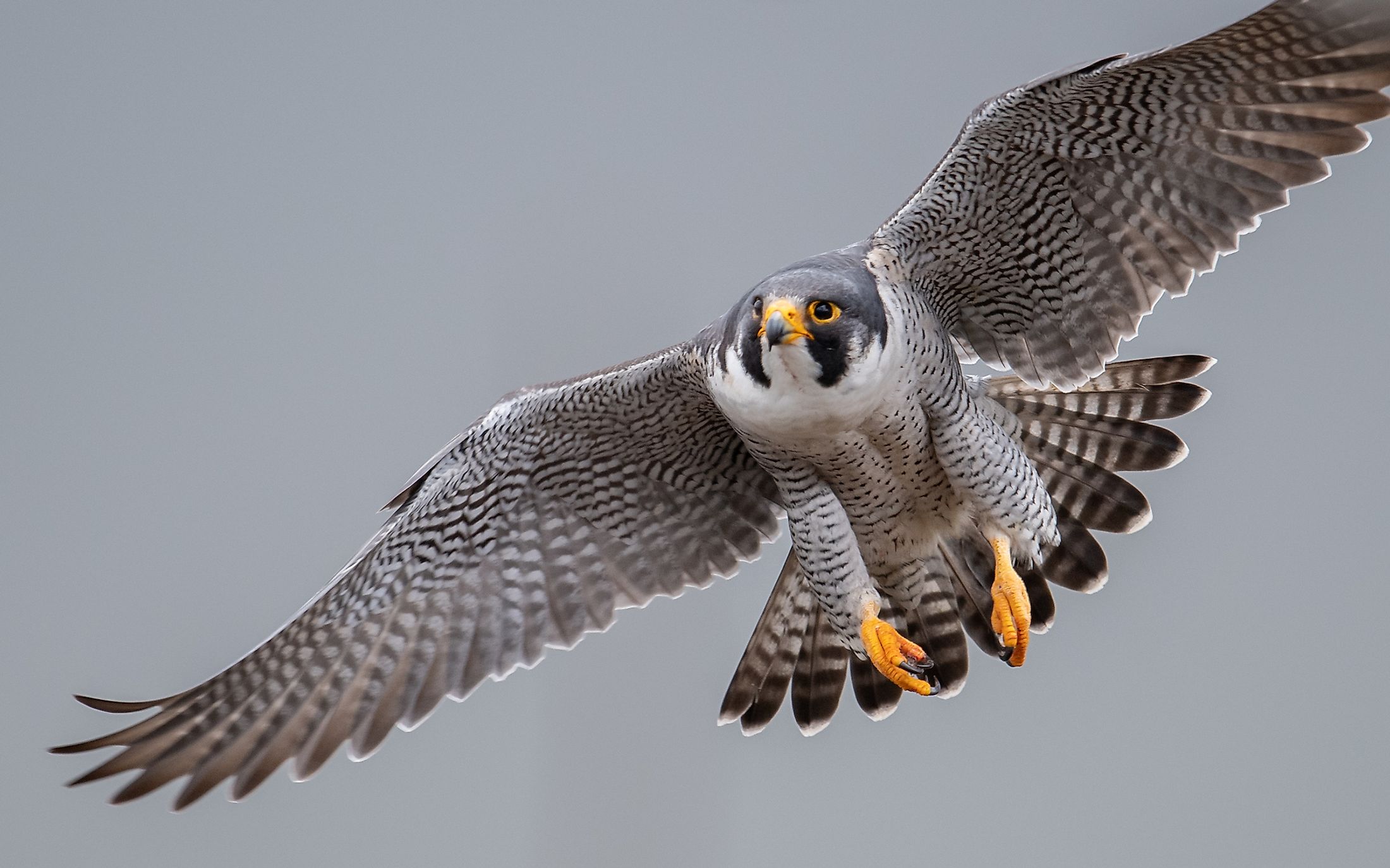
During a stoop, the peregrine pulls its wings close to its body. This creates a slim shape that moves through the air with less drag. The bird also uses its long, pointed wings and firm flight feathers to stay stable as it accelerates.
A peregrine’s nostrils have special bony structures that help control fast-moving air as it enters the nose. Its eyes also have protective features that help it see and remain stable during a high-speed dive.
The dive is more than a display of speed. It is a hunting tool. A peregrine may strike another bird in midair with its feet or knock it off balance before catching it. The bird often slows down before contact, since hitting prey at maximum speed could injure both animals.
What is a stoop?
A stoop is a steep, controlled hunting dive used by falcons. The bird first gains height, then dives toward prey with its wings partly or fully folded.
A stoop differs from:
- Level flight: Flying parallel to the ground.
- Gliding: Moving through the air with little or no wing flapping.
- Soaring: Using rising air to gain or maintain height.
- Climbing flight: Using repeated wingbeats to gain altitude.
The stoop is the reason speed claims for peregrine falcons are much higher than their normal flight speeds.
How Fast Do Other Falcon Species Fly?
Not every falcon reaches peregrine speeds. The word “falcon” covers many species, and each has a different body size, wing shape, habitat, and hunting method.
The gyrfalcon, North America’s largest falcon, is also extremely fast. It can make powerful dives and may reach speeds above 100 mph, although published figures vary by source and measurement method. It often relies on strong, direct flight as well as dives.
The prairie falcon, found across much of the western United States, is a fast aerial hunter. It can chase birds in open country and use steep dives near cliffs and canyons.
The American kestrel is also a falcon, but it is much smaller. It does not approach the peregrine’s top dive speed. Its smaller body and different hunting style help it hover, scan fields, and capture insects and small animals.
| Falcon species | Main speed characteristic | Typical hunting style |
|---|---|---|
| Peregrine falcon | Fastest known dive, above 200 mph | High-speed stoop at birds |
| Gyrfalcon | Powerful flight and fast dives | Pursuit and diving attacks |
| Prairie falcon | Fast, agile open-country flight | Chases birds and small mammals |
| American kestrel | Quick but much slower than a peregrine | Hovering and short attacks |
These comparisons are approximate. Scientists do not measure every species under the same conditions, so a simple ranking can hide important differences.

Is a Falcon Faster Than an Eagle?
A peregrine falcon is generally faster than an eagle in a dive. The peregrine’s narrow body and folded-wing posture are specialized for speed, while eagles are built more for strength, soaring, carrying prey, and sustained flight.
The golden eagle is often reported to reach roughly 150 to 200 mph in a dive, depending on the source and test conditions. That is extremely fast, but it is usually below the highest reported peregrine measurements.
Eagles can still be faster in some practical situations. A large eagle may cover ground efficiently with broad wings and rising air. Speed depends on the comparison: a short dive, level flight, pursuit, climb, or long-distance travel can produce different results.
The fairest summary is:
- Peregrine falcon: Usually the faster diving bird.
- Golden eagle: A powerful diver and strong long-distance flier.
- Level flight: Neither species maintains its maximum diving speed for normal travel.

How Fast Is a Falcon in Level Flight?
A falcon’s level-flight speed is commonly around 40 to 60 mph, though the exact speed changes with species, wind, behavior, and physical condition.
A falcon flying into a headwind may use more energy and show a lower ground speed. With a tailwind, its speed over the ground may be much higher even though its airspeed has not changed. This is why speed reports should identify whether they measure airspeed or ground speed.
A bird also changes speed based on its goal. It may fly slowly while searching for prey, accelerate during a chase, or flap hard to escape a threat. A healthy adult peregrine can shift between these flight modes within seconds.
Airspeed and ground speed
- Airspeed: How fast the bird moves through the surrounding air.
- Ground speed: How fast the bird appears to move over the land below.
- Wind speed: The movement of the air itself.
For example, a falcon flying at 50 mph into a 20-mph headwind may move over the ground at roughly 30 mph. With a 20-mph tailwind, its ground speed may be about 70 mph. This is a simplified example, but it shows why two valid measurements can differ.

How Do Scientists Measure Falcon Speed?
Researchers and trained-bird handlers have used several methods to estimate falcon speed. These methods do not always produce identical results.
Common approaches include:
- Timing a bird over a measured distance.
- Using high-speed cameras.
- Tracking altitude and position during a dive.
- Using radar or other remote tracking tools.
- Calculating speed from a recorded flight path.
- Measuring a trained bird in a controlled dive.
Each method has limits. A camera may miss the exact start or end of a dive. Radar may track a bird but provide less detail about its posture. A trained bird may dive under conditions that differ from a wild hunt.
The most reliable claims state the species, flight type, measurement method, and conditions. A statement such as “falcons fly 240 mph” is incomplete because it does not say whether the number describes a dive, level flight, wind-assisted motion, or a calculated estimate.
The Peregrine Fund describes the peregrine as capable of diving at more than 200 mph. The U.S. Fish and Wildlife Service also identifies the peregrine falcon as one of the fastest birds in the world. These sources support the broad answer, while individual peak figures should remain qualified.

What Limits a Falcon’s Top Speed?
Several factors limit how fast a falcon can fly. The most important are air resistance, body position, gravity, wind, altitude, and the bird’s need to control its movement.
Air resistance rises sharply as speed increases. A falcon must keep its body streamlined to avoid losing energy. Small changes in wing position can help it steer, brake, or prevent a dangerous spin.
The bird also needs enough height for a long dive. A short drop may not give it time to reach its maximum speed. A steep dive from greater altitude offers more time to accelerate, but the bird must still pull out safely before reaching the ground.
A falcon does not remain at peak speed after the dive. It must spread its wings, change direction, grab prey, or climb again. High speed is useful for a short attack, not for every part of the hunt.

Common Mistakes About Falcon Speed
The biggest mistake is treating a diving speed as a normal flight speed. A peregrine that can exceed 200 mph in a stoop does not cruise at that speed across the sky.
Other common errors include:
-
Using “falcon” as if it means only peregrine.
The American kestrel, prairie falcon, gyrfalcon, and peregrine are different species. -
Treating every speed record as equally verified.
Some figures come from direct measurements, while others come from estimates or older reports. -
Ignoring wind.
Wind can change ground speed without changing the bird’s effort in the same way. -
Comparing dives with level flight.
These are different movements with different physical demands. -
Assuming the fastest speed is sustainable.
A falcon uses its top speed for a brief attack, not continuous travel.
A careful answer includes the condition: a peregrine falcon can dive at more than 200 mph, while its normal level-flight speed is much lower.

Are Falcons Dangerous to People at High Speed?
Wild falcons generally avoid people. Their high-speed dives are aimed at prey, not humans.
People should still keep a safe distance from any wild bird, especially near a nest or fledgling. Do not approach, chase, feed, or attempt to handle a falcon. In the United States, many native birds are protected under federal and state wildlife laws.
If a falcon appears injured, contact a licensed wildlife rehabilitator or a state wildlife agency. Do not try to keep the bird or force food and water into its mouth. A bird of prey may have hidden injuries and can cause harm with its talons and beak.

Frequently Asked Questions
What is the fastest falcon in the United States?
The peregrine falcon is the fastest falcon commonly found in the United States. During a hunting dive, it can exceed 200 mph.
Can a falcon fly 300 mph?
There is no widely accepted, well-documented measurement showing a falcon flying at 300 mph. Reported peregrine speeds near 240 mph are much better supported than claims of 300 mph.
How fast does a peregrine falcon fly when not diving?
A peregrine commonly flies at about 40 to 60 mph in fast level flight. Its speed may be lower while searching for prey or higher over the ground with a strong tailwind.
Is a falcon faster than a cheetah?
Yes, a peregrine falcon is much faster in a dive. A cheetah can reach roughly 60 to 70 mph for a short sprint, while a peregrine can exceed 200 mph during a stoop. The comparison is not exact because one animal runs and the other dives.
Why do falcons dive instead of flying straight at prey?
A dive lets the falcon use gravity to gain speed and surprise its target. It also gives the bird more momentum during an aerial attack.
Can all falcons dive at more than 200 mph?
No. The more-than-200-mph figure applies to the peregrine falcon’s fastest dives. Other falcon species vary widely in size, shape, and hunting behavior.
Conclusion
The fastest falcon is the peregrine falcon. It can reach more than 200 mph in a steep hunting dive, with some reported measurements near 240 mph. Its normal level-flight speed is far lower, usually around 40 to 60 mph.
The most accurate answer depends on the species and flight type. If someone asks how fast a falcon bird is, the clearest response is: a peregrine falcon can dive at over 200 mph, but it does not fly at that speed during ordinary travel.