How Long Does It Take Birds To Migrate: A Quick Guide
For birds in the United States, migration can take a few hours, several days, or several months. A short nonstop flight may last one night. A longer seasonal journey often takes two to eight weeks, because birds stop to rest, eat, avoid storms, and wait for good winds.
The answer depends on the bird, the distance, the route, the weather, and whether you count only time in the air or the full trip from one seasonal home to another. A bird may fly for 10 hours but need several weeks to complete its migration.
Introduction
Bird migration is the regular movement of birds between breeding and nonbreeding areas. In the United States, many birds migrate north in spring and south in fall. Some travel between Alaska and South America, while others move only a few hundred miles within the country.
Migration is not one long flight for most birds. It is more like a road trip with planned stops. Birds may fly at night, rest in forests or wetlands, refuel with food, and continue when conditions improve.
How long does bird migration take?
A bird’s migration may take the following amount of time:
| Type of movement | Typical time | What it means |
|---|---|---|
| Short local movement | Hours to a few days | The bird moves to a nearby region |
| One nonstop flight | Several hours to several days | The bird flies without a long landing period |
| One-way seasonal migration | Several days to several weeks | The bird travels between breeding and wintering areas |
| Full round-trip migration | Several weeks to several months | The bird completes both spring and fall journeys |
| Very long, stop-and-go migration | Two to four months or more | The bird covers great distances with many rest and feeding stops |
These are broad ranges, not fixed rules. A strong tailwind can shorten a flight. Storms, cold weather, food shortages, or injury can delay it.
The flight time is the time a bird spends in the air. The migration time includes stops, detours, waiting periods, and time spent building energy reserves. This difference explains why a bird may cover a route in a few long flights but still take weeks to reach its destination.
The Cornell Lab of Ornithology explains that migration routes and timing vary by species, age, weather, food supply, and geography. The U.S. Fish and Wildlife Service also notes that migratory birds use many habitats along their routes, not only their breeding and wintering grounds.

Examples of bird migration times
Different species show why there is no single answer to the question “How long does it take birds to migrate?”
Ruby-throated hummingbirds
Ruby-throated hummingbirds migrate between eastern North America and Mexico or Central America. Some cross the Gulf of Mexico in a nonstop flight of roughly 500 miles.
That flight may take about 18 to 24 hours, depending on wind and the bird’s speed. Other ruby-throated hummingbirds travel around the Gulf coast and make shorter flights with stops.
The Gulf crossing is only one part of the journey. The complete spring or fall migration can take several weeks because the birds must stop to feed and recover.
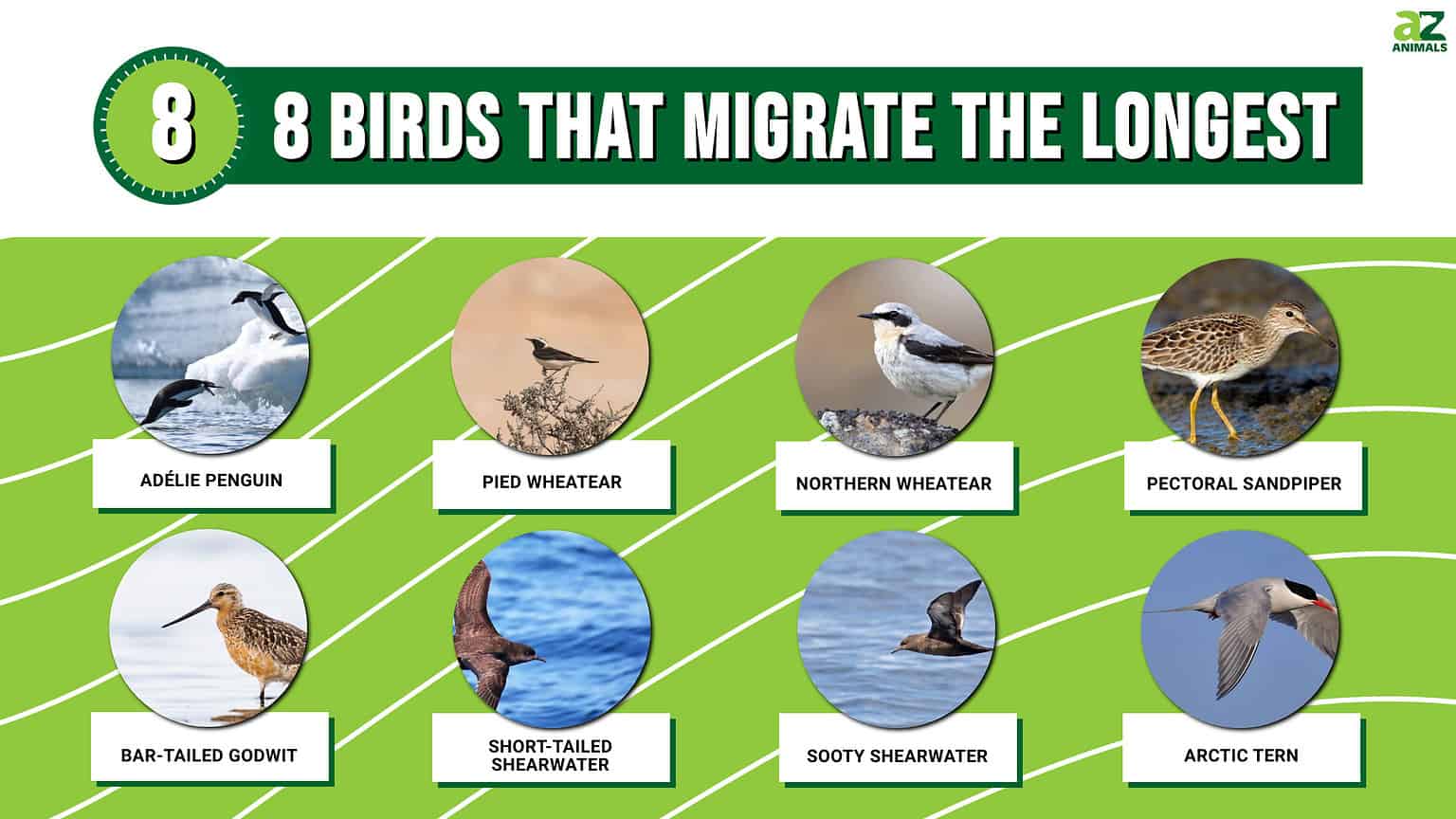
Bar-tailed godwits
Some bar-tailed godwits make one of the longest nonstop bird flights known. A tagged bird flew from Alaska to New Zealand, a distance of about 7,000 miles, in roughly 11 days without stopping to feed.
This is an extreme example. Most migrating birds do not fly for that long without landing. The godwit stores large amounts of body fat before departure and has adaptations that help it manage a long ocean crossing.
Arctic terns
Arctic terns travel between Arctic breeding areas and Antarctic waters. Their yearly journey can exceed 25,000 miles, depending on the route.
The complete migration cycle takes much of the year. Arctic terns do not make one nonstop flight around the world. Instead, they follow routes with favorable winds and productive feeding areas.
Warblers and other songbirds
Many warblers, vireos, thrushes, and other songbirds migrate at night. They may fly for six to 12 hours before stopping at a suitable habitat.
A songbird traveling from the northern United States to Central or South America may need several weeks to complete a one-way migration. The bird may cover the route through many nighttime flights rather than one continuous trip.
Waterfowl
Ducks, geese, and swans often migrate in stages. Some make short movements between nearby wetlands. Others travel thousands of miles between Canada, the United States, and Mexico.
A flock may complete one leg in a day or two, then remain at a wetland for days or weeks. Food, ice, water levels, and weather often control the pace.

What determines how fast birds migrate?
The main factors are distance, body size, food, weather, wind, geography, and the bird’s age.
Distance and route
A bird flying 300 miles has a different challenge from one flying 7,000 miles. However, distance alone does not determine the time.
A short route with many stopovers may take longer than a longer route with strong tailwinds and few safe places to land. Mountains, deserts, coastlines, and large bodies of water can also shape the route.
Food and fat reserves
Migration requires a great deal of energy. Before departure, many birds eat more and gain fat. Fat is a compact fuel source, but carrying extra weight also makes flight harder.
A bird may delay departure until it has enough energy. It may also stop for days at a rich feeding site before continuing.
Wind and weather
Birds often use tailwinds to reduce the energy needed for flight. Headwinds can slow them down or make migration more costly.
Storms may force birds to land early. Heavy rain, fog, snow, heat, and hurricanes can delay migration or push birds off course. Some birds wait for better conditions before leaving.
Day length and seasonal cues
Changing daylight helps many birds time migration. Temperature, food availability, and internal biological rhythms also play a role.
A bird may begin moving before a landscape looks ready for spring. Its body responds to several signals, not just local temperature.
Age and experience
Young birds may take longer routes or make more stops than experienced adults. Some species migrate alone, while others follow family groups or flocks.
A young bird may know the general direction through inherited behavior but still need to learn safe stopover sites and local conditions.
Geography and stopover habitat
Birds need safe places to rest and feed. Wetlands, coastal marshes, forests, grasslands, and river valleys can act as stopover sites.
When these areas are damaged or unavailable, birds may need to fly farther between meals. That can slow migration and increase the energy cost of the journey. The National Audubon Society and Smithsonian’s National Zoo both describe stopover habitat as a key part of successful migration.

Do birds migrate nonstop?
Most birds do not migrate nonstop from their breeding grounds to their wintering grounds. They usually divide the journey into a series of flights separated by rest and feeding periods.
Some birds can fly for many hours without landing. Night-migrating songbirds often do this. Birds crossing oceans or deserts may also make very long flights because there are few safe landing sites.
Nonstop migration is more common for species that:
- Have large energy reserves
- Travel over open water or deserts
- Can reduce energy use during flight
- Face strong seasonal pressure to reach a destination
- Have body shapes suited to efficient flight
Even a nonstop leg is not the same as a nonstop migration season. A bird may fly for 20 hours, rest for several days, and then continue.
A useful way to estimate total migration time is:
Total migration time = flight time + stopover time + weather delays + route adjustments
For example, this hypothetical bird might make:
- Four flight nights of 10 hours each
- Six stopovers lasting three days each
- Two weather delays of one day each
The total journey would take about 22 days, even though the bird spent only 40 hours in the air.

When do birds migrate in the United States?
In the United States, many birds migrate during spring and fall, but timing varies by species and location.
Spring migration
Spring migration generally moves birds north toward breeding grounds. Birds may begin moving through the southern United States in late winter or early spring. They often reach northern states, Alaska, and Canada later in spring.
Early arrivals may include some waterfowl and blackbirds. Many insect-eating songbirds arrive later, when insects become more plentiful.
Fall migration
Fall migration generally moves birds south toward warmer regions and better winter food supplies. Some birds begin leaving northern areas in late summer. Others migrate through September, October, or November.
Birds do not all leave at once. Adults, juveniles, males, and females may follow different schedules.
Regional differences
Migration timing differs across the country:
- In Alaska and the northern states, spring migration begins later and fall departure may begin earlier.
- In the Southeast, some species may remain year-round while others continue to the Caribbean or Central America.
- Along the Pacific Coast, birds may follow coastal routes rather than crossing the interior.
- In the Great Plains, weather fronts can create large waves of migrating birds.
- In the Northeast, peak songbird migration often occurs in spring and fall, but the exact dates change each year.
BirdCast, a project supported by the Cornell Lab of Ornithology, tracks large-scale nocturnal bird migration across the United States. Its forecasts can show when migration is likely to be heavy in a particular area, but they do not predict the exact arrival time of every species.
How can you tell whether birds are migrating?
You may notice several signs of migration, but one sighting cannot prove that a bird is moving between seasonal ranges.
Common signs include:
- Large flocks appearing suddenly
- Birds calling at night
- New species visiting a yard or park
- Birds feeding heavily in trees or shrubs
- Flocks moving south in fall or north in spring
- Birds gathering at wetlands, shorelines, and forest edges
The best way to check local migration is to use several kinds of evidence:
- Compare dates. Record when the bird appears and disappears.
- Check the species range. Use a trusted field guide or a source such as the Cornell Lab’s All About Birds.
- Observe behavior. Heavy feeding and flocking may suggest a stopover.
- Check local migration forecasts. BirdCast can show predicted movement in many parts of the United States.
- Avoid disturbance. Give resting birds space, especially near wetlands and coastal areas.
A bird that appears in your yard may be a short-distance migrant, a long-distance migrant, a year-round resident, or a bird that has simply moved because local food changed.
Common mistakes about bird migration time
The biggest mistake is assuming that every bird completes migration in one continuous flight. Most birds stop often, and the number of stops can change from one year to the next.
Another mistake is treating a migration map as a precise schedule. Maps show broad routes or average timing. They do not account for every storm, food shortage, illness, or individual choice.
It is also easy to confuse a bird’s daily movement with seasonal migration. A flock may move several miles to find food without leaving its normal range. Seasonal migration usually involves a repeated, larger-scale movement tied to breeding and wintering areas.
Finally, a late bird is not always lost or sick. Weather, age, food supply, competition, and local habitat can all affect arrival time. If a bird is injured, unable to fly, bleeding, or in immediate danger, contact a licensed wildlife rehabilitator rather than trying to care for it yourself.
Frequently asked questions
How far can a bird fly in one day?
The distance varies widely. Some birds fly only a few dozen miles between stopovers. Others can travel hundreds or thousands of miles in a single nonstop flight when crossing oceans or deserts.
Do birds sleep while migrating?
Some birds rest on land or water between flights. A few species can sleep briefly during long flights, but this ability does not mean they can migrate without rest. Long-distance flights still require major energy reserves.
Do all birds migrate south for winter?
No. Some birds migrate north and south between breeding and wintering grounds. Others move east or west, travel only short distances, or remain in the same area year-round.
Can weather stop bird migration?
Yes. Strong headwinds, storms, snow, heavy rain, fog, and extreme heat can delay migration. Birds may wait, change routes, or land earlier than planned.
Do birds return to the same place every year?
Many birds return to the same general breeding or wintering area. Some individuals also return to the same territory or stopover site. The level of site fidelity varies by species, age, sex, and habitat conditions.
Conclusion
So, how long does it take birds to migrate? A short flight may take hours, while a complete seasonal journey may take several weeks or months. The most useful answer depends on the species and whether you mean time in the air or the full journey with stops.
For birds in the United States, a one-way migration often falls somewhere between several days and several weeks, but exceptional nonstop flights can last many days. To understand a specific bird, check its species, route, season, and known stopover habitats.
The next step is to identify the bird and location. A local field guide, Cornell Lab species account, and BirdCast migration forecast can help you estimate when that species is likely to pass through your area.