How Far Do Migratory Birds Travel: Migration Distances
migratory birds in the United States can travel anywhere from a few dozen miles to more than 40,000 miles in one year. The distance depends on the species, its breeding range, winter range, weather, food supply, and route.
For example, some birds move only between nearby states. Others, such as Arctic terns and shorebirds, cross oceans and continents. A bird may travel 500 miles in one trip, 5,000 miles in a season, or more than 30,000 miles during a full annual cycle.
The best way to understand migration distance is to ask three questions:
- How far is one flight?
- How far is the full trip between breeding and wintering grounds?
- How many miles does the bird travel in an entire year?

How Far Do Migratory Birds Travel?
Most migratory birds travel between a few hundred and several thousand miles each year. Long-distance migrants may travel 10,000 miles or more, while a few species complete annual journeys of 30,000 to 50,000 miles.
Migration distance is not the same for every bird in a species. Birds from northern breeding areas often travel farther than birds from southern populations. Young birds may also take different routes from adults, and storms can force birds to make longer detours.
A bird’s migration distance usually includes:
- The trip from its breeding area to its wintering area.
- The return trip the following spring.
- Short movements between feeding and resting sites.
- Detours caused by weather, geography, or food shortages.
For instance, a songbird that flies 2,000 miles south in autumn may travel about 4,000 miles during its spring and fall migrations. If it makes extra movements during winter, its annual total may be higher.
Typical migration distances
| Migration type | Approximate distance | Common examples |
|---|---|---|
| Short-distance migration | Less than 500 miles | Some sparrows, finches, and waterfowl |
| Medium-distance migration | 500–2,500 miles | Many ducks, geese, and songbirds |
| Long-distance migration | 2,500–6,000 miles | Warblers, swallows, and shorebirds |
| Extreme migration | More than 6,000 miles | Arctic terns, godwits, and some seabirds |
These are broad ranges, not fixed rules. Some birds in the same species may migrate only a few hundred miles, while others cross several countries.

What Is the Longest Bird Migration?
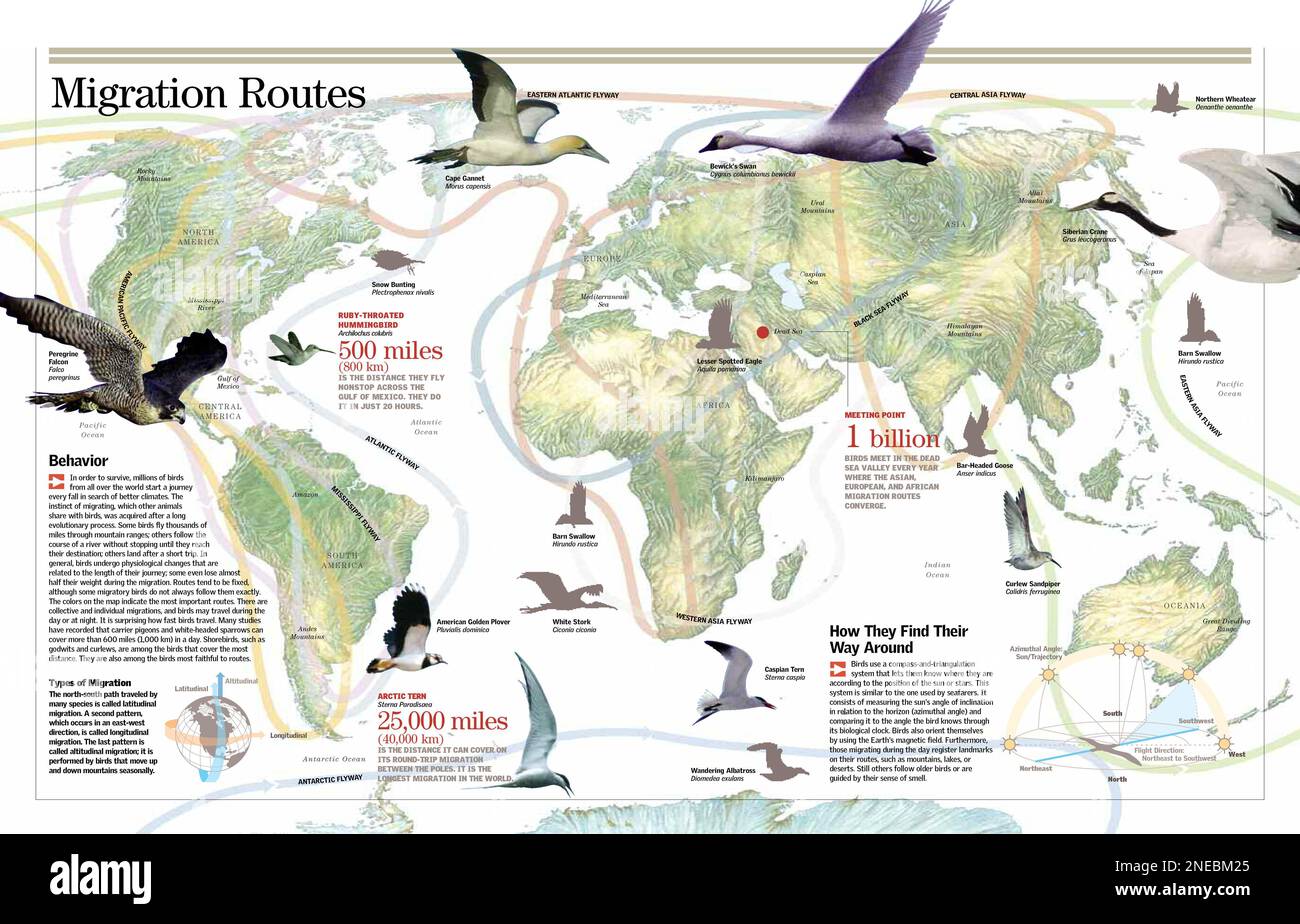
The Arctic tern has one of the longest known migrations of any animal. It travels between breeding areas in the Arctic and feeding areas near Antarctica. Depending on the route, an individual Arctic tern may travel up to about 44,000 miles in a year.
Some estimates are higher when birds follow winding routes rather than flying in a straight line. A bird may use prevailing winds, stop at rich feeding sites, and avoid severe weather. These choices can add thousands of miles to the journey.
The Arctic tern does not live in the continental United States as a common breeding bird, but it can be seen in parts of North America during migration. Its journey shows why annual migration distance can be much greater than the distance between two points on a map.
Other birds with very long migrations
Several other migratory birds travel remarkable distances:
- Bar-tailed godwit: Some birds fly from Alaska to New Zealand in a nonstop journey of roughly 7,000 miles. The flight can last more than a week.
- Red knot: Birds that breed in the Canadian Arctic may travel to South America and back. Their annual route can exceed 18,000 miles.
- American golden-plover: Some individuals travel between the Arctic and southern South America, covering thousands of miles each year.
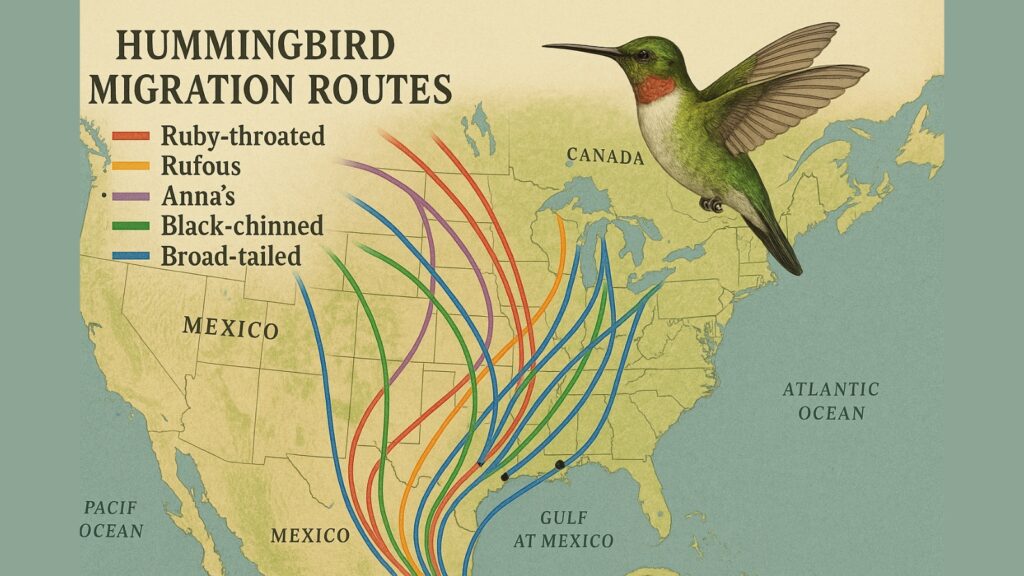
- Ruby-throated hummingbird: Many cross the Gulf of Mexico during migration. The overwater crossing is about 500 miles, although some birds take a coastal route.
- Swainson’s hawk: Birds may travel from western North America to Argentina and back, creating an annual journey of more than 10,000 miles.
The exact distance depends on the individual bird, tracking method, and population. A straight-line estimate is often lower than the actual route.

How Far Do Birds Travel in One Day?
A migrating bird may travel from a few miles to more than 500 miles in one day. The distance depends on the species, wind, body size, flight style, and whether the bird stops to feed.
Small songbirds often migrate at night and cover about 100 to 300 miles in a single flight. Under strong tailwinds, some can travel farther. Large birds, shorebirds, and waterfowl may cover several hundred miles in one day.
Some birds make nonstop flights that last many hours or even several days. The bar-tailed godwit is an extreme example. It can fly thousands of miles without landing when moving between Alaska and the South Pacific.
Daily travel is often uneven. A bird may fly hard for one night, then stop for several days. It may need time to:
- Eat enough food.
- Restore fat reserves.
- Wait for safe weather.
- Avoid predators.
- Recover from a long flight.
This pattern means that dividing a seasonal distance by the number of days does not show the bird’s true flight speed. The bird may spend only part of the migration period in active flight.
How Fast Do Migratory Birds Fly?
Many migratory birds fly between 15 and 40 miles per hour. Larger birds may fly faster, and strong tailwinds can raise their speed over the ground.
The speed of a bird through the air is different from its speed over the ground. A bird flying into a headwind may make slow progress. A bird with a strong tailwind may cover much more ground without using as much energy.
Approximate flight speeds include:
| Bird group | Typical air speed |
|---|---|
| Small songbirds | 15–25 mph |
| Ducks and geese | 30–50 mph |
| Hawks and other soaring birds | Varies widely with wind |
| Shorebirds | 30–60 mph in sustained flight |
| Hummingbirds | Up to about 30 mph in level flight |
These figures are general estimates. Flight speed changes with wind, altitude, wing shape, and the need to save energy.
Birds often use wind to reduce the cost of migration. Radar research and tracking studies show that many species choose flight times and routes that improve their chances of reaching the next stop safely.

What Determines How Far a Bird Migrates?
A bird’s migration distance is shaped by biology, climate, food, and geography. The most important factor is often where the bird breeds and where it can find food during winter.
Breeding location
Birds that breed far north often travel farther to reach suitable winter habitat. A bird breeding in Alaska may need to cross the United States, Mexico, and Central America before reaching its winter range.
Birds that breed farther south may migrate a shorter distance. Some do not migrate at all if they can find food and shelter throughout the year.
Food supply
Birds migrate because seasonal changes affect food. Insects, seeds, fruit, fish, and nectar may become scarce in one region and abundant in another.
A warbler may leave the United States when insects decline in autumn. A shorebird may follow coastal mudflats where it can feed on shellfish and small invertebrates.
Weather and wind
Wind can shorten or lengthen a journey. Birds may delay migration during storms or use favorable winds to cross large distances.
Hurricanes and strong cold fronts can push birds far off course. Some birds survive these events, but others become exhausted or reach places with little food.
Geography
Mountains, deserts, oceans, and large forests affect the route. Birds may follow coastlines, river valleys, and mountain passes because these areas offer food and shelter.
The route is rarely a straight line. A bird may travel farther to reach a safe stopover site.
Age and experience
Young birds often migrate without their parents. Many use inherited directional cues, the position of the sun and stars, Earth’s magnetic field, and visual landmarks.
Older birds may choose better routes and stopover sites. They may also adjust their timing more effectively when weather changes.
How Do Scientists Measure Bird Migration Distance?
Scientists measure migration distance with several tools. The method affects how precise the result is.
Bird banding
Researchers place small identification bands on birds and record where the birds are captured or found later. Banding can show that a bird moved from one region to another, but it does not reveal every mile of the journey.
The U.S. Geological Survey Bird Banding Laboratory manages bird-banding data in the United States and Canada.
Satellite tracking
Small satellite transmitters can track larger birds over long distances. This method can show the route, stopover sites, travel speed, and timing.
Transmitters must be light enough for the bird to carry safely. As a result, satellite tracking is more common in larger birds such as geese, hawks, and shorebirds.
Geolocators
A geolocator records light levels. Researchers use sunrise and sunset data to estimate a bird’s location. These devices are light enough for some smaller birds.
A geolocator may provide less precise location data than a satellite transmitter. Researchers often need to recapture the bird to download the information.
Radar and acoustic monitoring
Weather radar can detect large movements of birds, especially at night. It can estimate the number, direction, and height of birds moving through an area.
Acoustic monitoring records calls from migrating birds. This helps researchers learn which species pass through a region, even when the birds are hard to see.
Distance calculations
Scientists may report either:
- Straight-line distance: The shortest map distance between two places.
- Route distance: The distance along the bird’s actual path.
- Annual distance: The total distance traveled during the full year.
Route distance is usually the most useful measure for understanding the bird’s real effort.
How Far Do Common U.S. Migratory Birds Travel?
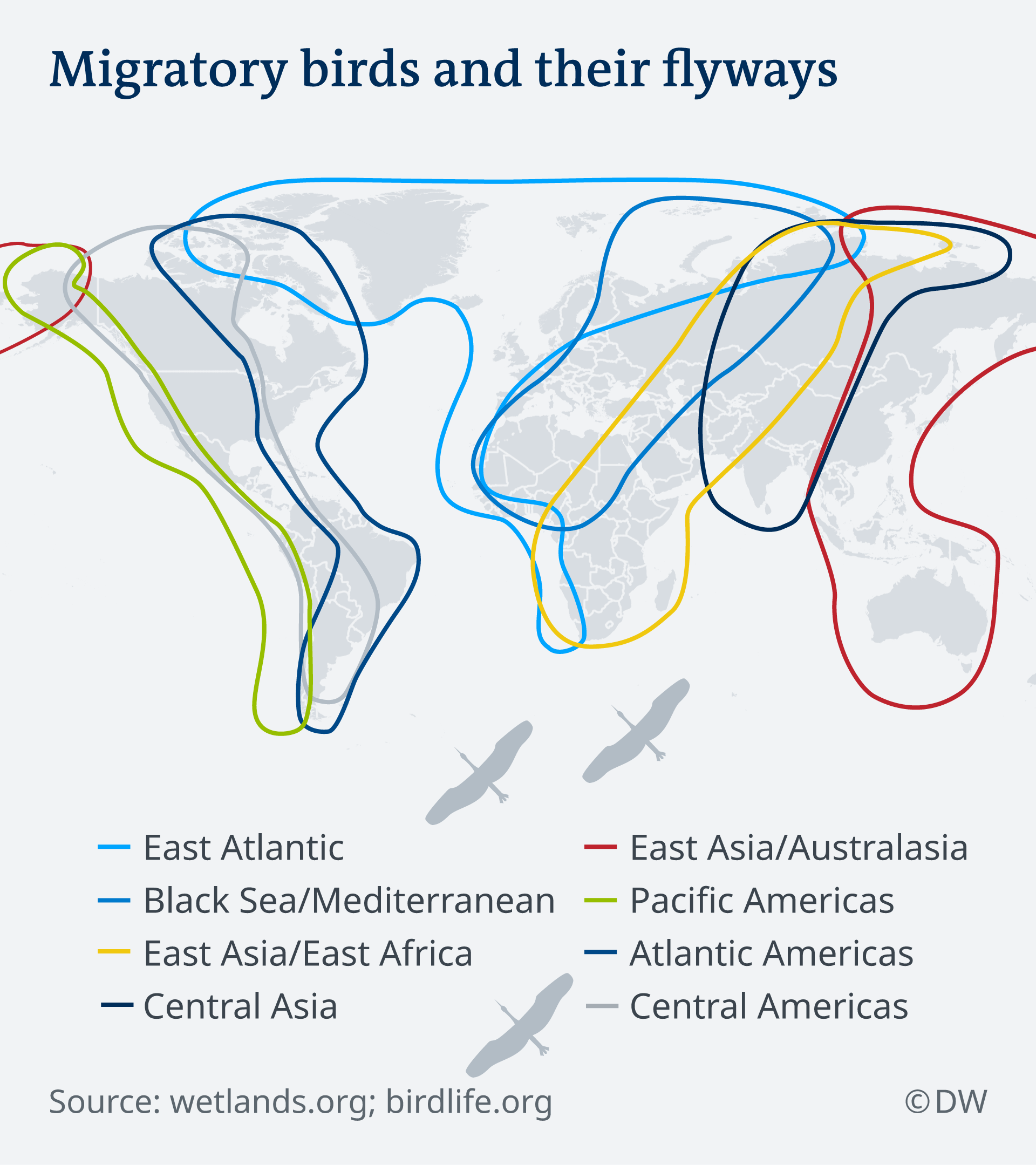
The United States has several major migration routes, including the Atlantic, Mississippi, Central, and Pacific Flyways. Birds use these broad pathways to move between breeding and wintering areas.
The distances below are approximate. Populations and individuals can vary.
| Bird | Approximate migration distance |
|---|---|
| Ruby-throated hummingbird | About 500 miles across the Gulf of Mexico for some birds; much farther for the full annual cycle |
| Barn swallow | Often several thousand miles between North America and South America |
| Wood thrush | About 2,000–4,000 miles each way, depending on population |
| Common nighthawk | Roughly 4,000–7,000 miles each way between North America and South America |
| Arctic tern | Up to about 44,000 miles in a year |
| Red knot | More than 9,000 miles each way for some populations |
| Canada goose | Often hundreds to several thousand miles, depending on the population |
| American robin | Some populations migrate only short distances; others travel more than 1,000 miles |
The Canada goose is a useful reminder that migration is not one-size-fits-all. Some geese remain in the northern United States year-round. Others travel between the Arctic and the southern United States.
The same pattern occurs in American robins, blue jays, and several finches. A bird may be migratory in one region but resident in another.

Do All Birds Migrate the Same Distance?
No. Migration distance can differ between species, populations, and individual birds.
Some birds are short-distance migrants. They may move from northern states into the southern United States during winter. Others are long-distance migrants that cross the Gulf of Mexico or continue into Central and South America.
A species may also show partial migration. This means that some individuals migrate while others stay in the same area. Food, age, sex, weather, and local climate can affect the choice.
Climate change is also altering migration patterns for some species. Earlier spring temperatures may cause earlier movement, while drought and habitat loss can change stopover use. These changes do not affect every species in the same way.
For current information about species and migration conservation, consult the U.S. Fish & Wildlife Service Migratory Birds program and the Cornell Lab of Ornithology.

Why Do Birds Make Such Long Journeys?
Birds migrate long distances because the benefits can outweigh the risks. Northern breeding areas often provide long summer days, abundant insects, and fewer competitors. Tropical and southern areas may offer better winter food and shelter.
Migration also allows birds to use different habitats during different seasons. A bird does not need to survive the entire year in one place if it can follow seasonal food supplies.
The journey is still dangerous. Birds face:
- Storms and extreme temperatures.
- Predators.
- Lack of food and water.
- Window strikes and other human-made hazards.
- Habitat loss at stopover sites.
- Light pollution that can disorient night migrants.
- Exhaustion during long flights.
Stopover habitat is especially important. A bird may need only a small wetland, forest patch, or shoreline to rest and refuel. Losing several stopover sites can make a route much harder, even when the breeding and wintering areas remain protected.

How Can People Help Migratory Birds in the United States?
People can help migratory birds by protecting food, water, and safe resting areas. Small changes at home can reduce common risks.
- Keep cats indoors, especially during migration seasons.
- Use window treatments or bird-safe window markers where birds strike glass.
- Turn off unnecessary outdoor lights at night.
- Plant native trees, shrubs, and flowers.
- Avoid pesticides when safer options are available.
- Keep dogs away from nesting and shorebird areas.
- Protect ponds, wetlands, and native grasslands.
- Report unusual bird sightings through trusted monitoring programs such as eBird.
During migration, birds need more than a final destination. They need a chain of safe places along the route. A small backyard with native plants can provide food and cover, but it works best as part of a wider network of habitat.

Common Mistakes About Bird Migration Distance
Mistake 1: Treating every bird in a species as identical
A species can contain several populations with different routes. Use population-level data when available.
Mistake 2: Confusing one-way distance with annual distance
A 3,000-mile journey south may become a 6,000-mile annual trip after the return flight.
Mistake 3: Using a straight line on a map
Birds often follow coastlines, valleys, and wind systems. The real route may be longer.
Mistake 4: Assuming every bird flies nonstop
Most migrants stop to rest and feed. A few species can fly for days, but that is not typical for all migratory birds.
Mistake 5: Calling every seasonal movement migration
Some birds move locally in response to snow or food. Others make true long-distance migrations. The terms should not be used as exact synonyms.
Mistake 6: Assuming migration has a fixed calendar date
Migration timing changes with weather, latitude, food, and climate. A field guide can provide useful averages, but local conditions may shift the dates.

Key Takeaways
- Migratory birds in the United States may travel from a few dozen miles to more than 40,000 miles per year.
- Many common migrants travel between 500 and 6,000 miles each way.
- Arctic terns are among the longest-distance migrants, with annual journeys of up to about 44,000 miles.
- Some bar-tailed godwits fly about 7,000 miles nonstop.
- The actual distance depends on the population, route, weather, stopover sites, and measurement method.
- Annual distance includes both the autumn and spring journeys, not just one direction.
- Protecting stopover habitat is as important as protecting breeding and wintering grounds.
Frequently Asked Questions
What bird flies the farthest each year?
The Arctic tern is one of the farthest-flying birds. Some individuals travel up to about 44,000 miles each year between Arctic breeding areas and Antarctic feeding areas.
How far can a bird fly without stopping?
The distance varies by species. Some songbirds fly hundreds of miles without landing. Certain shorebirds, including the bar-tailed godwit, can fly roughly 7,000 miles nonstop under favorable conditions.
Do birds fly at night during migration?
Yes. Many songbirds migrate at night. Flying after dark can reduce exposure to heat and some predators. Birds also use stars, Earth’s magnetic field, and other cues to navigate.
Do migratory birds return to the same place every year?
Many birds return to the same breeding or wintering region. Some show strong site loyalty, but weather, age, habitat change, and food supply can alter their route.
What is the shortest bird migration?
There is no single shortest distance because some birds make small seasonal movements of only a few miles. Other birds remain in the same area all year and do not migrate.
Conclusion
Migratory birds travel much farther than a map may suggest. A bird may move a few hundred miles between seasons, while another crosses oceans and continents during a yearly journey of tens of thousands of miles.
The most useful measure is the bird’s full route, not just the straight-line distance between two locations. Species, population, weather, wind, food, and habitat all shape the journey.
To learn about birds near you, check local migration reports through eBird, visit a nearby refuge, and look for seasonal changes in bird numbers. A simple map, field guide, or local birding group can help you connect what you see in the United States with the much longer journey behind it.