How Big Is A Falcon Bird: Size Guide
In the United States, a falcon can be as small as a 10-inch American kestrel or as large as a 25-inch gyrfalcon. Most falcons weigh between 3 ounces and 4 pounds. Their wingspans range from about 20 inches to 5 feet, depending on the species.
The word falcon does not describe one bird. It describes a group of fast, narrow-winged birds in the genus Falco. In the U.S., common falcons include the American kestrel, merlin, peregrine falcon, prairie falcon, and gyrfalcon.

Quick answer: How big is a falcon?
A typical falcon is about 9 to 20 inches long, weighs 3 ounces to 2 pounds, and has a wingspan of 20 inches to 4.5 feet.
The exact size depends on the species, age, sex, and region. Female falcons are often larger and heavier than males. This size gap is called sexual dimorphism.
Here are useful examples:
- American kestrel: 8.7–12.2 inches long; 20–24 inches wide; 2.8–5.8 ounces
- Merlin: 9.1–11.8 inches long; 20.9–26.8 inches wide; 5.6–8.5 ounces
- Peregrine falcon: 14.2–19.3 inches long; 39.4–43.3 inches wide; 18.8–56.5 ounces
- Prairie falcon: about 17–20 inches long; up to about 4.5 feet wide; roughly 1.5–2.2 pounds
- Gyrfalcon: about 19–25 inches long; up to about 5 feet wide; roughly 2–4.5 pounds
The peregrine falcon is the species most people mean when they picture a large, powerful falcon in the United States. The American kestrel is the smallest and most widespread U.S. falcon.
Falcon size by species
Falcon species vary greatly in size. The table below uses adult measurements reported by bird references from Cornell Lab of Ornithology, the National Audubon Society, and other established wildlife sources.
| U.S. falcon | Body length | Wingspan | Typical weight |
|---|---|---|---|
| American kestrel | 8.7–12.2 in | 20–24 in | 2.8–5.8 oz |
| Merlin | 9.1–11.8 in | 20.9–26.8 in | 5.6–8.5 oz |
| Peregrine falcon | 14.2–19.3 in | 39.4–43.3 in | 18.8–56.5 oz |
| Prairie falcon | About 17–20 in | About 3.5–4.5 ft | About 1.5–2.2 lb |
| Gyrfalcon | About 19–25 in | About 4–5 ft | About 2–4.5 lb |
These are typical adult ranges, not fixed limits. A bird at the low end may be a male, while a larger bird may be a female. Birds from different regions can also differ in size.
The American kestrel is close to the size of a blue jay or mourning dove, although it has a different body shape. The merlin is larger and more compact. A peregrine falcon can be similar in length to a crow, but its long wings make it look much broader in flight.
A large gyrfalcon may look closer to a small eagle than to a kestrel. It is still a falcon, but it is one of the largest members of the group.

How big is an American kestrel?
The American kestrel is the smallest falcon in North America. It is usually 8.7 to 12.2 inches long, with a 20- to 24-inch wingspan.
It weighs about 2.8 to 5.8 ounces. That is lighter than many common backyard birds. Despite its small size, the kestrel is a skilled hunter.
American kestrels often sit on wires, fence posts, and roadside poles. They hunt insects, small mammals, lizards, and small birds. Their pointed wings and long tail help them turn quickly.
A kestrel may look small when perched. Its wings appear much larger when open. This is why wingspan gives a better idea of its size in flight.
How big is a peregrine falcon?
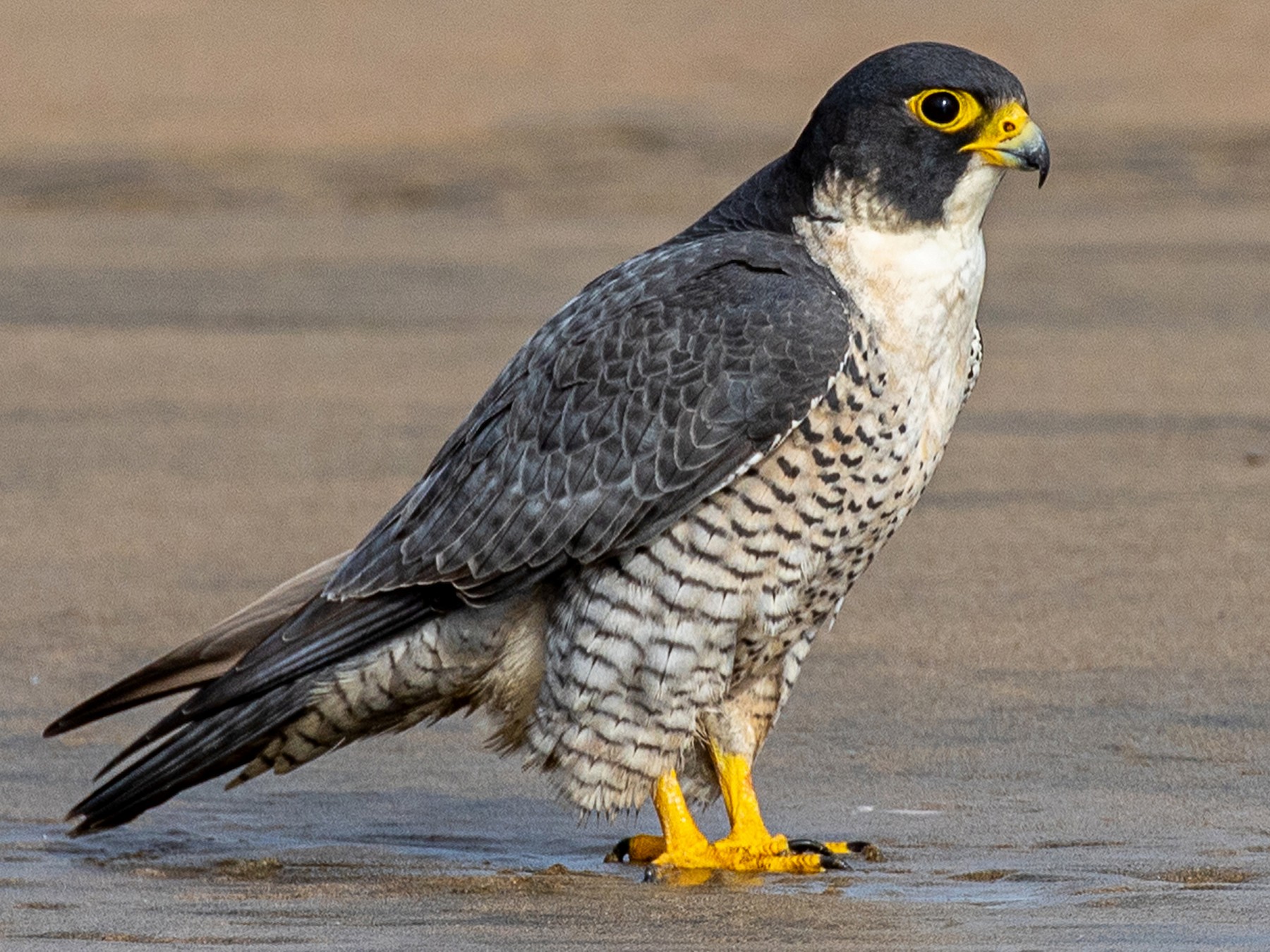
An adult peregrine falcon is usually 14.2 to 19.3 inches long. Its wingspan is about 39.4 to 43.3 inches, or roughly 3.3 to 3.6 feet.
Peregrines weigh about 18.8 to 56.5 ounces. Females are commonly larger than males. A large female may weigh more than twice as much as a small male.
A peregrine has a strong chest, pointed wings, and a relatively short tail. This shape helps it fly fast and turn sharply. The species is famous for high-speed dives, called stoops, when it hunts birds in the air.
In the United States, peregrine falcons can live in cities, coastal areas, mountain ranges, and open country. Tall buildings can serve as nesting sites because they resemble cliff faces.
How big is a prairie falcon?
A prairie falcon is about 17 to 20 inches long. Its wingspan can reach about 4.5 feet, and it often weighs between 1.5 and 2.2 pounds.
Prairie falcons live mainly in the western United States. They favor deserts, grasslands, open valleys, and cliffs. Their pale brown back and dark underwing markings help distinguish them from peregrine falcons.
Compared with a peregrine, the prairie falcon is often similar in length but may look slimmer. It has long wings and a long tail suited to flight over open land.
How big is a merlin?
A merlin is a small, stocky falcon. It is about 9.1 to 11.8 inches long, with a wingspan of 20.9 to 26.8 inches.
Most merlins weigh between 5.6 and 8.5 ounces. They are heavier and more powerful than American kestrels, even though they are not much longer.
Merlins often hunt small birds. They use speed and surprise rather than the high diving style associated with peregrines. In the United States, they may appear during migration or remain year-round in parts of the north and west.
How big is a gyrfalcon?
The gyrfalcon is the largest falcon. It is about 19 to 25 inches long, with a wingspan that can approach 5 feet.
Its weight varies widely. Some adult males weigh around 2 pounds, while large females may weigh more than 4 pounds. This difference is one reason published ranges can look broad.
Gyrfalcons breed in Arctic regions and may appear in northern parts of the United States during winter. They have white, gray, or dark plumage. Their heavy bodies and broad wings help them hunt birds in cold, open landscapes.
A gyrfalcon can be much heavier than a peregrine. It may also look more like a large hawk because of its broad chest and powerful build.

Falcon size compared with other birds
A falcon’s size can be easier to understand when compared with familiar birds.
| Bird | Approximate comparison |
|---|---|
| American kestrel | Similar in length to a blue jay, but more slender |
| Merlin | Similar in length to a robin or small crow, but more compact |
| Peregrine falcon | Similar in length to a crow, with a much wider wingspan |
| Prairie falcon | Similar in overall length to a peregrine, but often slimmer |
| Gyrfalcon | Larger and heavier than a peregrine; may resemble a small eagle |
Size alone does not identify a falcon. Body shape, wing shape, markings, habitat, and behavior also matter.
For example, a peregrine may be shorter than a red-tailed hawk but look longer in flight because of its pointed wings. A kestrel may weigh less than a mourning dove but appear larger because of its upright posture and long tail.
Why are female falcons larger than males?
Female falcons are often larger than males. This pattern occurs in many birds of prey and is known as reverse sexual size dimorphism.
The size difference may help a pair use different prey. A smaller male may be more agile when chasing certain birds. A larger female may be better suited to incubating eggs and defending a nest.
The difference is not always easy to see in the field. A large male can overlap in size with a small female. Reliable identification should not depend on size alone.
Sex, age, health, and food supply can all affect a bird’s body mass. Weight also changes during the year. A bird may weigh more before migration or less after a long journey.
What does a falcon’s wingspan mean?
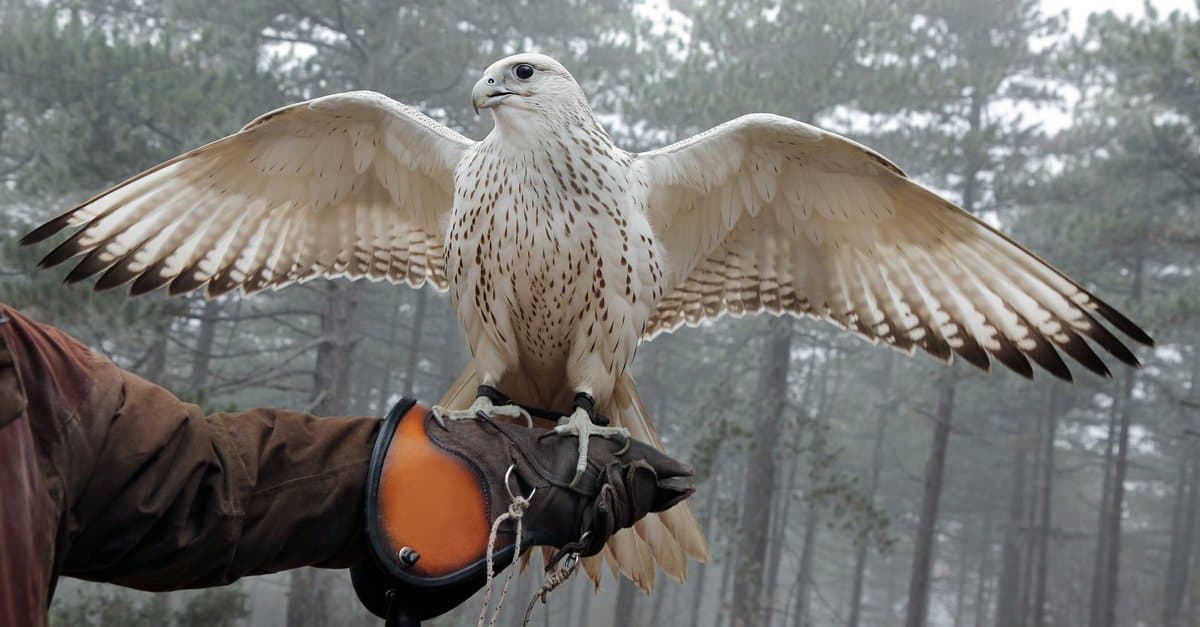
A falcon’s wingspan is the distance from the tip of one fully extended wing to the tip of the other. It does not measure the bird’s body.
Wingspan helps explain how a falcon flies. Long, pointed wings support speed and quick turns. They also reduce drag during fast flight.
A peregrine’s wingspan of about 3.3 to 3.6 feet may seem large compared with its body length. That is normal for a bird built for aerial pursuit.
Wing shape matters as much as wing size. A broad-winged bird may have a similar wingspan to a narrow-winged bird but fly in a different way. This is why falcons can look smaller than hawks when perched but very fast and wide in the air.
How to estimate a falcon’s size in the wild
You can make a rough estimate by using a known object nearby. A telephone wire, fence post, rooftop, or common bird can provide a useful reference.
Use these steps:
- Estimate body length first. Look from the bill to the tip of the tail.
- Check the body shape. A kestrel looks small and slim. A peregrine looks thicker and more muscular.
- Watch the wings in flight. Pointed wings suggest a falcon, while broad, rounded wings suggest many hawks.
- Compare it with a known bird. A kestrel is much smaller than a peregrine.
- Use location and habitat. A prairie falcon is more likely in open western country, while an American kestrel can occur across much of the United States.
- Avoid judging by one view. A perched bird may look smaller or larger depending on its posture.
Photos can help, but perspective can distort size. A bird closer to the camera may look much larger than one in the background.
Do not approach a wild falcon to measure it. Keep a safe distance, avoid blocking its escape route, and use binoculars or a camera with a zoom lens.

Are falcons bigger than hawks or eagles?
Most falcons are smaller than most eagles. Many falcons are also smaller than common hawks, but there are exceptions.
A gyrfalcon can be larger than some small hawks. A peregrine is often similar in length to a red-shouldered hawk but usually has a different body shape. Large eagles, such as bald eagles and golden eagles, are far heavier than any falcon.
The best comparison uses three measures:
- Body length
- Wingspan
- Weight
Weight is often the clearest measure of overall bulk. A bird may have a long wingspan but still weigh less than another bird with shorter wings.
Falcons are built for speed. Hawks often have broader wings for soaring and maneuvering through trees. Eagles have heavier bodies, larger feet, and stronger bills.
What is the smallest falcon in the United States?
The American kestrel is the smallest falcon commonly found in the United States. It is usually less than 1 foot long and often weighs less than 6 ounces.
Some small falcons elsewhere in the world are even smaller. However, the American kestrel is the key small falcon for U.S. bird watchers.
It is also one of the easiest falcons to see. Look for it perched on wires, poles, fence posts, and dead branches. It may hover in place while searching for prey below.
What is the largest falcon in the United States?
The gyrfalcon is the largest falcon found in the United States. It can reach about 25 inches in length, with a wingspan near 5 feet.
Gyrfalcons are uncommon across most of the country. They are most likely to appear in Alaska, northern Canada, and northern U.S. states during winter.
The peregrine falcon is more familiar to most people because it breeds in many U.S. regions and often nests in cities. It is large, but the gyrfalcon is generally heavier and longer.
What affects a falcon’s size?
Several factors affect the reported size of a falcon:
- Species: Each species has its own normal range.
- Sex: Females are often larger than males.
- Age: Young birds may have different weights and feather proportions.
- Geographic region: Birds from colder regions may be larger.
- Season: Migration and food supply can change body weight.
- Measurement method: Sources may measure length, wingspan, or weight in different ways.
Published numbers should therefore be treated as ranges. A single falcon does not need to match every number in a field guide.
When identifying a bird, use size with color, shape, flight style, habitat, and location. A size estimate by itself is rarely enough.

Sources used for these size ranges
The measurements in this guide are based on established North American bird references and wildlife organizations, including:
- Cornell Lab of Ornithology: American Kestrel
- Cornell Lab of Ornithology: Merlin
- Cornell Lab of Ornithology: Peregrine Falcon
- Cornell Lab of Ornithology: Prairie Falcon
- National Audubon Society: Gyrfalcon
- U.S. Fish & Wildlife Service: Peregrine Falcon
These sources report ranges for wild birds. Measurements may differ slightly between references because of sample size, region, sex, and measurement technique.
Key takeaways
- Falcons range from about 9 to 25 inches long.
- Their wingspans range from about 20 inches to 5 feet.
- The American kestrel is the smallest common U.S. falcon.
- The gyrfalcon is the largest falcon found in the United States.
- Peregrine falcons are usually 14.2–19.3 inches long with a wingspan near 3.3–3.6 feet.
- Female falcons are often larger than males.
- Size alone cannot identify a falcon. Shape, markings, habitat, and behavior also matter.
Frequently asked questions
Is a falcon bigger than a crow?
Some falcons are larger than crows, but not all. An American kestrel is usually smaller than a crow. A peregrine may be similar in body length but has longer, more pointed wings. A gyrfalcon is larger and heavier than a crow.
Can a falcon carry a dog or cat?
A normal falcon cannot carry a healthy dog or cat. Even the largest falcons are not built to lift animals that heavy. Their prey is usually much smaller, such as insects, small mammals, or birds.
Is a peregrine falcon bigger than a hawk?
It depends on the hawk species. A peregrine may be larger than a small hawk but smaller and lighter than a red-tailed hawk. Compare the species rather than using the general words hawk and falcon.
How much does a baby falcon weigh?
A baby falcon’s weight changes quickly as it grows. It depends on the species, age, sex, and access to food. A nestling may weigh far less than an adult, so adult size ranges should not be used to judge a young bird.
What should I do if I find an injured falcon?
Keep people and pets away. Do not feed the bird or try to handle it unless a wildlife professional tells you to do so. Contact a licensed wildlife rehabilitator, your state wildlife agency, or a local animal control office for instructions.
Conclusion
A falcon can be a small, 3-ounce American kestrel or a powerful, 4-pound gyrfalcon. Most U.S. falcons fall between these extremes. For a quick estimate, think of falcons as 9–25 inches long with wingspans from 20 inches to about 5 feet.
If you are identifying one in the wild, start with size, then check its wing shape, markings, habitat, and flight style. A field guide or local birding group can help confirm the species.