How Does A Flock Of Birds Change Direction: Explained
A flock of birds changes direction through local coordination. Each bird watches nearby birds and adjusts its speed, spacing, and flight path. When one bird turns, its neighbors respond. That response spreads through the flock as a fast-moving wave.
The flock does not usually need a single leader. Instead, many small decisions create one smooth group movement. This process helps birds avoid collisions, stay together, escape predators, and respond to wind or food sources.
Introduction: Flocking in the United States
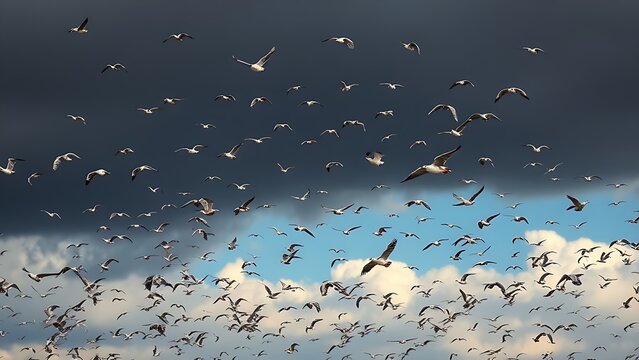
Across the United States, you can see this behavior in starlings over city parks, blackbirds above farm fields, shorebirds along the Atlantic and Pacific coasts, and geese moving across lakes and wetlands. A large flock may twist in the sky as if it were one animal, yet each bird still makes its own flight decisions.
The key is that birds react to nearby flock members. They do not need to know the full shape or direction of the group. By following a few simple rules, they can produce complex patterns such as sharp turns, expanding clouds, and dense murmurations.

The Short Answer: Birds Follow Local Rules
A flock changes direction when individual birds adjust their flight in response to nearby birds and outside forces.
Most flocking behavior depends on three basic rules:
- Stay near the group. A bird moves toward nearby flock members if it begins to fall behind.
- Avoid collisions. A bird turns away when another bird gets too close.
- Match movement. A bird adjusts its speed and direction to fit the birds around it.
These rules work together. If birds only moved closer, they would crash. If they only avoided one another, the flock would scatter. If they only matched direction, small gaps could grow until the group broke apart.
Researchers often call these behaviors cohesion, separation, and alignment.
A bird also responds to other signals. These may include:
- A nearby predator
- A sudden sound
- Wind speed and direction
- Terrain, trees, buildings, or water
- A feeding or roosting site
- Changes in light or visibility
- A neighbor’s sudden wing or body movement
The result is a group turn that looks planned, even though it can arise from many separate choices.

How the Turn Spreads Through the Flock
A direction change often begins with one bird or a small part of the flock. That bird banks, slows, speeds up, or changes altitude. Birds close to it detect the movement and react. Their neighbors then react in turn.
This creates a propagating signal. The signal can travel through the flock much like a wave moves across water. Birds farther away may turn a moment later, even though they never saw the first bird directly.
The process is not perfectly uniform. Some birds turn sooner, while others lag behind. The flock may stretch, compress, or form a curved shape during the change. After the turn, the birds adjust their spacing and speed until the group becomes stable again.
Why the flock can turn so quickly
Birds have fast visual systems and strong control of their wings and tails. They can detect a neighbor’s:
- Change in angle
- Wing beat
- Speed
- distance
– Body posture - Flight path
A bird does not need to calculate the entire flock. It mainly needs to avoid a nearby collision and remain connected to its local neighbors.
Research on European starlings found that birds tend to respond to a small set of nearby flock members rather than to every bird in the group. This type of local interaction can help a flock remain coordinated even when it contains hundreds or thousands of birds. See the Proceedings of the National Academy of Sciences study on starling flock behavior.

Do Birds Follow a Leader?
Usually, no single bird controls the whole flock. A bird at the front may influence birds behind it, but its position does not automatically make it a permanent leader.
Leadership can be temporary and local. For example, a bird near the edge of a flock may detect a hawk first. It turns away, and nearby birds follow the same movement. In another moment, a bird on the opposite side may react first to a tree, building, or change in wind.
This system offers two benefits:
- Fast response: The flock does not need to wait for one leader to make a decision.
- Shared information: Many birds can detect danger or environmental changes at different points in the group.
A flock can therefore act as a distributed system. Each bird has limited information, but the group can still respond as a whole.
That does not mean all flock movement is leaderless. Some species use more organized structures. Geese may follow experienced birds during migration, and family groups may stay together. Still, a sudden mass turn is often the result of local responses rather than a command from one bird.
The Three Main Forces Behind a Flock Turn
1. Alignment
Alignment means matching the direction and speed of nearby birds.
When a bird sees its neighbors banking left, it may bank left too. This helps maintain a common heading. Alignment is especially useful during travel because it reduces large differences in speed and direction.
Alignment does not require birds to fly in a perfect line. Birds may point in slightly different directions while still moving as one group.
2. Separation
Separation keeps birds from hitting one another.
If a neighbor moves too close, a bird may:
- Bank away
- Slow down
- Speed up
- Change altitude
- Fold or adjust its wings
- Shift sideways
Separation is often the fastest response during a sharp turn. A dense flock must constantly make small corrections because each bird occupies moving airspace.
3. Cohesion
Cohesion keeps the flock from breaking apart.
A bird that drifts too far from the group may turn toward nearby flock members. Cohesion is not the same as flying directly toward the flock. The bird must balance attraction with collision avoidance.
Together, these three forces produce a flexible group. The flock stays connected without becoming rigid.
Outside forces also matter
Birds do not respond only to one another. Wind can push part of a flock off course. Obstacles can force a sudden change. A predator can cause birds to scatter, dive, or compress into a dense shape.
The flock’s movement is therefore a result of both:
- Social forces: responses to other birds
- Environmental forces: wind, terrain, predators, and destinations

Why Murmurations Look Like Liquid or Smoke
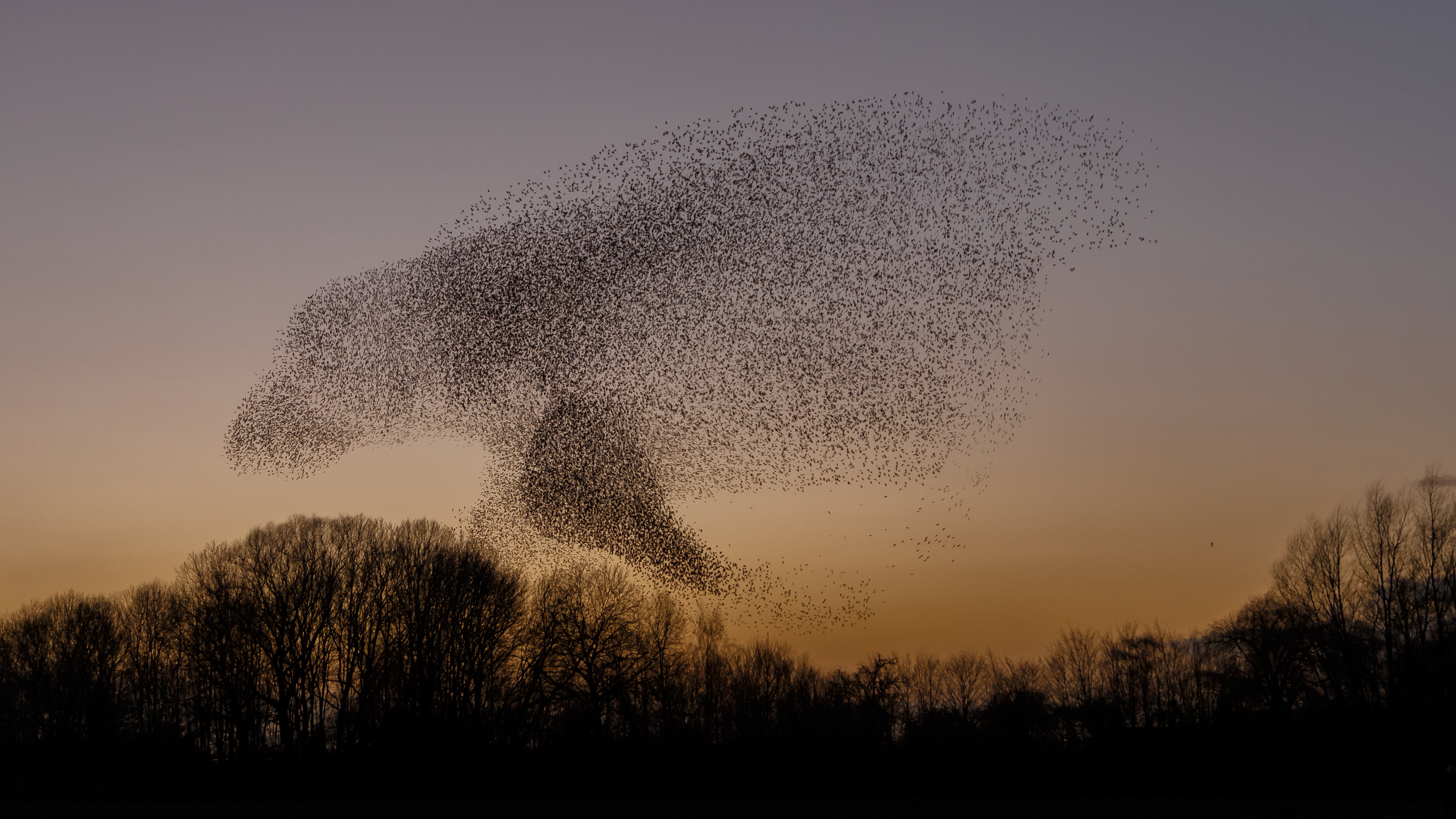
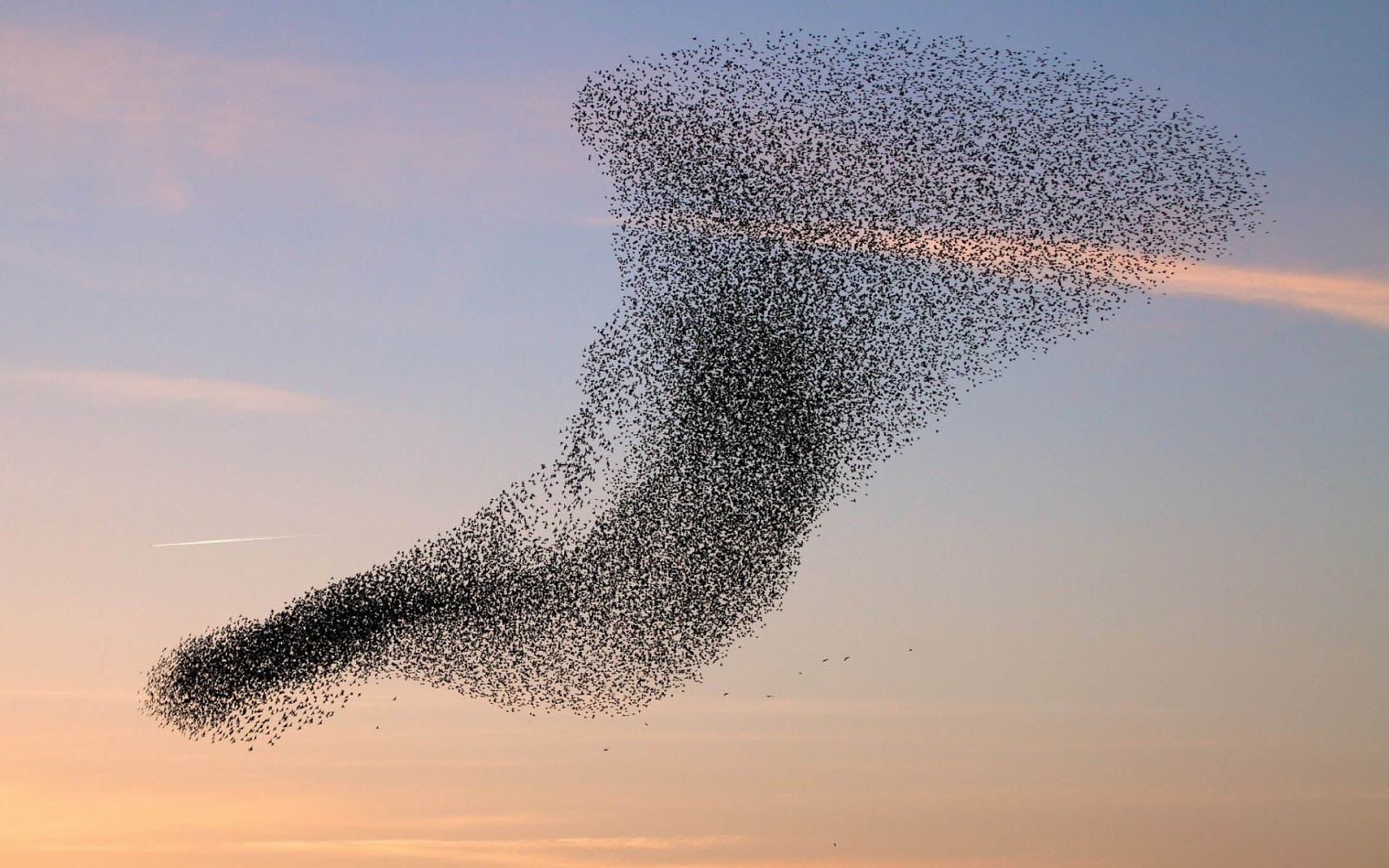
A murmuration is a large, shifting flock display often associated with European starlings. The flock may expand, contract, twist, and reverse direction in seconds.
It looks like one flexible body because nearby birds respond quickly to changes around them. A small movement can spread across the group. The flock’s outline changes as birds adjust their spacing, but the group remains connected.
Several effects make the motion appear smooth:
- Birds turn at slightly different times.
- Each bird follows nearby movement instead of copying the entire flock.
- The flock may bend before all birds complete the turn.
- Dense spacing makes small motions visible as a large pattern.
- Light and distance can hide the gaps between birds.
A murmuration is not a single coordinated decision in the human sense. It is an emergent pattern. Emergence means that a large-scale result comes from many smaller actions.
Computer scientists have modeled similar movement with rules for separation, alignment, and cohesion. These models are useful for understanding flock-like motion, but they are simplified. Real birds also use vision, sound, body motion, flight skill, weather cues, and species-specific behavior.

How Birds Sense a Direction Change
Birds mainly use vision to track nearby flock members, but other senses and body systems may help.
Vision
Vision allows birds to detect:
- Neighbor positions
- Relative speed
- Changes in wing movement
- Gaps in the flock
- Predators
- Obstacles
- The horizon and ground
A bird may not need to identify each neighbor. It can respond to movement patterns and nearby spacing.
Touch and air pressure
Birds in very dense flocks may experience changes in airflow caused by nearby wings. Birds also have sensitive feathers and skin that help them detect air movement during flight.
These cues are harder to observe than visual signals. Researchers should not assume that airflow alone explains a flock turn. It is one possible part of a larger sensory system.
Sound
Calls and wing sounds may help birds maintain contact, especially when visibility is poor. Sound can also signal alarm or support group cohesion. However, not every direction change is caused by a vocal command.
Balance and body control
A bird’s inner ear helps it sense movement and balance. Its wings, tail, and body position then control the turn. A banked turn changes the lift produced by the wings and causes the bird to curve through the air.

What Happens During a Sharp Turn?
During a sharp turn, the flock usually passes through several stages:
- Initiation: One or more birds change speed, angle, or altitude.
- Detection: Nearby birds notice the movement.
- Propagation: The response spreads through neighboring birds.
- Compression or expansion: The flock shape changes as birds avoid collisions.
- Stabilization: Birds match their new direction and spacing.
The flock may not turn as a flat sheet. It can bend in three dimensions. Some birds may rise while others drop. Birds on the outside often travel farther during the turn because they follow a wider arc.
This difference creates a useful geometric effect. A bird near the center of a turning flock may make a smaller adjustment. A bird near the outer edge may need to move faster or bank more sharply to stay with the group.
The turn can also travel from the front to the back, from one side to another, or through several local clusters. The exact pattern depends on the species, flock size, density, flight speed, weather, and threat.
Why Birds Do Not Crash During a Direction Change
Birds reduce collision risk by keeping a personal buffer around their bodies. This buffer is not fixed. It changes with speed, flock density, visibility, and the behavior of nearby birds.
A bird may respond before physical contact becomes likely. Early action gives it time to change course. Birds also use different flight levels and small side-to-side movements to avoid one another.
Flocks can still experience collisions. Risk may rise when:
- Visibility is poor
- The flock is unusually dense
- Birds are startled at close range
- Wind is turbulent
- Birds leave a roost at the same time
- Human activity disrupts the group
A smooth-looking flock does not mean every bird follows a perfect path. It means birds make frequent corrections that usually prevent contact.
Do not disturb large flocks
People should avoid chasing or startling birds to create a dramatic turn. Do not use drones near wildlife unless you have checked applicable federal, state, and local rules and have a lawful reason to operate. The U.S. Fish & Wildlife Service provides guidance on protected birds and wildlife disturbance.
Watch from a distance, keep dogs controlled where required, and avoid blocking feeding, nesting, or roosting areas.

Does a V Formation Change Direction Differently?
Yes. A V formation is more structured than a loose murmuration, but it still depends on individual adjustments.
Geese and other large birds often fly in a V because each bird can benefit from the upward air produced by a bird ahead and to the side. The lead position is more demanding, so birds may change positions during a long flight.
When the formation turns:
- The lead bird begins the change, or a side bird adjusts first.
- Nearby birds alter their heading to keep formation.
- Birds farther back follow the new flight path.
- The V may widen, narrow, or become uneven during the turn.
- The group reforms after the adjustment.
A V formation does not prove that one permanent leader controls the flock. It shows that a group can use both local coordination and a more visible structure.
Energy-saving flight is affected by wing position, distance, body size, wind, and species. A study of northern bald ibises found that birds adjusted their positions in ways consistent with reducing the cost of flight. This does not mean every V formation gives the same benefit in every weather condition. See the Nature study on formation flight in birds.

What Changes the Way a Flock Turns?
The same species may turn differently in different conditions. The main variables include:
| Variable | Likely effect on direction changes |
|---|---|
| Flock size | Larger groups may show slower or more complex wave patterns |
| Bird density | Dense groups need faster collision-avoidance responses |
| Flight speed | Faster birds need more space and earlier corrections |
| Wind | Wind can bend, stretch, or shift part of the flock |
| Predator threat | Birds may turn sharply, dive, scatter, or compress |
| Visibility | Fog, rain, darkness, or glare can reduce visual tracking |
| Species | Wing shape, body size, social behavior, and flight style differ |
| Habitat | Trees, buildings, shorelines, and open fields limit options |
| Group structure | Families, pairs, and mixed flocks may respond differently |
These factors explain why a flock of geese may make a calm, broad turn while starlings may produce rapid, twisting movement.
A flock also behaves differently during travel, feeding, roosting, and escape. A feeding flock may spread out. A roosting flock may compress. A threatened flock may make a sudden turn with little warning.

A Simple Example of Flock Coordination
Imagine a flock flying east over a U.S. wetland. One bird sees a hawk approaching from the north and banks south.
The nearest birds detect the change. They turn south to avoid the threat and maintain spacing. Birds beside them respond next, followed by birds farther away. The flock may bend into a crescent before the last birds complete the turn.
No bird needs to know the hawk’s exact location. Each bird only needs to respond to the alarm, the nearby movement, and the changing distance between neighbors.
This local response can produce a group-level escape. It also explains why the turn may look nearly instant from the ground.
The example is simplified. Real escape behavior depends on the predator, species, flock size, terrain, light, wind, and the birds’ prior experience.
Common Misconceptions About Flock Direction Changes
“The bird in front always leads.”
Not necessarily. A front bird may influence the group, but direction changes can begin at the edge, center, or rear. Leadership may shift from moment to moment.
“Every bird copies the bird next to it.”
Birds respond to several nearby birds, not always one neighbor. They also balance alignment with spacing and outside threats.
“A flock changes direction at exactly the same time.”
The movement usually spreads through the flock. The delay may be hard to see, but birds often turn in sequence.
“Murmurations are controlled by telepathy.”
There is no need for a mysterious group mind. Local sensing and rapid adjustment can explain much of the visible pattern.
“The flock is one organism.”
A flock can behave like a single moving shape, but it is made of individual birds. Each bird still controls its own flight and may react differently.
“A computer simulation proves that real birds use only three rules.”
Models can show how simple rules might produce flocking. They do not prove that real birds use only those rules. Biological behavior includes senses, learning, anatomy, weather, and social context.

Key Takeaways
- A flock changes direction through local responses between nearby birds.
- The main flocking rules are separation, alignment, and cohesion.
- A turn often begins with one bird or a small group and spreads as a wave.
- Birds use vision, body movement, balance, sound, and environmental cues.
- Most flock turns do not require one permanent leader.
- Murmurations look like one fluid body because many individual corrections happen quickly.
- Wind, predators, density, species, and habitat all affect the shape and speed of a turn.
- V formations use local coordination too, even when one bird appears to lead.
Frequently Asked Questions
How fast can a flock of birds change direction?
The change can begin within a very short time after a nearby bird moves, but the whole flock may take longer to complete the turn. Response time depends on species, flight speed, visibility, flock density, and the reason for the turn.
Which bird starts the turn?
There is no fixed answer. The first bird may be the one that sees a predator, encounters wind, reaches an obstacle, or simply adjusts its path. The initiating bird may be near any part of the flock.
Do birds communicate before turning?
Sometimes birds use calls or alarm sounds, but many turns begin through visible movement. A bird can respond to a neighbor’s bank, speed change, or sudden gap without receiving a clear vocal signal.
Why do birds sometimes split into smaller groups?
A flock may split when birds respond to different threats, obstacles, food sources, or wind patterns. Separation can also occur when local groups move too far apart for cohesion to hold them together.
Can humans predict a flock’s next move?
Observers can identify common patterns, but exact prediction is difficult. Small changes in wind, predators, individual birds, and nearby obstacles can alter the result. Watching from a distance is safer and less disruptive than trying to influence the flock.
Conclusion
A flock of birds changes direction through rapid, local adjustments. Each bird watches nearby flock members, avoids collisions, matches movement, and responds to the environment. Those small actions spread through the group and create a coordinated turn.
The apparent magic of a murmuration comes from simple behavior working at large scale. The flock looks like one creature, but its motion is built from many birds sensing, reacting, and correcting their paths at the same time.