
How Far Do Birds Migrate: Migration Distances Explained
Birds in the United States may migrate a few miles between nearby habitats or travel more than 10,000 miles each year between North America and distant wintering grounds. The exact distance depends on the species, its breeding range, food supply, weather, and whether you measure one-way travel, a round trip, or the total path of every stop.
A small backyard bird may move from the northern United States into the Southeast. A shorebird that breeds in Alaska may fly nonstop to New Zealand. Some seabirds travel around the globe during one annual cycle.
The best answer is not one number. Bird migration ranges from short local movements to some of the longest journeys made by any animal.

How far do birds migrate?
Most migrating birds travel between a few hundred and several thousand miles. Long-distance migrants in the United States often travel between North America and Central or South America, while Arctic-breeding birds may cross oceans and reach the Southern Hemisphere.
The table below shows the scale of common migration patterns.
| Migration pattern | Approximate distance | Typical example |
|---|---|---|
| Short-distance movement | Less than 100 miles | Birds moving to lower elevations or nearby food sources |
| Regional migration | 100–1,000 miles | Birds moving within the United States |
| Continental migration | 1,000–4,000 miles | Birds traveling between Canada, the United States, and Mexico |
| Intercontinental migration | 4,000–10,000 miles | Birds traveling between North America and South America |
| Extreme long-distance migration | More than 10,000 miles | Arctic terns and some shorebirds |
These are broad ranges, not fixed rules. Two birds from the same species may follow different routes. One may stop often along the coast, while another crosses a large area of land or water.
Distance also changes with the season. A bird may take one route south in the fall and a different route north in the spring. Winds, storms, food, and daylight can all alter the path.
One-way distance, round-trip distance, and total travel are different
A migration distance can mean several things:
- One-way distance: The trip from a breeding area to a wintering area.
- Round-trip distance: The journey south and the return journey north.
- Annual travel distance: All movement during a year, including detours and stops.
- Nonstop distance: The longest stretch flown without landing.
- Route distance: The actual path followed, rather than a straight line on a map.
For example, a bird may have a 3,000-mile one-way migration but travel more than 7,000 miles in a year after stopovers and route changes.
Researchers often use satellite tags, geolocators, weather radar, band recoveries, and direct observation to estimate these distances. A straight-line map measurement may be much shorter than the bird’s real route.
Why the route is often longer than the map distance
Birds rarely fly in a perfect straight line. They may:
- Follow coastlines, rivers, mountain passes, or island chains.
- Avoid strong headwinds or dangerous storms.
- Stop at wetlands and grasslands to feed.
- Cross barriers in stages.
- Return to the same stopover sites each year.
- Change direction when food or weather conditions shift.
A bird flying around a storm may add hundreds of miles to its journey. That extra distance is part of the bird’s real migration, even though it does not appear in a simple point-to-point estimate.

Examples of birds that migrate long distances
The following examples show why there is no single answer to “how far do birds migrate.”
Arctic tern: more than 20,000 miles in some annual cycles
The Arctic tern breeds in the far north, including parts of the Arctic region, and travels toward Antarctic waters for the southern summer. It then returns north for the breeding season.
The species is widely recognized as one of the world’s longest-distance migrants. Depending on the route and the method used to measure it, an individual may travel more than 20,000 miles in a year. Some tracking studies have recorded annual routes of more than 40,000 miles because the birds follow winding paths over the Atlantic Ocean.
The key point is that the Arctic tern does not simply fly from one pole to the other in a straight line. Its route may curve around weather systems and follow productive ocean areas.
Bar-tailed godwit: more than 8,000 miles nonstop
The bar-tailed godwit is a shorebird that breeds in Alaska. Some individuals fly from Alaska to New Zealand without stopping to feed.
Tracking research has documented nonstop flights of roughly 7,000 to more than 8,000 miles, depending on the bird and the route. These flights can last for days. The birds build large fat reserves before departure and rely on favorable winds to reduce the energy cost.
This is one of the clearest examples of the difference between nonstop distance and total annual distance. The nonstop flight is extraordinary, but the bird also makes a return journey and may travel to other locations during the year.
Ruby-throated hummingbird: about 500 miles across the Gulf of Mexico
Many ruby-throated hummingbirds migrate between the eastern United States and Mexico or Central America. Some fly across the Gulf of Mexico, a journey of about 500 miles over open water.
Other individuals travel around the Gulf through Texas or along the Gulf Coast. The route may be longer, but it gives the birds access to places where they can rest and feed.
A hummingbird’s small body makes the nonstop Gulf crossing especially demanding. The bird must store enough fat before leaving and must cope with wind, rain, and limited opportunities to land.
Swainson’s hawk: thousands of miles between North and South America
Swainson’s hawks breed across much of the western United States and Canada. Many migrate to Argentina and other areas of southern South America.
Their one-way journeys can cover roughly 6,000 to 7,000 miles. These hawks often use rising columns of warm air, called thermals, to gain height and glide. This saves energy compared with continuous flapping.
That strategy also shapes their route. Swainson’s hawks tend to avoid long ocean crossings because thermals are weaker over open water.
Red knot: long journeys between the Arctic and South America
Red knots that breed in the Arctic may migrate to the southern tip of South America. Some travel more than 9,000 miles one way.
The species relies on important stopover sites, including Delaware Bay on the U.S. Atlantic coast. There, migrating birds feed on horseshoe crab eggs before continuing north. Loss of food at these stopover sites can affect the birds’ ability to complete the migration and breed.
This example shows that migration distance is only one part of the challenge. The quality of the places along the route can matter just as much as the length of the journey.
Canada goose: often hundreds or thousands of miles
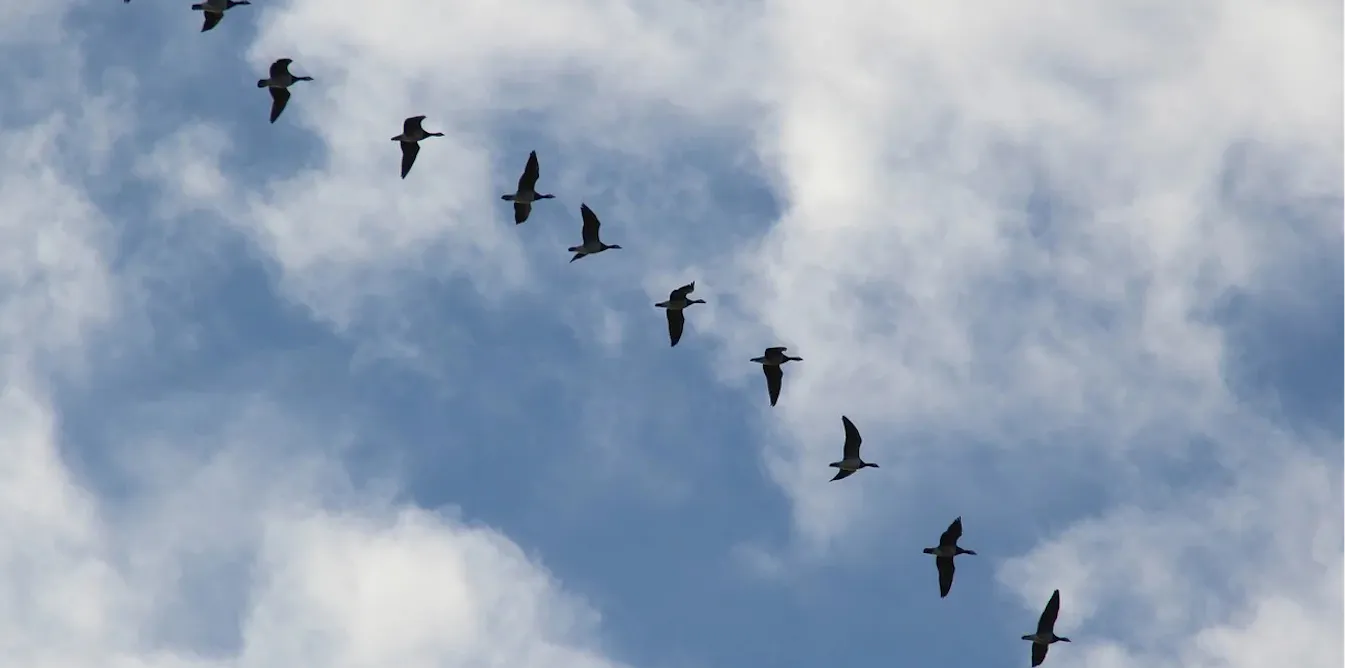
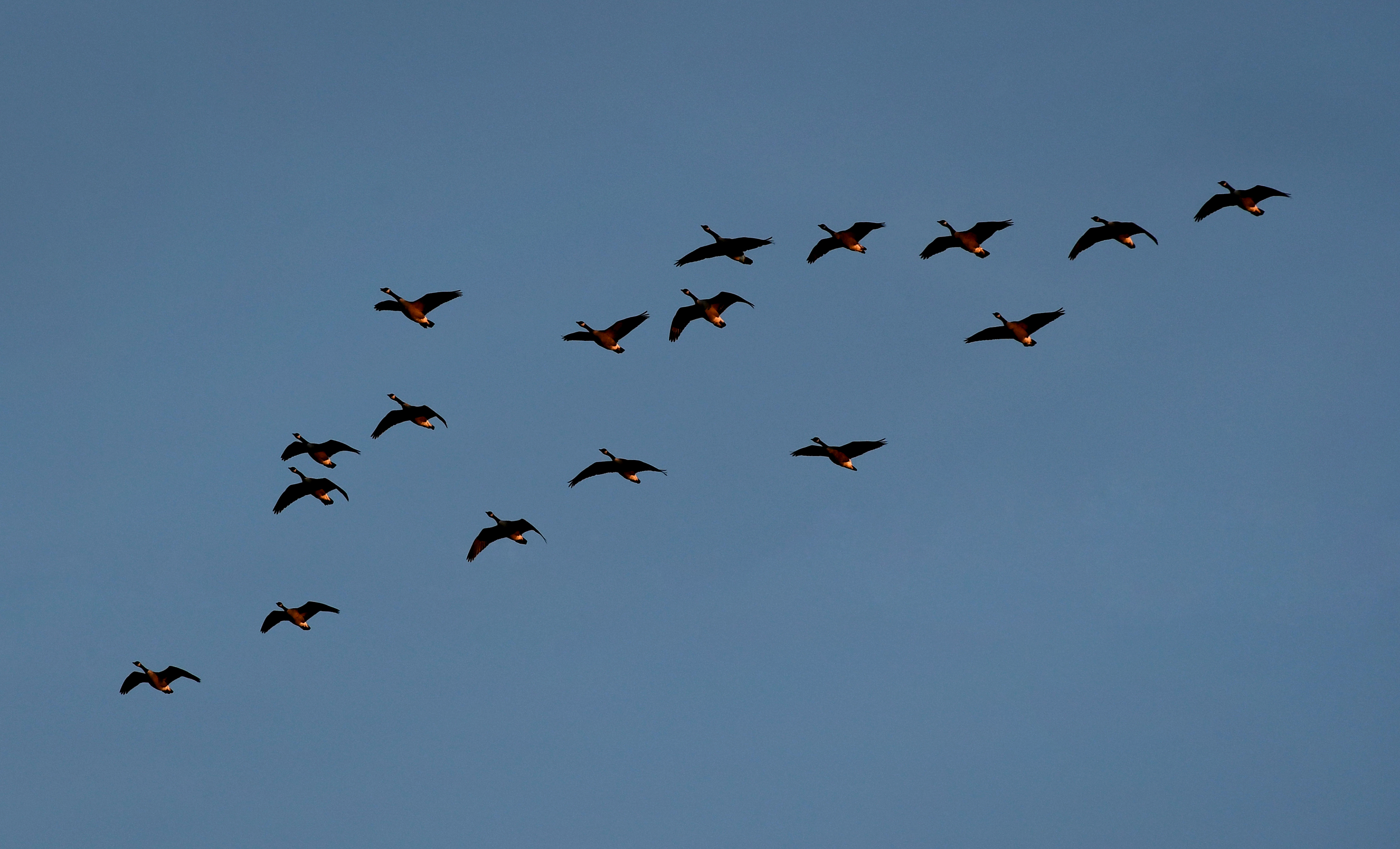
Canada geese show a wide range of migration behavior. Some populations move only a few hundred miles, while others travel more than 2,000 miles between breeding and wintering areas.
Some Canada geese have also become year-round residents in areas with reliable food and open water. This means not every bird in a species follows the same migration pattern.

What determines how far a bird migrates?
Bird migration distance is shaped by biology, geography, food, and weather. The most important factor is usually the location of suitable breeding and nonbreeding habitat.
Food and seasonal resources
Birds migrate because conditions change. In northern regions, insects, seeds, berries, and open water become scarce during winter. Moving south can provide more food.
For birds that breed in the Arctic, the long summer days can create a short period of abundant food. They may travel thousands of miles to use that seasonal supply, then leave before winter arrives.
A bird does not migrate simply because a certain distance is normal. It migrates when the benefits of moving outweigh the energy and danger of travel.
Breeding habitat
Many species travel far north to breed because the region offers:
- Long daylight hours.
- Large seasonal insect populations.
- Fewer predators in some habitats.
- Less competition for nesting areas.
- Open tundra, forest, wetland, or grassland habitat.
After breeding, the birds return to areas with better winter food and shelter.
Body size and flight style
Body size affects how a bird travels, but it does not set a simple limit. Larger birds may carry more fat, while smaller birds may benefit from lower energy needs and favorable winds.
Flight style also matters:
- Soaring birds use thermals and wind to reduce flapping.
- Fast, strong fliers may cross large areas of land or water.
- Shorebirds may build large fat stores for nonstop flights.
- Small songbirds often migrate at night and stop frequently.
- Seabirds may use ocean winds and travel vast distances while searching for food.
A bird’s wing shape, muscle strength, fat storage, and metabolism all affect its migration strategy.
Wind and weather
Wind can shorten or lengthen a migration. Tailwinds help birds move faster and use less energy. Headwinds can force them to stop, change direction, or wait for better conditions.
Weather can also create sudden dangers. A storm may cause birds to lose energy, become disoriented, or arrive at a place with little food. Some birds delay migration when conditions are poor.
Birds often use large-scale weather patterns to improve their chances. Radar studies in the United States show that migration can occur in waves when wind and temperature conditions become favorable.
Geography and natural barriers
Mountains, deserts, oceans, and ice can shape migration routes. Birds may follow:
- The Atlantic and Pacific coasts.
- The Mississippi Flyway.
- The Central, Pacific, or Atlantic Flyways.
- Mountain valleys and passes.
- Major rivers and wetland chains.
The four major North American flyways are broad geographic corridors, not narrow roads. Birds within the same flyway may use different habitats and routes.
Evolution and inherited behavior
Migration patterns develop over many generations. Young birds may inherit a general direction and timing from their parents, then improve navigation through experience.
Some birds migrate alone. Others travel in flocks, which can help them find food, avoid predators, and use energy more efficiently.
How scientists measure bird migration distance
Scientists use more than one method because each tool reveals a different part of the journey.
Bird bands and rings
A metal band placed on a bird can link two locations when the bird is captured, found, or reported later. Banding has helped document migration routes for more than a century.
The limitation is that researchers may know only where a bird started and where it was later found. The full route remains unknown.
GPS and satellite tracking
GPS and satellite tags can record detailed paths, including detours, stopovers, and changes in speed. These devices work best for birds large enough to carry the tag safely.
A tracking study may show that the same species uses several routes. It can also reveal how birds respond to storms, drought, wildfires, or habitat loss.
Geolocators
Light-level geolocators estimate a bird’s location from sunrise and sunset times. They are small enough for some songbirds, but their location estimates are less precise than GPS.
Researchers may recapture the bird the following year to download the stored data. This method can reveal broad migration routes and timing.
Weather radar
Weather radar can detect large movements of birds at night. In the United States, radar data helps researchers estimate when migration waves occur and how many birds may be moving through an area.
Radar usually cannot identify every species. It is most useful when combined with field observations, banding, acoustic recordings, and tracking data.
Direct observation and citizen science
Birders contribute useful records through projects such as eBird. These reports can help show when species arrive, depart, and appear in unusual places.
Observation data has limits. A sighting may not reveal the bird’s exact origin, destination, or total distance. Still, many observations combined over time can reveal broad patterns.

How far do birds migrate in the United States?
Birds in the United States use several broad migration routes. The distance depends on where they breed and where they spend the nonbreeding season.
Birds moving within the United States
Some birds migrate only within the country. For example, a bird may breed in Alaska or the northern states and spend winter in California, Texas, Florida, or the Southeast.
These movements can range from a few dozen miles to more than 2,000 miles. Elevation also matters. Mountain birds may move downhill in winter without leaving the same general region.
Birds traveling between the United States and Mexico
Many species breed in the United States and spend winter in Mexico. Examples include several warblers, flycatchers, raptors, and shorebirds.
One-way travel may range from several hundred miles to more than 2,500 miles, depending on the starting point and destination.
Birds traveling between the United States and Central or South America
Some birds continue farther south to Central America, the Caribbean, or South America. Swainson’s hawks, scarlet tanagers, barn swallows, and many shorebirds may cover thousands of miles each way.
These birds depend on habitats across many countries. A wetland in the United States, a forest in Mexico, and a grassland in South America may all be part of one bird’s annual cycle.
Birds that migrate along the U.S. coast
Coastal birds may follow the Atlantic, Pacific, or Gulf coasts. The route can be longer than a direct inland path, but coastlines provide food and shelter.
Shorebirds often depend on a chain of beaches, mudflats, marshes, and estuaries. If one stopover loses habitat, the effect can spread across the entire migration route.
How long does bird migration take?
Migration can last from a few hours to several months. The total time depends on how often a bird stops and how far it must travel.
A bird flying across the Gulf of Mexico may complete the nonstop flight in less than a day. A songbird crossing North America may take weeks because it stops to feed and rest.
Some birds migrate in stages:
- They build energy reserves.
- They fly to a stopover site.
- They feed and recover.
- They continue when weather conditions improve.
- They reach the breeding or wintering area.
Stopovers are not wasted time. They are essential parts of the journey. A bird may need days or weeks to replace the fat used during one flight.
Migration timing also differs between spring and fall. Spring migration is often faster because birds compete for breeding territories. Fall migration may be more spread out because birds are no longer racing to claim a nest site.

Do all birds migrate?
No. Some birds migrate long distances, some move short distances, and some remain in the same area all year.
Birds may be:
- Permanent residents: They remain in one region year-round.
- Short-distance migrants: They move to nearby areas when conditions change.
- Partial migrants: Some individuals migrate while others stay.
- Long-distance migrants: They travel between distant breeding and nonbreeding grounds.
- Irruptive migrants: They move in unpredictable numbers when food supplies change.
A species can include both migrants and residents. For example, a bird may migrate in the northern part of its range but remain year-round in a warmer southern area.
Migration can also change over time. Warmer winters, urban growth, drought, forest loss, and supplemental food may alter when or where birds move.

Do birds migrate at night or during the day?
Many songbirds migrate at night. Night travel can reduce exposure to some predators and may help birds avoid heat. Cooler air may also lower the cost of flight.
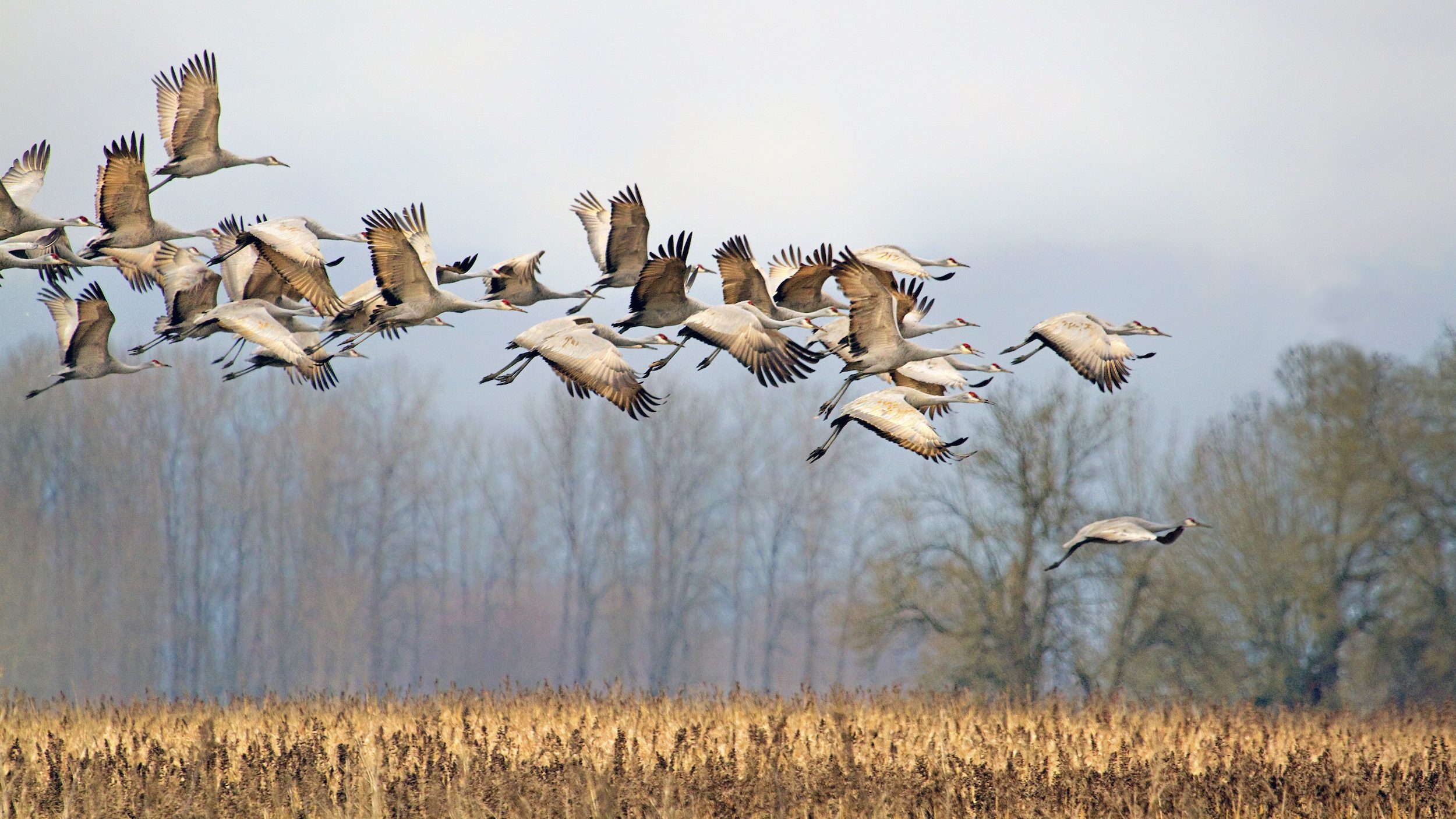
During daylight, these birds stop to feed. Raptors, swallows, geese, cranes, and many seabirds commonly migrate during the day, although timing varies by species and weather.
Birds use several navigation clues:
- The sun’s position.
- Stars.
- Earth’s magnetic field.
- Coastlines, rivers, and mountain ranges.
- Smells and local landscape cues.
- Memory from earlier journeys.
No single clue explains navigation in every species. Birds combine inherited behavior with information gathered during the trip.
Artificial light can disrupt night migration. Bright city lights may attract or disorient birds, especially during low clouds or fog. Turning off unnecessary lights during peak migration periods can reduce this risk.

What are the biggest dangers during migration?
Migration is costly because birds must spend energy while facing changing conditions. Major dangers include:
- Habitat loss at breeding, stopover, and wintering sites.
- Lack of food after drought, storms, or land-use change.
- Collisions with windows, towers, and other structures.
- Predators and hunting pressure.
- Severe weather.
- Light pollution.
- Pesticide exposure and contamination.
- Disease and poor body condition.
For many birds, the most dangerous part is not the longest flight. It may be the loss of a stopover site where the bird must refuel.
How people can help migrating birds
People in the United States can reduce common risks by:
- Making windows safer with exterior screens, decals, or closely spaced patterns.
- Keeping cats indoors, especially during migration.
- Planting native plants that provide insects, seeds, berries, or shelter.
- Reducing outdoor lighting at night.
- Keeping dogs away from resting shorebirds.
- Supporting wetlands, grasslands, forests, and coastal habitat.
- Reporting bird sightings through reliable monitoring programs.
If you find an injured wild bird, avoid feeding it or handling it more than necessary. Place it in a secure, ventilated box and contact a licensed wildlife rehabilitator. Do not attempt to keep a wild migratory bird as a pet.

Common mistakes when estimating bird migration distance
Mistake 1: Treating every bird in a species as identical
A species may include several populations with different routes. A Canada goose in Alaska may migrate differently from one in the Midwest.
Mistake 2: Confusing a straight-line distance with the real route
A map tool may measure the shortest path. The bird may follow a much longer route around mountains, coastlines, or storms.
Mistake 3: Calling a nonstop flight the full migration
A bird that flies 500 miles across the Gulf may travel several thousand miles during the entire season.
Mistake 4: Assuming birds always migrate south
Many birds move south in fall, but not all do. Some move east or west to find food, descend from mountains, or follow coastlines.
Mistake 5: Assuming every bird must migrate
Resident and partial-migrant populations are common. Local climate and food supply can change migration behavior.
Mistake 6: Treating a record distance as typical
The longest documented flight is not the normal distance for every member of a species. A record bird may have used an unusual route or exceptional weather.
Key takeaways
- Birds may migrate less than 100 miles or more than 20,000 miles in a year.
- Many North American migrants travel between the United States, Canada, Mexico, Central America, and South America.
- Arctic terns and some shorebirds make especially long journeys.
- One-way, round-trip, nonstop, and annual distances are different measurements.
- Weather, food, body design, geography, and habitat all shape migration.
- Stopover sites are essential because birds need places to rest and refuel.
- Not every bird in a species migrates, and some populations change their behavior over time.
- The most accurate distance estimates come from tracking, radar, banding, and long-term observation used together.
Frequently asked questions
What bird migrates the farthest?
The Arctic tern is one of the farthest-migrating birds. Some individuals travel more than 20,000 miles per year, and tracked routes can exceed 40,000 miles when detours are included.
What bird flies the farthest without stopping?
The bar-tailed godwit holds one of the best-known nonstop flight records. Individuals have flown from Alaska to New Zealand for more than 7,000 miles, with some documented routes exceeding 8,000 miles.
Do birds migrate thousands of miles in one day?
A few birds can fly thousands of miles in one nonstop flight, but most birds do not cover that distance in one day. Many migrate in stages and stop to feed and rest.
Do birds return to the same place each year?
Many do. Birds often return to the same breeding area, wintering region, or stopover site. Young birds may use inherited directions, while adults may rely on memory and experience.
How can I tell if a bird near my home is migrating?
Look for a sudden increase in species that do not stay in your area year-round, changes in flock size, and birds appearing during spring or fall migration periods. A local bird guide or a verified eBird record can help identify the species and its typical range.
Conclusion
Bird migration can cover a short regional route or span half the planet. In the United States, the distance may be a few miles for a mountain bird, several thousand miles for a warbler or hawk, or more than 20,000 miles per year for an Arctic tern.
To understand how far a bird migrates, first identify the species and population. Then ask whether the measurement describes a one-way trip, a nonstop flight, a round trip, or the full annual route. That distinction turns a surprising number into a useful picture of the bird’s real journey.