How Do Birds Find Their Way Home: Bird Navigation
Birds in the United States find their way home by combining several navigation tools. They use the Sun, stars, Earth’s magnetic field, landmarks, smells, sound, memory, and inherited instincts. No single method explains every trip.
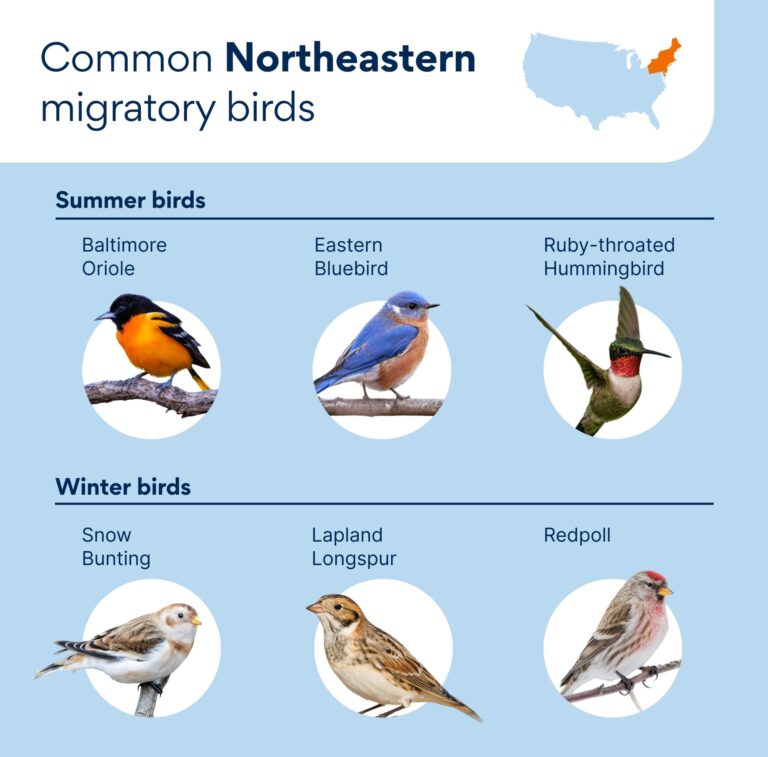
A ruby-throated hummingbird flying from the southern United States to Canada may use a different mix of clues than a homing pigeon returning across a city. Weather, age, experience, time of day, and the bird’s species all affect the route.
The best answer is simple: birds build a mental map from many signals, then use that map to guide long flights and local trips.

What does “home” mean for a bird?
For a bird, home may mean a nesting site, winter territory, feeding area, or place where it was born. Some birds return to the same tree, marsh, cliff, or neighborhood each year.
Birds also show different types of movement:
- Migration: A seasonal trip between breeding and wintering areas.
- Homing: A return to a known place after being moved or after a long journey.
- Dispersal: A one-way move away from the birthplace, often by a young bird.
- Local movement: Short trips between food, water, shelter, and nesting sites.
A bird does not always travel back by the same exact path. It may change course to avoid storms, find food, or use favorable winds. “Finding home” often means reaching a familiar area rather than following a fixed line like a road or trail.
How do birds navigate?
Birds navigate with a layered system. They may first set a general direction using an internal compass, then correct their route with landmarks, smells, and other environmental clues.
The Sun acts as a compass
Many birds can use the Sun to determine direction. The Sun appears to move across the sky during the day, so a bird must also account for time. This ability is called a sun compass.
A bird’s internal clock helps it interpret the Sun’s position. For example, the Sun’s location in the morning does not mean the same direction as its location in the afternoon. Experiments with caged birds have shown that changing a bird’s light-dark cycle can shift the direction in which it tries to migrate.
Clouds do not always stop this system. Birds can detect patterns in scattered sunlight, even when the Sun itself is hidden. However, heavy clouds, storms, and long periods of poor visibility can make solar navigation harder.
Stars guide night migrants
Many North American songbirds migrate at night. Warblers, thrushes, sparrows, and some other species can use the stars to hold a course.
Young birds appear to learn the pattern of the night sky during an early period of life. The North Star, or Polaris, is especially useful in the Northern Hemisphere because it stays close to true north. Birds do not need to identify many individual stars. They can use the overall pattern of the sky as a directional map.
Research on indigo buntings helped show how birds learn celestial direction. When young birds saw an artificial star pattern that rotated around a different point, they later oriented toward the false “north.” This finding supports the idea that birds learn star patterns rather than relying only on instinct.
Earth’s magnetic field provides a built-in compass
Birds can sense aspects of Earth’s magnetic field. This sense is called magnetoreception. It may help birds determine direction and, in some cases, estimate their position.
The magnetic field differs across the planet. Its strength and angle change from place to place. Birds may use these changes as part of a large-scale map, although scientists are still studying exactly how that map works.
Researchers have proposed more than one biological mechanism:
- Light-sensitive proteins in the eye may help birds detect magnetic direction.
- Tiny magnetic particles in body tissues may provide another form of magnetic information.
- The inner ear or nervous system may also play a role.
The evidence does not support the idea that birds carry a simple magnetic “GPS.” Magnetic sensing is one part of a larger system. Local magnetic disturbances, solar activity, and human-made electrical noise may affect the signal, but birds can often switch to other cues.
Landmarks help birds recognize familiar places
Once birds reach a familiar region, visual landmarks become very useful. Rivers, coastlines, mountain ranges, roads, buildings, farms, and forest edges can help a bird stay on course.
Pigeons are a clear example. Studies of homing pigeons suggest that they use visual features near the destination. Their ability to return may also involve odors carried by the wind. A pigeon that has learned a landscape can use it much like a person uses a familiar route through a town.
Landmarks are most useful at a local or regional scale. They cannot explain how a young bird crosses an unfamiliar continent on its first migration. For that part of the trip, inherited direction, celestial cues, magnetic information, and wind may matter more.
Smells may create a map
Some birds use odor patterns in the air to learn where they are. This ability is called olfactory navigation.
The idea is best supported in homing pigeons and some seabirds. A bird may learn that winds from different directions carry different mixtures of plant, soil, ocean, or urban odors. Later, it may compare the smell of the air with a mental odor map.
Smell is not the only explanation for bird navigation. Experiments have produced different results across species and conditions. The safest conclusion is that odors can help some birds, especially when they are near familiar areas, but they do not explain every bird’s journey.
Sounds and low-frequency signals may add information
Birds may also respond to broad environmental sounds. Oceans, rivers, forests, storms, and human activity create sound patterns that can change across a landscape.
Some researchers have studied infrasound, which means sound below the range of normal human hearing. This type of sound may travel long distances, especially near large storms or coastlines. Evidence for its role in bird navigation remains less settled than the evidence for stars, the Sun, landmarks, and magnetic sensing.

Do birds know where they are going?
Birds may use both inherited instructions and learned maps. The balance depends on the species and the bird’s age.
Young birds of some species migrate in a genetically influenced direction for a certain period. They may not need an experienced adult to show them the basic route. A young bird can inherit a tendency to fly southeast, southwest, or another broad direction at a particular season.
This system is often called a vector program. It includes a direction and an approximate duration. It is useful, but it is not perfectly precise. Weather, wind, food, and other conditions can change the final path.
Older birds often improve through experience. They learn:
- Where safe stopover sites are located
- How long to rest before continuing
- Which wind conditions help or hurt
- Where food and water are reliable
- How local landmarks look from the air
- How to adjust when the normal route is blocked
This creates an important difference between first-time and experienced travelers. A young bird may follow a broad inherited plan. An adult may combine that plan with a detailed memory of the landscape.
How do birds correct their course?
Birds rarely fly for thousands of miles without making adjustments. They compare their current information with the direction they need to travel.
A bird may correct its course when:
- A crosswind pushes it sideways
- A storm forces it around a weather system
- Mountains or large bodies of water change the route
- Food is scarce at a stopover site
- A familiar landmark appears in an unexpected location
- The bird detects a change in magnetic direction or intensity
This is similar to steering a boat. The bird may aim slightly into the wind rather than directly toward its destination. When conditions change, it adjusts again.
Wind can either help or hurt migration. A strong tailwind may reduce the energy needed for flight. A headwind can slow progress and increase energy use. Birds often choose departure times based on weather forecasts they sense through pressure, wind, temperature, and cloud changes.
Do all birds migrate back to the same place?
No. Some birds return to the same breeding territory or wintering site with remarkable consistency. Others shift locations from year to year.
Species that often show strong site fidelity include many:
- Seabirds
- Shorebirds
- Waterfowl
- Songbirds
- Raptors
- Swallows
Even within one species, individuals may behave differently. An adult with a successful nesting territory may return to it. A young bird may travel farther to find an open territory.
Habitat loss can also change the meaning of “home.” If a wetland dries, a forest is cleared, or a coastline is heavily altered, a bird may not find the place it learned earlier. A strong navigation system cannot always overcome a missing food source or destroyed nesting site.
How do birds find their way at night?
Night-migrating birds use a mix of stars, Earth’s magnetic field, inherited direction, wind, and possibly polarized light at dusk.
Many birds begin migration near sunset. At this time, they may use the fading light and star patterns to establish direction. Once in flight, magnetic information can help them maintain a heading when clouds hide the stars.
Artificial light can disrupt this process. Bright buildings, stadiums, communication towers, and other structures may attract or disorient night migrants. Birds can circle lights, collide with windows, or lose energy before reaching a safe stopover site.
People in the United States can reduce this risk by turning off unnecessary outdoor lights during peak migration periods. Window treatments, exterior screens, and bird-safe glass can also reduce collisions near homes and offices.

How do scientists study bird navigation?
Scientists study navigation through field observations, tracking devices, controlled experiments, and long-term banding records.
Bird banding
A small band placed on a bird’s leg can connect two observations. If someone later finds or reports the band, researchers may learn where the bird moved.
Banding works best when many people report marked birds. It can show broad travel patterns, survival, and site fidelity, but it does not provide a continuous route.
Radio and satellite tracking
Transmitters can show where a bird travels over time. Larger species, such as eagles, storks, and some seabirds, may carry satellite tags. Smaller birds may carry lighter radio tags or geolocators.
Each tool has limits:
| Method | What it can show | Main limitation |
|---|---|---|
| Leg band | Recovery location and timing | Few birds are found again |
| Radio tag | Local and regional movements | Receivers must detect the signal |
| Satellite tag | Long-distance routes | Weight, battery life, and cost limit use |
| Geolocator | Approximate travel path | The bird must be caught again |
| Radar | Broad migration flow | Usually cannot identify each bird |
| Stable isotopes | Possible geographic origin | Results can be broad or uncertain |
Orientation experiments
Researchers may place birds in controlled settings and record the direction they try to fly. They can change the light cycle, star pattern, magnetic field, or visual surroundings.
These tests help isolate one cue at a time. However, a cage or laboratory does not perfectly reproduce open-air flight. The strongest conclusions usually come from combining controlled experiments with tracking in the wild.
The U.S. Geological Survey’s bird migration research and the U.S. Fish and Wildlife Service’s migration resources provide useful background on tracking and migration science.
Why do birds sometimes get lost?
Birds can lose their way when normal cues are blocked, changed, or confused. A storm may push a bird far off course. Bright lights may attract a night migrant toward a dangerous urban area.
Other causes include:
- Strong winds or hurricanes
- Thick fog and heavy rain
- Habitat destruction
- Window and tower collisions
- Magnetic disturbances
- Artificial light at night
- Lack of food at a stopover site
- Inexperience in young birds
- Human transport of birds far outside their normal range
A bird seen far from its normal range is not always “lost.” Some birds are blown off course, while others explore new areas or follow unusual weather patterns. A rare bird report needs careful identification because unfamiliar species can resemble common local birds.
Can people help birds get home?
Yes. The most helpful actions protect the places and conditions birds need during travel.
Make windows safer
Window collisions kill or injure many birds in the United States. To reduce risk:
- Add outside window screens or tested bird-safe markers.
- Place markers across the full pane, not only in one corner.
- Keep feeders either very close to a window or much farther away.
- Turn off unnecessary indoor and outdoor lights at night.
- Close blinds during peak migration when practical.
If you find an injured bird, place it gently in a small ventilated box lined with a towel. Keep the box dark, quiet, and away from pets. Do not give food or water unless a licensed wildlife rehabilitator tells you to. Contact a wildlife rehabilitator or state wildlife agency as soon as possible.
Protect stopover habitat
Migrating birds need food, water, cover, and safe places to rest. Native plants can provide insects, seeds, berries, and shelter. Avoid pesticides when possible, especially during periods when birds are feeding young.
Keep cats indoors or use a secure outdoor enclosure. Free-roaming cats can kill birds that are tired, grounded, or stopping to feed.
Report birds responsibly
If you see a banded bird, report the band through the North American Bird Banding Program. Record the band number, date, location, and any other details requested.
Do not chase, handle, or move a healthy bird simply because it is resting. A bird that pauses during migration may be conserving energy, not waiting for help.
Common myths about bird navigation
Myth: Birds use only Earth’s magnetic field
Birds use many cues. Magnetic sensing can help with direction and position, but it works alongside the Sun, stars, landmarks, smells, wind, and memory.
Myth: Every bird follows the same route every year
Routes vary by species, age, weather, food, and geography. Some birds show strong site fidelity, while others make flexible movements.
Myth: Young birds must follow their parents
Some species migrate with adults, but others migrate alone. In those species, young birds may inherit a broad direction and timing program.
Myth: Birds never lose their way
Birds can become disoriented or displaced. They may also choose a new route when conditions change. Navigation is powerful, but it is not perfect.
Key takeaways
- Birds find their way home by combining several navigation systems.
- The Sun and stars help provide direction.
- Earth’s magnetic field may act as both a compass and a map.
- Landmarks, smells, sounds, and memory become more useful in familiar areas.
- Young birds may inherit a broad migration program.
- Adult birds often improve their routes through experience.
- Weather, light pollution, habitat loss, and human structures can disrupt navigation.
- Safer windows, darker nights, native plants, and protected habitat can help birds complete their journeys.
Frequently asked questions
How do birds know which direction to fly?
Birds use internal programs and environmental cues. Depending on the species, they may use the Sun, stars, magnetic information, wind, landmarks, smells, and memory to select and maintain a direction.
Can birds remember where their nest is?
Many birds can return to the same nesting territory. They may recognize visual landmarks, local smells, sounds, and the location of the territory itself. This ability is stronger in some species than in others.
How do birds navigate over the ocean?
Seabirds may use the Sun, stars, magnetic information, wind, wave patterns, smells, and ocean features. They can also conserve energy by using favorable winds and air currents.
Do birds use GPS?
Birds do not use human-made GPS satellites in the way phones and aircraft do. They have natural navigation systems that can provide directional and geographic information.
What should I do if I find a bird that seems lost?
Do not assume a resting bird is lost. Watch from a distance first. If the bird is injured, unable to fly, or in immediate danger, place it in a dark, ventilated box and contact a licensed wildlife rehabilitator or state wildlife agency.
Conclusion
Bird navigation is not one trick. It is a flexible system that combines instinct, memory, senses, weather, and experience.
A bird may begin a journey with an inherited direction, use stars or the Sun to stay on course, sense Earth’s magnetic field, and then recognize familiar landmarks near home. Protecting dark skies, safe windows, food-rich stopover sites, and healthy habitat gives birds a better chance to complete that remarkable trip.