How Do Birds Use Sound Maps To Migrate: Migration Guide
For birds that migrate across the United States, sound can act like one part of a moving map. A robin may recognize a familiar river valley. A shorebird may hear surf along the Atlantic coast. A young songbird may learn the sounds of its breeding area before it leaves.
But birds do not usually follow a sound map alone. They combine sound with the Earth’s magnetic field, stars, sunlight, landmarks, smell, wind, and memory. In this sense, a “sound map” is not a paper map made of noises. It is a mental record of places, sound patterns, and natural signals that can help a bird know where it is and which way to go.
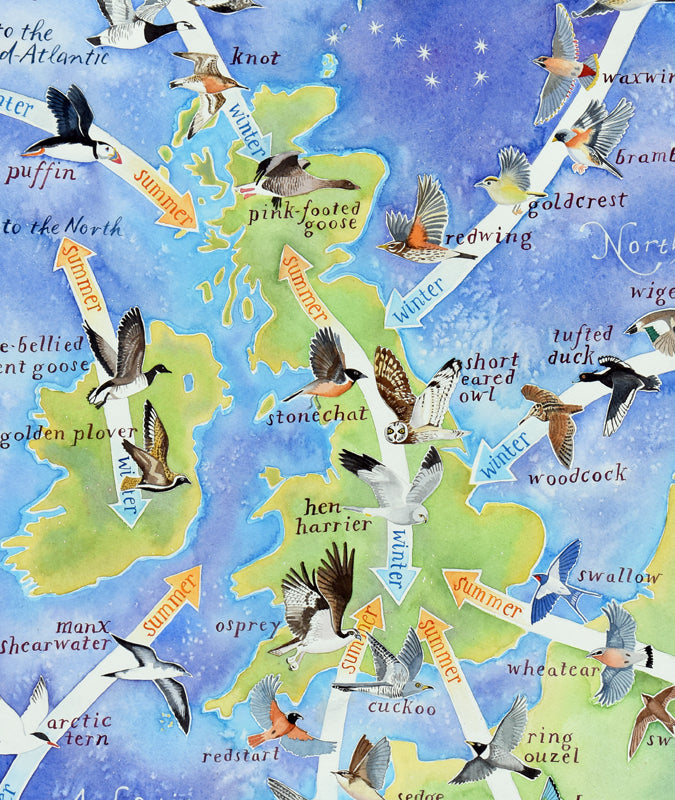
What Is a Sound Map?
A sound map is a mental picture of an area based on the sounds found there. Birds can notice which sounds are nearby, which are far away, and how those sounds change as they move.
A sound map may include:
- The calls of other birds
- Running water and ocean surf
- Wind over forests, grasslands, or mountain passes
- Insects, frogs, and other animals
- Urban sounds such as traffic or machinery
- Low-frequency sounds that travel long distances
This does not mean that every bird has a detailed sound map of its full route. The evidence is stronger for sound recognition, place memory, and acoustic cues than for a complete sound-only navigation system.
Birds often use sound in three ways:
- To recognize a familiar place
- To find nearby habitat
- To gather information about weather, terrain, and other animals
Sound can help a bird confirm its location. It usually does not provide the entire route by itself.
How Birds Use Sound During Migration
Birds use sound before, during, and after migration. The role of sound changes with the bird’s age, species, route, and environment.
1. Young birds learn local sounds
Many birds hear the sounds of their home area before their first migration. They learn the calls of their species, the sounds of predators, and the general sound pattern of their habitat.
Some young songbirds also learn songs from older birds. Song learning is not the same as learning a migration route, but it shows that birds can store complex sounds and use them later.
A bird may remember:
- The calls of its family or flock
- The songs of nearby adults
- The sound of a nesting area
- The background noise of forests, wetlands, or fields
This memory can help the bird identify a familiar place when it returns.
2. Birds recognize habitat by its sound
Different habitats have different sound patterns. A wetland may contain frogs, marsh birds, insects, and moving water. A pine forest has a different mix of wind, insects, and bird calls.
These patterns can act as acoustic habitat markers. A bird flying at night may not see much detail below it. Sound can still provide clues about what lies nearby.
For example, a bird may use the sound of:
- Surf to identify a coastline
- A river to find water or a valley
- Marsh birds to locate a wetland
- Other migrants to find a stopover area
This type of use is most likely when the bird is near a known place or a suitable habitat. Sound becomes less reliable in unfamiliar areas or when strong winds carry noise away from its source.
3. Calls help birds stay with a group
Many birds migrate in groups. Calls help them keep contact when visibility is poor, such as at night, in fog, or during heavy rain.
Contact calls can help a flock:
- Stay together
- Warn of danger
- Locate separated birds
- Coordinate movement
- Respond to changes in the group
Some night-migrating birds call while flying. These calls may help with social contact rather than direct navigation. A call does not always tell a bird where north or south is. It may simply help the group act as one.
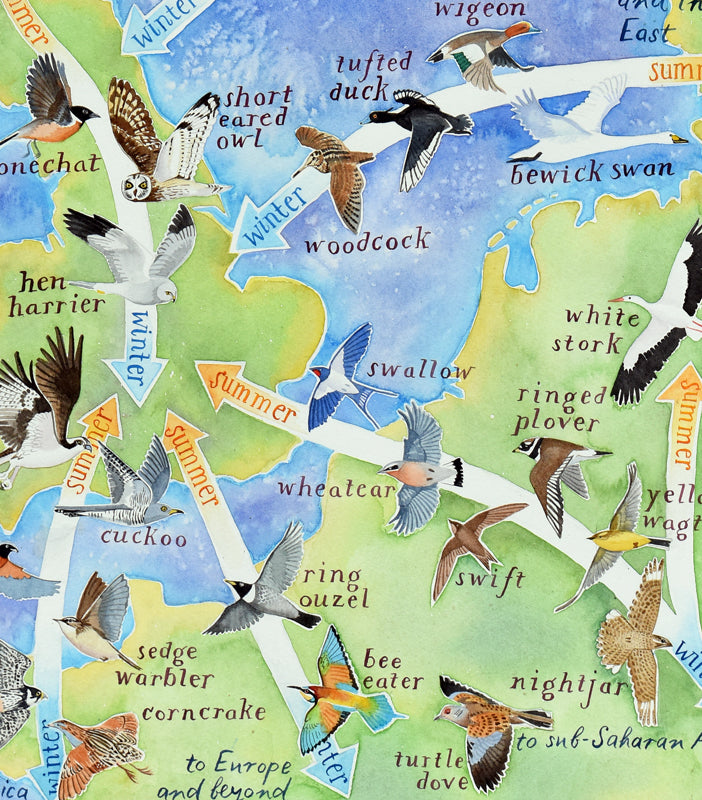
Do Birds Follow Sounds Like a GPS Signal?
No. Sound does not usually work like a GPS signal that gives a bird an exact position.
A sound source can be hard to locate because wind changes how sound travels. Mountains, trees, buildings, and water can reflect or block sound. Traffic and aircraft can also cover natural sounds.
Birds may solve part of this problem by comparing several clues at once. They can use:
- The direction of a sound
- How loud the sound is
- Changes in the sound as they fly
- The timing of repeated calls
- The sound’s relationship to visible landmarks
- Wind and magnetic information
This is similar to how a person finds a familiar place in a city. A person may hear a train, see a bridge, and notice a road sign. None of those clues gives the full answer alone. Together, they can identify the location.
Sound direction and distance
A bird has two ears, so it can compare the timing and loudness of a sound arriving at each side of its head. This helps it estimate direction.
A bird may also judge distance from changes in loudness and sound quality. These judgments are not exact. They work best when the bird already knows the area or when the sound source is strong.
Sound changes as birds move
A sound map is useful because the sound landscape changes along a route. A bird leaving a forest may hear fewer tree-dwelling species and more open-field sounds. Near a coast, surf may grow louder. Near a city, road noise may become stronger.
These changes can tell a bird that it is approaching a boundary or a familiar region.
What Other Navigation Tools Do Birds Use?
Bird migration depends on several systems. Sound is one possible cue, but it is not the main explanation for every migration route.
The Earth’s magnetic field
Many migratory birds can detect aspects of Earth’s magnetic field. This ability may help them sense direction and, in some cases, geographic position.
A magnetic compass can help a bird answer:
Which way should I travel?
A magnetic map may help answer:
Where am I?
These are different tasks. Research suggests that birds may use magnetic information with stars, landmarks, smell, and memory.
The stars and the Sun
Some birds use the night sky as a compass. Young birds can learn star patterns and use the rotation of the sky to identify direction.
During the day, birds may use the Sun and its position. Their internal body clock helps them account for the Sun’s movement across the sky.
Landmarks
Rivers, mountain ranges, coastlines, and cities can guide birds that fly during the day. Landmarks also help birds confirm that they are near a known stopover or breeding site.
Smell
Some birds use odors carried by the wind. A smell map may help them identify regions with different plants, soil, or water sources.
Wind
Wind can make migration easier or harder. Birds may choose routes with helpful winds and avoid strong headwinds. They can also use wind patterns to reduce energy use.
The best explanation is not that birds use one perfect system. They use a flexible set of clues. If clouds hide the stars, a bird may rely more on magnetic cues. If it reaches a familiar coastline, landmarks and sound may become more useful.
Is Infrasound Part of a Bird’s Sound Map?
Infrasound is sound below the normal lower limit of human hearing, usually below about 20 hertz. Some natural events produce infrasound, including ocean waves, storms, earthquakes, and volcanic activity.
Researchers have proposed that some birds may detect low-frequency sound during long-distance travel. In theory, infrasound could help birds sense large geographic features or distant weather systems.
However, this area needs care. Evidence that birds hear low-frequency sound does not prove that they use a detailed infrasonic map to cross a continent. The role of infrasound in bird migration remains less certain than the roles of magnetic sensing, celestial cues, landmarks, and learned behavior.
A careful summary is:
- Birds can hear a wide range of sounds.
- Natural low-frequency sounds can travel far.
- Some studies suggest that birds may respond to such cues.
- It is not established that most migratory birds use infrasound as a primary navigation system.
This distinction matters because popular articles sometimes present infrasound as a proven “GPS for birds.” Current evidence does not support such a broad claim.
How Human Noise Affects Migrating Birds
Human noise can change the sound maps that birds use. Roads, airports, construction sites, ships, and oil and gas activity can cover natural sounds or force birds to change their behavior.
Noise may cause birds to:
- Call more loudly
- Change the pitch of their calls
- Call less often
- Avoid noisy habitat
- Spend less time feeding
- Miss calls from mates or flock members
- Use more energy to stay in contact
These effects can matter during migration because birds need food and rest at stopover sites. A noisy area may still contain good food, but noise can make the habitat less useful if birds cannot hear danger, flock members, or other animals.
Artificial light creates a separate problem. Many birds migrate at night and can become disoriented by bright city lights. Noise and light may occur together, but they affect birds through different pathways.
People can reduce these risks by:
- Keeping outdoor lights off when they are not needed
- Using shielded lights that point downward
- Reducing loud noise near wetlands and migration stopovers
- Protecting quiet shoreline, forest, and grassland areas
- Supporting bird-safe building and city planning
The National Park Service and other conservation agencies treat natural sound as part of habitat quality. Quiet is not empty space for wildlife. It is information.
A Simple Example: How a Bird May Combine Sound Cues
Imagine a white-crowned sparrow moving south through the western United States.
The bird may begin with an inherited direction preference. It can also use the Earth’s magnetic field and the position of the stars. As it travels, it may recognize familiar habitat sounds, respond to calls from other birds, and use rivers or mountain ranges as landmarks.
If clouds hide the stars, the bird still has other options. If strong wind shifts sound, the bird can rely less on sound and more on magnetic or visual cues. If it reaches a known stopover area, local sounds may confirm that it has arrived.
This example is a model of combined navigation. It does not mean every white-crowned sparrow uses the same clues in the same way.
What Sound Maps Can—and Cannot—Explain
Sound maps can help explain why birds return to familiar areas, stay connected during flight, and recognize useful habitat. They may also explain how birds gather information when vision is limited.
Sound maps cannot, by themselves, explain all bird migration.
They do not fully answer:
- How a first-time migrant chooses a long-distance route
- How birds correct for wind over thousands of miles
- How birds identify their exact destination
- How inherited behavior and learning interact
- How navigation changes after storms or habitat loss
The answer differs by species. A duck, shorebird, songbird, crane, and seabird may use different cues because they fly through different environments.
Age also matters. Young birds may depend more on inherited direction rules. Older birds may use memory and familiar landmarks. A bird making its first migration does not have the same experience as an adult returning to a known nesting area.
Common Misconceptions About Bird Sound Maps
“Birds have a complete audio map in their brains.”
This has not been established for all birds. Birds can learn sounds and remember places, but scientists do not have evidence that every migrant stores a detailed audio map of its full route.
“A bird follows one sound from its nesting site to its wintering site.”
Long-distance routes usually involve many cues. A single river, call, or ocean sound is unlikely to guide a bird across an entire continent.
“Bird calls point birds in the right direction.”
Calls mainly support communication. They may help birds stay together or find one another. A call does not automatically function as a compass.
“Infrasound is proven to be the main migration guide.”
The possible role of infrasound is still being studied. It should be described as a proposed or partial cue, not a universal explanation.
“Human noise only matters in cities.”
Noise can affect birds in rural areas too. Roads, wind turbines, aircraft, boats, industrial sites, and energy facilities can change natural soundscapes far from large cities.
How Scientists Study Sound and Migration
Researchers use several methods to test whether sound affects migration.
Playback experiments
Scientists play recorded sounds and observe whether birds change their behavior. They may test bird calls, habitat sounds, traffic noise, or other signals.
A change in behavior does not always prove that the sound guides migration. It may show alarm, attraction, confusion, or social interest.
Tracking devices
Radar, GPS tags, radio transmitters, and geolocators help researchers compare flight paths with sound exposure and habitat features.
Small songbirds often cannot carry the same devices as large birds. Device weight, battery life, and location accuracy affect the results.
Orientation tests
In controlled settings, researchers measure the direction birds try to fly. They can change the magnetic field, block stars, add sound, or alter light conditions.
These tests help isolate one cue, but they may not perfectly represent the choices a bird makes in the wild.
Field sound recordings
Researchers record natural and human-made sound at nesting sites, stopover sites, and wintering areas. They then compare sound patterns with bird presence, feeding, calls, and movement.
Together, these methods show that sound matters in bird behavior. They also show why it is difficult to claim that sound alone controls migration.
The Best Answer in One Sentence
Birds use sound maps by recognizing natural and social sound patterns, comparing those sounds with other navigation cues, and using the combined information to locate familiar places, stay with groups, and choose suitable habitat during migration.
Frequently Asked Questions
Do birds migrate by following bird calls?
Usually, bird calls help with contact and group behavior rather than provide a complete route. Calls can help birds stay together and locate one another, especially in darkness or poor visibility.
Can birds hear rivers or oceans from far away?
Sometimes. Water and surf can produce strong sounds, but the distance depends on wind, terrain, background noise, and the loudness of the source. A bird may use these sounds as local clues rather than as a constant long-distance guide.
Do all migrating birds use sound in the same way?
No. Species differ in hearing ability, habitat, migration distance, age, and learning. A shorebird near the coast may use different sound cues from a songbird crossing the Great Plains.
Does city noise stop birds from migrating?
Not always. Many birds still migrate through or near cities. However, noise can change calling, feeding, habitat use, and flock contact. Artificial light can add a separate risk for birds flying at night.
What is the strongest navigation cue for migratory birds?
There is no single strongest cue for every species. Birds may combine magnetic sensing, stars, the Sun, landmarks, smell, wind, memory, and sound. The balance changes with weather, age, location, and experience.
Key Takeaways
- A sound map is a mental record of sounds linked to places and habitats.
- Birds may use calls, surf, rivers, wind, insects, and other natural sounds as local clues.
- Sound helps birds recognize areas and stay in contact, but it is not usually a complete navigation system.
- Birds combine sound with magnetic, visual, celestial, olfactory, and wind cues.
- Infrasound may play a role in some cases, but its importance remains uncertain.
- Human noise can disrupt communication and reduce the value of important stopover habitat.
- The most accurate view is that bird migration uses several overlapping navigation systems.
Conclusion
Birds use sound as part of a larger navigation toolkit. A familiar soundscape can tell a bird that it is near a river, coast, forest, wetland, flock, or nesting area. It can also help birds communicate when vision fails.
Sound alone is not a proven GPS-like map for migration. Birds make better use of it when they combine it with magnetic information, stars, landmarks, smell, wind, and memory. Protecting quiet natural areas therefore helps preserve more than peace for people—it protects information that birds may need while they travel.