How Do Birds Feet Not Freeze: The Cold-Weather Secret
Introduction
Birds across the United States, from Canada geese on frozen ponds to chickadees in snowy backyards, often stand on ice or cold ground without damaging their feet. They can do this because their legs and feet use a special heat-saving system called countercurrent heat exchange.
This system keeps warm blood from losing all its heat before it reaches the feet. Birds can also reduce blood flow to their feet, tolerate very cold tissue, and use feathers, fat, behavior, and shelter to limit heat loss. Their feet may become extremely cold, but the tissue usually stays above the point where ice crystals form.
The key point is simple: birds do not keep their feet as warm as the rest of their bodies. Instead, they control heat loss and protect the vital parts of the foot from freezing.

The Main Reason Birds’ Feet Do Not Freeze
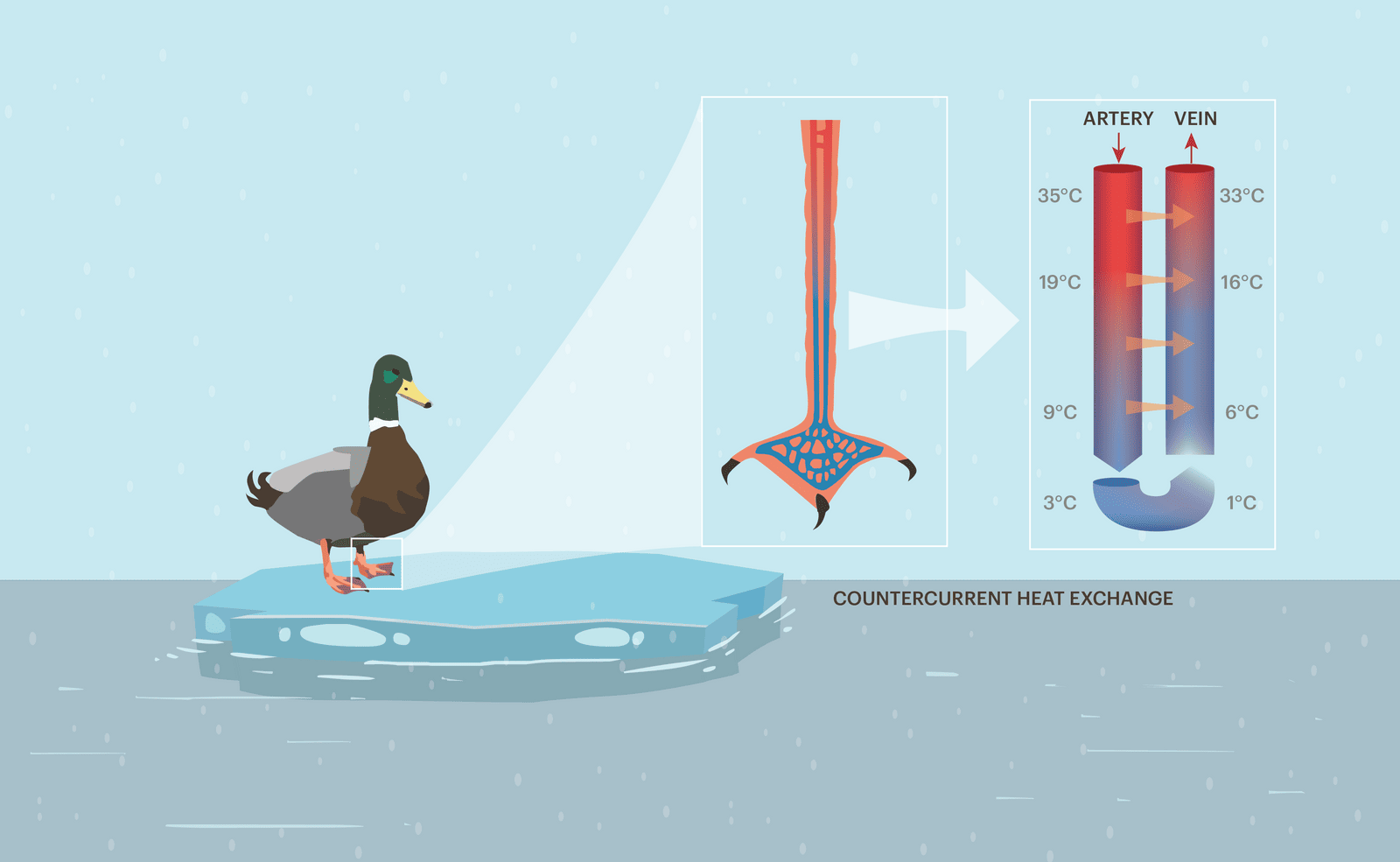
Birds’ feet avoid freezing because arteries and veins in their legs lie close together and exchange heat. Warm blood flowing down toward the foot transfers some of its heat to colder blood returning to the body.
This arrangement works like a built-in heat exchanger:
- Warm blood leaves the bird’s warm body core.
- It travels down an artery toward the foot.
- Cold blood rises through nearby veins.
- Heat moves from the warm artery to the cold veins.
- Blood returning to the body is warmed before it reaches the core.
- Blood arriving at the foot is cooler, so the foot loses less heat.
This process is called countercurrent heat exchange because the blood in the artery and vein flows in opposite directions.
The system creates a temperature gradient along the leg. The upper leg is warmer, while the foot may be close to the temperature of the surrounding air or ice. That lower foot temperature reduces the difference between the bird’s tissue and the cold surface. As a result, the foot loses heat more slowly.
Research on bird thermoregulation, including classic work by Per Scholander and later studies of water birds, established countercurrent exchange as a major way birds conserve heat. The system is also found in some mammals, such as Arctic foxes and marine mammals, although the structure differs among species.
Why cold feet help
Heat flows faster when the temperature difference is large. A foot at body temperature would lose heat rapidly when placed on snow or ice. A very cold foot loses heat much more slowly.
This may seem uncomfortable, but it is useful. The bird protects its warm body while allowing its feet to become cold. The feet function more like controlled thermal buffers than miniature warm hands.

How Countercurrent Heat Exchange Works in a Bird’s Leg
The heat exchange system depends on close contact between blood vessels. In many birds, arteries carrying warm blood from the body run beside veins carrying cold blood back from the foot.
Because the vessels are close, heat can pass through their walls. The blood does not need to reach the foot at full body temperature. It gives up part of its heat before arriving there.
A simplified example helps:
- Blood leaving the body may be about 104°F, close to the bird’s core temperature.
- As it moves down the leg, it transfers heat to returning blood.
- Blood reaching the foot is much cooler than core blood.
- Returning blood is warmed before it reaches the body.
These temperatures vary by species, weather, blood flow, and activity. The example is only a model, not a universal measurement for every bird.
The exchange is most effective when the blood vessels run close together and when blood flow is controlled. Birds can change circulation in the legs based on temperature and activity. When the risk of heat loss rises, they may reduce blood flow to the feet. When they need to warm the tissue, blood flow can increase.
This system does not make a bird’s feet immune to cold injury. It lowers heat loss and helps prevent freezing under normal conditions.
Bird Feet Are Built to Lose Heat
Bird feet have several features that make cold survival possible.
Little muscle and fat in the lower foot
Most of a bird’s lower leg and foot contains tendons, bones, skin, and limited soft tissue. It has less muscle and fat than the body core. That means the foot has less warm tissue to protect and less heat-producing tissue to cool.
The lower foot is also narrow. A narrow part has less volume compared with its surface area, so it can cool quickly. This may sound harmful, but it helps keep cold away from the body.
Scales provide a tough outer layer
Many bird feet are covered with scales made largely of keratin. Keratin is the same tough protein found in feathers, claws, and human fingernails.
Scales do not act like thick winter boots. They provide a durable barrier against abrasion, water, and rough ice. They also reduce direct exposure of delicate tissue.
The foot may be cold without being frozen
A bird’s foot can feel cold to the touch and still be healthy. Cold is not the same as freezing.
Freezing occurs when ice crystals form within or around cells. Ice crystals can damage cell membranes and blood vessels. Birds avoid this in normal conditions by controlling blood flow and maintaining enough internal water and solute balance to keep tissue from freezing.
In some cold-adapted birds, natural compounds in body fluids may also help lower the temperature at which ice forms. The exact contribution differs by species and is not equally understood in all birds.

Do Birds’ Feet Ever Freeze?
Yes. Birds can suffer frostbite, especially during severe weather or when other stressors are present.
The risk rises when a bird is exposed to:
- Very low temperatures for long periods
- Wet feathers or wet feet
- Strong wind
- Ice or snow that remains in contact with the foot
- Poor nutrition or dehydration
- Illness or injury
- Restricted blood flow
- Traps, fishing line, or tight material around the leg
- Human-made surfaces that conduct heat away quickly
Frostbite often affects toes, webbing, and other exposed areas first. In serious cases, tissue may become pale, gray, black, swollen, or hard. Damage may not appear fully until the tissue begins to warm.
People should not rub a suspected frostbitten foot or apply direct heat. Rubbing can damage injured tissue, while heating pads, hair dryers, and hot water can cause burns. If a wild bird appears injured, immobile, or unable to use a foot, contact a licensed wildlife rehabilitator or a local wildlife agency.
Birds may also suffer cold stress without frostbite. A bird that remains puffed up, sits on the ground, closes its eyes, or fails to fly may need help. Do not handle a wild bird unless a wildlife professional advises you to do so.

How Birds Control Blood Flow to Their Feet
Countercurrent exchange works together with circulation control. Birds do not send the same amount of warm blood to their feet in every condition.
When a bird is losing too much heat, blood vessels in the legs can narrow. This response is called vasoconstriction. It reduces blood flow near the surface and limits heat loss.
When the bird needs more heat in the foot, vessels can widen. This is called vasodilation. Increased blood flow can deliver more heat and oxygen to cold tissue.
Birds also shift their posture. A bird may:
- Stand on one foot while pulling the other into its feathers
- Tuck both feet under its body
- Sit on its belly or breast
- Fluff its body feathers
- Face away from strong wind
- Move to a sheltered branch or dense shrub
These actions protect the feet without requiring the bird to keep them warm all the time.
Ducks and other water birds often have an additional advantage: their bodies are insulated by dense feathers and body fat, while their legs and feet remain relatively thin. Some species also reduce blood flow when swimming in cold water.

Why Water Birds Can Stand on Ice and Swim in Cold Water
Water birds provide some of the clearest examples of cold-adapted feet. Ducks, geese, swans, gulls, and other species may walk on ice or swim in cold water without rapidly losing body heat.
Their legs use countercurrent exchange to reduce heat transfer between the body and the environment. Warm blood traveling down the leg gives heat to cold blood moving upward. This keeps the body’s core warmer while allowing the foot to remain cold.
Webbed feet also have a large surface area. That can increase heat loss, but the blood-vessel system helps offset the problem. In addition, the foot is not maintained at the same temperature as the chest or abdomen.
The arrangement is not free of cost. Cold feet may have less muscle performance and slower nerve responses. A bird may therefore move more carefully or limit the time it spends in extreme cold.
A bird standing on ice is also not necessarily comfortable. It is surviving through an efficient trade-off: cold feet and a warm core are safer than warm feet and a rapidly cooling body.

Why Birds Do Not Use Their Feet Like Mammals Use Their Hands
Bird feet are not designed to maintain the same temperature as human hands or dog paws. Birds use their feet mainly for perching, walking, swimming, climbing, and grasping.
Most birds do not need fine touch or high muscle performance in their toes during cold exposure. Reducing foot temperature is therefore less costly than allowing the body core to cool.
Perching birds can also limit contact with cold surfaces. A chickadee may grip a branch, tuck one foot into its feathers, and alternate feet. A large bird may stand with both feet on the ground but shift weight and reduce the time spent in exposed positions.
Some birds have feathers extending down the legs, while others have mostly bare legs. Feather coverage helps, but it is not the main explanation for cold feet. The vascular heat-exchange system is more important in many species.

Do All Birds Handle Cold the Same Way?
No. Cold tolerance varies widely among bird species, individuals, and conditions.
A bird’s ability to cope with cold depends on:
| Factor | Why it matters |
|---|---|
| Species | Different birds have different leg structures, insulation, and circulation |
| Body size | Larger birds often lose heat more slowly relative to body mass |
| Habitat | Birds from cold regions may have stronger cold adaptations |
| Water exposure | Wet feathers and feet can increase heat loss |
| Wind | Moving air strips heat from exposed tissue |
| Food supply | Food provides energy for heat production |
| Health | Illness and injury can reduce circulation and body reserves |
| Acclimation | Birds may adjust to seasonal cold over time |
| Shelter | Dense plants, cavities, and roosts reduce wind and heat loss |
A healthy winter-adapted bird can tolerate conditions that would be dangerous for a weakened bird of the same species. Young birds, injured birds, and birds affected by starvation are more vulnerable.
Birds also differ in their use of torpor. Some small North American birds, including certain hummingbirds, can lower body temperature at night to save energy. Torpor is a whole-body response and is separate from the heat-exchange system in the feet.

Common Myths About Birds’ Feet in Winter
Myth: Birds’ feet are always warm
They are not. A bird’s feet may be far colder than its body. The goal is not to keep the feet warm; the goal is to keep the vital organs warm.
Myth: Birds have antifreeze in their feet
Birds do not have automotive antifreeze. Some species may have body-fluid adaptations that help resist freezing, but this is not a simple chemical antifreeze system.
Myth: Ice cannot hurt a bird’s feet
Ice can cause injury. Prolonged exposure, wet conditions, poor health, and restricted circulation can lead to frostbite.
Myth: Birds never feel cold
Birds can sense cold and respond to it. They may tuck their feet, fluff their feathers, seek shelter, reduce activity, or change blood flow.
Myth: Bird feet freeze because they lack nerves
Bird feet contain nerves and can sense touch, pressure, and temperature. Cold may reduce nerve function, but it does not mean the feet are numb under all conditions.

How to Help Birds During Severe U.S. Winter Weather
Most healthy wild birds do not need people to warm their feet. The best help is usually access to food, water, and shelter.
You can support backyard birds by:
- Offering suitable bird food in a clean feeder
- Keeping feeders dry and free of spoiled food
- Providing dense native shrubs or evergreen cover
- Removing fishing line, string, and plastic from the yard
- Keeping cats indoors or using safe outdoor enclosures
- Replacing frozen drinking water when practical
- Avoiding salt, chemicals, and antifreeze near bird areas
- Contacting a licensed wildlife rehabilitator about an injured bird
Do not place a wild bird near a heater, use a heating pad, or pour warm water over its feet. Sudden warming can worsen tissue damage, and improper handling can cause stress or injury.
If a bird is trapped in ice, tangled, bleeding, unable to stand, or showing signs of frostbite, seek professional wildlife help. In the United States, state wildlife agencies and licensed wildlife rehabilitators are the appropriate sources for case-specific guidance.

Key Takeaways
- Birds’ feet do not stay as warm as their bodies.
- Countercurrent heat exchange transfers heat between nearby arteries and veins.
- Warm blood going down the leg preheats cold blood returning to the body.
- Birds can reduce blood flow to their feet and tuck them into feathers.
- Scales, low tissue volume, posture, and insulation also reduce heat loss.
- Birds can still develop frostbite in extreme or unhealthy conditions.
- Cold feet are normal; blackened, swollen, injured, or unusable feet are not.
Frequently Asked Questions
How cold can a bird’s feet get?
The exact temperature depends on the species, weather, blood flow, and surface. In cold conditions, a bird’s feet may approach the temperature of the surrounding air or ice while the body core remains much warmer. There is no single safe foot temperature for all birds.
Why do ducks not get frostbite on ice?
Ducks use countercurrent heat exchange in their legs. This reduces the amount of body heat sent into the feet and limits heat loss from the body. Their feet can become very cold without normally freezing.
Do birds feel pain in their feet when standing on snow?
Birds can sense cold, pressure, and pain. They may tolerate cold feet because their circulation and behavior protect the body core, but extreme exposure can still cause discomfort and tissue injury.
Should I warm a bird’s frozen feet?
No. Do not rub the feet or apply direct heat. Place the bird only where a wildlife professional directs you, and contact a licensed wildlife rehabilitator or state wildlife agency for instructions.
Why does a bird stand on one foot in winter?
Standing on one foot lets the bird pull the other foot into its warm body feathers. Birds may switch feet to limit heat loss while keeping balance and staying alert.
Conclusion
Birds’ feet do not freeze easily because their bodies use heat exchange, blood-flow control, protective scales, and smart behavior. The feet can become cold while the bird’s core stays warm.
This system works best when the bird is healthy, dry, well fed, and able to move or find shelter. It is powerful but not perfect. Severe cold, wind, wet conditions, illness, and injury can still cause frostbite.
When watching birds in a U.S. winter, cold feet are usually part of normal survival. A bird that cannot stand, fly, or use a foot is different. In that case, leave direct treatment to a licensed wildlife professional.