How Do Migratory Birds Navigate: Nature’s GPS Explained
Migratory birds navigate across the United States and beyond by combining several tools. They use the Earth’s magnetic field, the Sun, stars, landmarks, smells, weather patterns, memory, and inherited travel routes. No single system explains every trip.
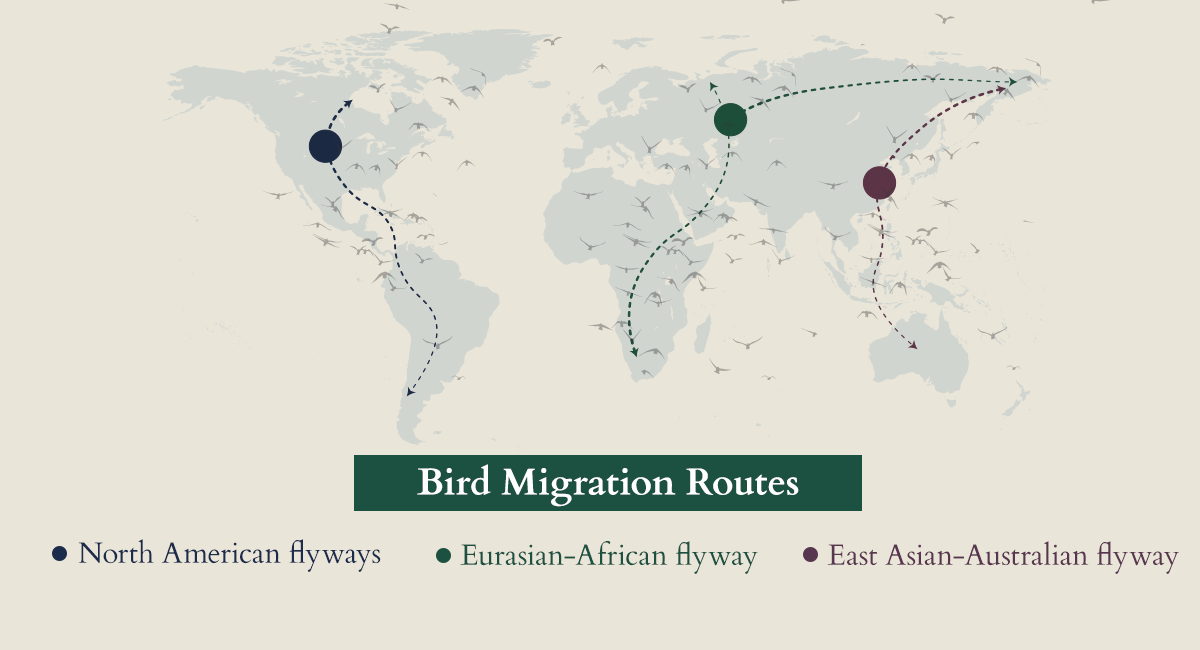
A bird may use one cue over the Gulf of Mexico, another near the Appalachian Mountains, and several cues together when it reaches an unfamiliar stop. This flexible system helps species such as ruby-throated hummingbirds, Arctic terns, warblers, geese, and shorebirds travel thousands of miles with remarkable accuracy.

What does bird navigation mean?
Bird navigation is the process of finding and following a route between breeding grounds, wintering areas, and stopover sites. Migration is the seasonal movement itself. Navigation is how a bird knows where it is, where it must go, and how to correct its course.
Birds must solve two related problems:
- Direction: Which way should I fly?
- position: Where am I, and how far am I from my destination?
A compass can provide direction, but it does not always show a bird its exact location. Birds appear to solve the larger problem by combining compass cues with maps built from landmarks, smells, sound, and past experience.
Young birds may begin with an inherited direction and distance program. Older birds often improve their routes through learning and memory.
How do birds use the Earth’s magnetic field?
The Earth’s magnetic field gives many migratory birds a compass. It can also provide map-like information about location, but scientists are still studying the exact way birds sense and use all magnetic cues.
Magnetic compass
A bird’s magnetic compass helps it detect direction. Unlike a pocket compass, this system does not depend on a visible needle. Research suggests that some birds sense magnetic direction through light-sensitive proteins in the eye, while other birds may detect magnetic information through structures linked to the nervous system.
The magnetic compass in many birds is inclination-based. This means birds may sense the angle at which magnetic field lines enter the Earth rather than simply reading magnetic north. That angle changes with latitude.
For example, the magnetic field near the equator differs from the field farther north. A bird may use these changes as part of a broad geographic map.
Magnetic map
A magnetic map may help birds estimate their position. Earth’s magnetic field changes across space in several ways, including:
- Magnetic intensity
- Field angle, or inclination
- The difference between magnetic north and true north
- Local magnetic features
Birds may compare these values with information learned during earlier trips. The map is not thought to work like a precise road map. It is more like a set of broad signals that helps a bird detect whether it is north, south, east, or west of its expected route.
The strength and limits of this ability can vary by species, age, weather, and location.
How do the Sun and stars guide migrating birds?
The Sun provides both a daytime compass and a way to estimate time. Stars provide a nighttime compass, especially for birds that migrate after dark.
The Sun compass
A bird can use the Sun’s position to maintain a general direction. Since the Sun moves across the sky during the day, the bird must also use an internal clock. This clock helps it adjust for the changing position of the Sun.
This system is called a time-compensated Sun compass. A bird that flies east in the morning must account for the Sun’s movement later in the day. Without time compensation, the bird’s course would slowly shift.
Birds may also use:
- The angle of sunlight
- Changes in light near sunrise and sunset
- Shadows and brightness
- Polarized light patterns in the sky
Polarized light is especially useful near dawn and dusk. It can help birds detect the Sun’s position even when the Sun is low or partly hidden by clouds.
The night sky
Many songbirds migrate at night. They can use star patterns to maintain direction, particularly when the sky is clear.
Young birds do not appear to memorize every star. Instead, studies suggest that they learn the general pattern of the night sky. They may recognize the center of the sky’s rotation and use that pattern as a directional guide.
The North Star can help indicate north in the Northern Hemisphere, but birds likely use a wider pattern of stars rather than relying on one star alone.
Light pollution can make this task harder. Bright city skies may hide stars and change the visual environment used by night-flying birds.
Do birds use landmarks, smells, and sound?
Yes. Birds use environmental clues, but the importance of each clue depends on the species and the stage of migration.
Landmarks
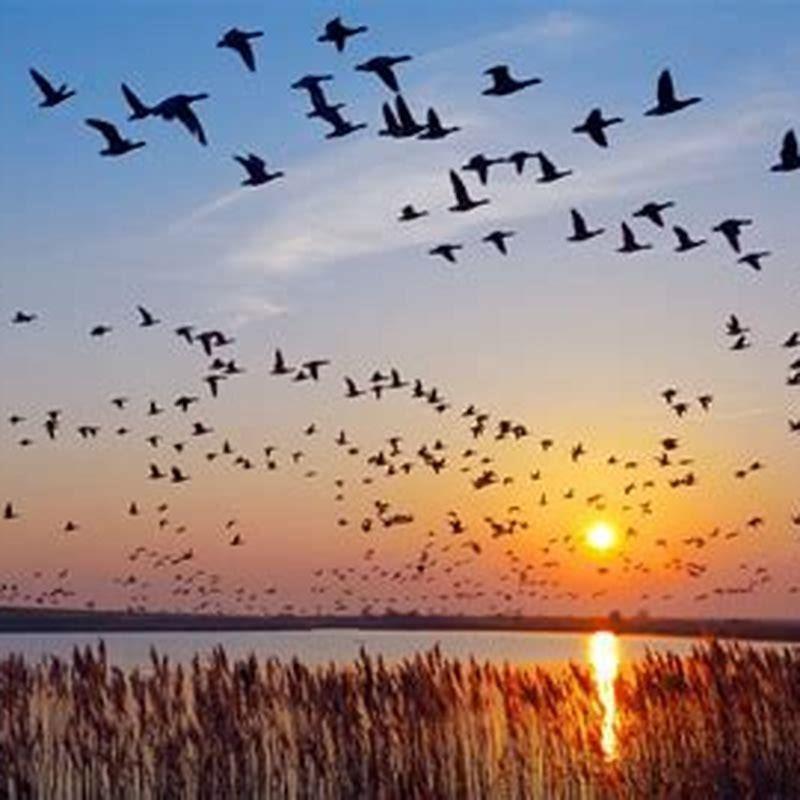
Mountains, rivers, coastlines, forests, wetlands, and large cities can help birds stay on course. These features are especially useful during the day and during the final part of a journey.
A bird flying along the Atlantic coast may use the shoreline as a broad guide. A bird crossing the central United States may follow river valleys, mountain ranges, or familiar grasslands.
Landmarks can also help birds locate food and safe resting areas. A route is not only a line between two points. It includes places where a bird can stop, feed, and avoid danger.
Smell
Some birds appear to use odors as geographic clues. Wind carries chemical signals from forests, oceans, soil, and vegetation. A bird may learn that a certain mix of smells is linked to a particular region.
This may explain why some birds can return to a familiar breeding site even when visual landmarks are limited. Smell is unlikely to guide every species in the same way, but research supports its role in the navigation of at least some birds.
Sound
Sound can help birds recognize places. Wetlands, forests, coastlines, and urban areas each have distinct sound patterns. Birds may also use calls from other birds to locate suitable habitat.
Sound is most useful at close or moderate range. It is less likely to provide a complete guide across an entire continent.

How do young birds learn a migration route?
Young birds often start with an inherited program, then refine it through experience. This mix of instinct and learning explains why some first-time migrants can travel far without adult guidance, while older birds often take more precise routes.
Inherited direction and distance
Many young birds appear to inherit a basic migration program. It may include:
- A preferred direction
- A travel season
- A rough distance
- A period of restlessness before migration
This behavior is sometimes called zugunruhe, a German term for migratory restlessness. A young bird may become active at the proper season and show a strong urge to move in a particular direction.
The inherited program is not always a fixed route. It may act more like a rough plan. Weather, food, habitat, and obstacles can change the final path.
Learning from experience
Older birds can learn:
- Reliable stopover sites
- Local wind patterns
- Mountain passes
- Safe water crossings
- Food-rich habitats
- Routes with fewer predators or hazards
Some birds travel with parents or other adults and may copy parts of the route. In species that migrate alone at night, birds may learn through repeated trips and gradual correction.
Why routes can differ within one species
Not every bird in a species follows the same path. Route choice may depend on:
- Age
- Sex
- Population
- Weather
- Wind
- Food supply
- Breeding location
- Wintering location
- Previous migration experience
A bird that breeds in Minnesota may use a different route from one that breeds in Georgia, even if both belong to the same species.
How do birds use weather during migration?
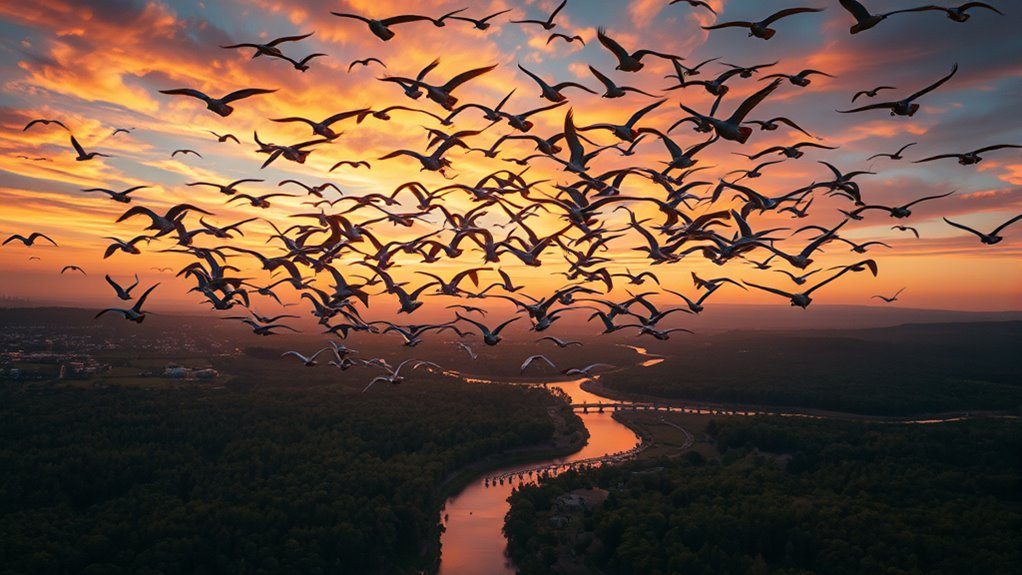
Weather can help or hinder migration. Birds do not simply ignore wind. Many choose conditions that reduce energy use and improve travel speed.
Wind
A tailwind pushes a bird toward its destination. A headwind slows the bird and raises the energy cost of flight. Birds may wait for favorable winds before beginning a long crossing.
Some birds also change altitude to find better winds. Wind direction and speed can vary greatly between the ground and higher air layers.
Temperature and pressure
Weather fronts can create useful winds and rising air. Large birds, such as hawks, eagles, vultures, and storks, may use thermals. These are columns of warm rising air that help soaring birds gain height with less flapping.
Small songbirds may migrate ahead of a cold front when winds are favorable. They may stop when rain, storms, or strong headwinds make travel unsafe.
Clouds and storms
Clouds can block the Sun and stars. Storms can force birds off course, cause exhaustion, or push them over open water. Birds may respond by:
- Delaying departure
- Changing altitude
- Changing direction
- Landing early
- Following a coastline
- Using magnetic cues when visual cues are weak
Bad weather does not always cause a disaster. Many birds can correct their course after conditions improve. However, severe storms can increase deaths, especially when birds are already tired or flying over areas with few safe landing sites.

How do birds correct their course?
Birds can adjust their route when wind or weather pushes them away from the normal path. This ability is called compass compensation or drift compensation.
A bird may sense that it has moved too far east or west and change its heading. It may use magnetic information, landmarks, wind cues, or a known geographic feature to correct the error.
Correction is easier when the bird has a clear reference point. A coastline, mountain range, or river can reveal that the bird has drifted. Over the open ocean, the bird may depend more heavily on its magnetic compass, Sun, stars, and wind.
Birds do not always return to the exact line of the original route. They may choose a safer or more efficient path after being displaced.
Can birds navigate over the ocean?
Yes. Some birds cross large areas of open water with few visible landmarks. They may combine magnetic information, the Sun, stars, wind, and memory.
The Atlantic Ocean is a major challenge for birds that travel between North America and the Caribbean, Central America, and South America. The Gulf of Mexico is also an important migration barrier for many birds moving between the United States and Latin America.
Before crossing open water, birds may build fat reserves. During the crossing, they must manage energy, wind, dehydration, and the risk of storms. A favorable wind can shorten the trip. A strong headwind can make the same crossing far more demanding.
Birds that cross the ocean are not guaranteed to fly in a straight line. Their path may bend with wind or change as they respond to weather.

What happens when artificial light disrupts bird navigation?
Artificial light can disorient nocturnal migrants. Bright buildings, stadiums, towers, and city skies may attract or confuse birds during night flight.
This creates several risks:
- Birds may circle lights and waste energy.
- Birds may collide with glass buildings.
- Birds may leave a normal route.
- Birds may stop in poor habitat.
- Birds may become more exposed to predators.
In the United States, reducing unnecessary outdoor light during peak migration can help. Practical steps include:
- Turn off nonessential lights at night.
- Close blinds during migration periods.
- Use motion sensors instead of lights that stay on.
- Aim outdoor lights downward.
- Choose shielded fixtures.
- Reduce bright lighting near glass buildings.
Programs such as Lights Out encourage cities and building owners to reduce nighttime lighting during migration. These steps do not control every danger, but they can reduce avoidable collisions and confusion.

How do scientists study bird navigation?
Scientists study bird navigation with field observations, tracking tools, laboratory tests, and long-term banding data.
Common methods include:
| Method | What it can show | Main limit |
|---|---|---|
| Bird banding | Return locations and survival records | Only gives data when a bird is found or reported |
| Radio or satellite tracking | Detailed routes and timing | Devices can be costly and may affect the bird if too heavy |
| Geolocators | Broad movements over long periods | The bird must be recaptured to download some data |
| Radar | Large-scale migration flow | Radar may not identify each bird’s species |
| Orientation cages | Directional preferences under controlled conditions | Cage behavior may not match free flight |
| Genetic studies | Differences among populations | Genes do not reveal every daily route |
| Weather models | Wind and storm effects | Models may not capture each bird’s choices |
Researchers may also test how birds respond when scientists alter magnetic fields, change star patterns, block odors, or place birds in unfamiliar locations.
No single test explains the whole process. Bird navigation is a system, so the strongest findings come from several methods used together.

Do all migratory birds navigate in the same way?
No. Navigation differs among species, populations, and individuals.
A soaring hawk may rely heavily on thermals and mountain ridges. A warbler migrating at night may use stars, magnetic cues, and inherited direction. A seabird may use wind, smell, waves, and ocean features. A goose may follow learned landmarks and social groups.
Even within one species, young birds and adults may use different strategies. A young bird may follow an inherited compass direction. An adult may use a familiar route and known stopover sites.
The best answer is therefore not that birds use one special sense. They use a navigation toolkit. The tools change with habitat, weather, time of day, and past experience.
Common myths about migratory bird navigation
Myth: Birds follow one fixed line each year
Birds often return to the same broad region, but daily routes can shift. Wind, storms, food, habitat loss, and human structures can alter the path.
Myth: Birds navigate only by instinct
Some navigation is inherited, but experience matters too. Older birds can learn stopover sites and improve their route choices.
Myth: The magnetic field acts like a GPS signal
The magnetic field can provide directional and location clues, but it does not work exactly like a satellite navigation system. Birds combine it with other information.
Myth: Birds always fly south for winter
Many birds move south, but migration can also be northward, eastward, westward, uphill, downhill, or along a coast. Some species make short movements within the United States.
Myth: A bird that is blown off course cannot recover
Many birds can compensate for drift and regain a useful route. Severe weather can still cause major problems, especially over open water.

How can people help migrating birds in the United States?
The most useful steps are simple: protect habitat, reduce night lighting, prevent window collisions, and provide safe food and water.
Homeowners can:
- Keep cats indoors, especially during migration.
- Place bird feeders away from windows or very close to them.
- Add window screens, external shades, or collision markers.
- Turn off outdoor lights at night.
- Plant native trees, shrubs, and flowers.
- Avoid pesticides when possible.
- Keep fresh water clean and shallow.
- Leave leaf litter and natural cover where safe.
Do not assume that a feeder alone solves migration risks. A bird still needs safe habitat, clean water, shelter, and protection from glass and predators.
If you find an injured migratory bird, avoid feeding it or giving it water unless a licensed wildlife rehabilitator tells you to do so. Place the bird in a ventilated box lined with a soft towel, keep it warm and quiet, and contact a licensed wildlife rehabilitator or state wildlife agency.
Frequently Asked Questions
How do birds know when to migrate?
Birds respond to changes in daylight, temperature, food, hormones, and internal biological rhythms. Day length is a major seasonal signal for many species. These signals can trigger migratory restlessness before the journey begins.
Do birds follow other birds during migration?
Some birds migrate in groups and gain useful information from adults or flock members. Geese, cranes, and many waterfowl may use social learning. Other birds, including many songbirds, migrate alone or at night and rely more on inherited behavior and personal experience.
Can birds get lost during migration?
Yes. Storms, strong winds, artificial light, habitat loss, and unfamiliar landscapes can push birds off course. Many recover, but some become exhausted, collide with structures, or reach unsuitable habitat.
Do birds use GPS?
Birds do not use human-made GPS receivers as a natural sense. GPS devices can track birds when researchers attach a suitable transmitter, but the bird’s own navigation system depends on natural cues such as magnetic fields, light, landmarks, smells, and memory.
How far can migratory birds travel?
Distances vary widely. Some birds move only a few miles between seasonal habitats. Others travel thousands of miles between the United States and Central or South America. The total distance depends on the species, population, breeding site, wintering site, and number of stopovers.
Why do some birds migrate at night?
Night travel can reduce heat stress and exposure to some predators. Cooler air may also help small birds manage energy. Clear stars and a stable magnetic compass can provide useful navigation cues.
Key Takeaways
- Migratory birds use several navigation systems at once.
- The Earth’s magnetic field provides important direction and location clues.
- The Sun and stars act as natural compasses.
- Landmarks, smells, sounds, wind, and memory help refine the route.
- Young birds often begin with inherited directions and distances.
- Older birds can learn better routes and safer stopover sites.
- Weather and artificial light can change migration success.
- Different species use different combinations of cues.
- Protecting habitat and reducing nighttime light can help birds migrate safely.
Conclusion
Migratory bird navigation is a flexible system, not a single built-in device. Birds blend inherited behavior with magnetic sensing, celestial cues, environmental signals, weather awareness, and memory.
For birds traveling across the United States, this combination turns a difficult journey into a series of decisions. The next time you see a warbler in a backyard, a goose over a river, or a hawk riding a thermal, remember that its route depends on both ancient biological tools and the changing landscape below.