How To Describe Birds Flying In Creative Writing: Tips
To describe birds flying in creative writing, combine clear motion, sensory detail, body language, and mood. Show how the bird moves through the air instead of simply saying it “flew.” A hawk may circle over an Arizona canyon, while a gull may tilt above an Atlantic beach or a sparrow may burst from a city park in Chicago. The setting, species, weather, and viewpoint should shape every word.
A strong description answers four simple questions:
- How does the bird move?
- What does the bird’s body do?
- What does the observer see or hear?
- What feeling does the flight create?

Choose a Flight Pattern Before You Choose Your Words
The best bird-flight descriptions begin with a specific flight pattern. “Flying” is a broad action. Birds may glide, soar, hover, flap, dive, drift, dart, or rise on warm air.
Bird anatomy supports these differences. Wing shape, body size, and tail structure affect how a bird moves. For example, broad-winged birds often use rising air to soar, while small songbirds may use quick wingbeats to cross short gaps.
Use the flight pattern that fits the bird and the scene.
| Flight pattern | What the bird does | Useful verbs |
|---|---|---|
| Flapping | Beats its wings to gain or maintain movement | beat, pump, flap, drive, paddle |
| Gliding | Travels with little or no wing movement | glide, coast, slide, skim |
| Soaring | Gains height by using rising air | circle, spiral, climb, wheel |
| Hovering | Stays nearly in one place | hover, hang, hold, tremble |
| Diving | Drops quickly through the air | dive, plunge, drop, spear |
| Darting | Moves fast with sudden changes in direction | dart, zip, bolt, streak |
| Drifting | Moves slowly with the wind | drift, float, wander, sail |
| Banking | Tilts its body while turning | bank, tilt, lean, roll |
| Landing | Slows and reaches for a surface | descend, settle, alight, touch down |
Match the verb to the bird
A turkey vulture does not usually “zip” across the sky. A hummingbird can “hover” near a flower. A falcon can “plunge” toward prey. A goose can “paddle” through the air with slow, strong wingbeats.
The verb should reveal the bird’s size, strength, speed, and purpose.
The red-tailed hawk circled above the Kansas field, its wings spread wide as it searched the grass below.
This sentence gives the reader more than the fact of flight. It suggests patience, height, and purpose.
Use paired movements
Birds rarely move in one smooth action. Their flight often includes a rhythm:
- flap, flap, glide
- rise, bank, descend
- hover, dip, pull away
- launch, climb, circle
- dive, brake, land
These paired or grouped movements help the reader picture the sequence.
The sparrow burst from the hedge, beat its wings three times, then vanished beneath the porch roof.
The sentence moves in the same rhythm as the bird.

Describe the Bird’s Body in Motion
A bird in flight is not just a set of wings. Its head, tail, feet, feathers, and body all respond to the air.
Use one or two physical details that show movement. Too many details can slow the scene. The goal is not to list every feather. The goal is to make the flight visible.
Wings
Wings can:
- stretch wide
- snap open
- fold against the body
- beat in short bursts
- tremble at the tips
- cup the air
- slice downward
- lift and settle
The wing shape can also suggest character or mood.
The heron’s broad wings rose and fell with slow, heavy strokes.
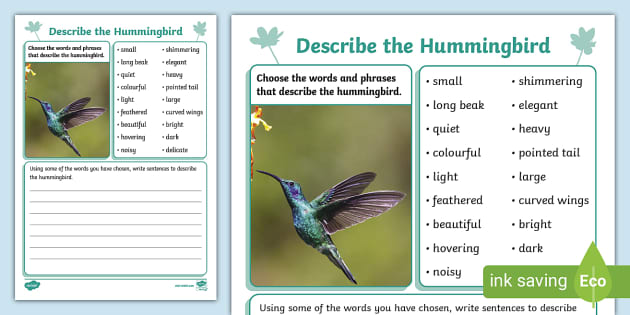
The hummingbird’s wings blurred beside the porch feeder.
The crow’s wings snapped open as it dropped from the fence.
Tail
A bird’s tail helps with balance, braking, and turning. In fiction, it can make a description more exact.
The kestrel fanned its tail and held still above the roadside grass.
The swallow flicked its forked tail and changed direction.
The pigeon spread its tail as it came down toward the courthouse roof.
Feet and claws
Feet often show a transition between flight and landing.
The robin tucked its feet beneath its feathers as it crossed the yard.
The osprey dropped its legs and opened its talons above the water.
The sparrow extended its tiny feet before settling on the wire.
Head and eyes
Head movement can show alertness or purpose.
The hawk turned its head from side to side, watching the field.
The gull twisted its neck toward the sound of the fishing boat.
The owl flew low, its face fixed toward the dark line of trees.
Choose details that matter to the scene. If the bird is hunting, focus on its eyes and claws. If it is landing, focus on its feet and tail. If it is escaping, focus on sudden wingbeats and direction changes.

Use Sensory Details Beyond Sight
Most descriptions of birds in flight rely too heavily on visual detail. Add sound, air, light, and the observer’s physical response.
Sound
Different birds create different sounds in flight. Wingbeats may be soft, loud, rapid, or nearly silent. Some birds also call while flying.
Try words such as:
- rustle
- rush
- beat
- clap
- whistle
- cry
- chatter
- croak
- shriek
- murmur
The flock passed overhead with a soft rush of wings.
Canada geese called to one another as they crossed the cold evening sky.
The mourning dove lifted from the sidewalk, its wings making a brief, sharp whistle.
Avoid claiming that every bird makes a loud sound. Many birds fly with little noise, especially at a distance. Let the species and distance guide the description.
Air and temperature
Flight changes the air around the observer.
The hawk’s passage stirred the dry grass below.
A flock of starlings swept over the field, leaving a cool shadow on her face.
The bird rose into the warm air above the desert road.
These details connect the bird to the setting. They also help the reader feel the scale of the movement.
Light and color
Light can change how feathers appear. A bird may look black against a bright sky but reveal blue, green, or purple when it turns.
The crow crossed the sunset as a black cutout.
When the grackle banked, oil-blue color flashed across its wings.
Sunlight caught the white underside of the gull as it turned over the water.
Use color with care. A plain sky can make a bird stand out. A storm, sunset, or city glow can change the same bird’s appearance.
The observer’s body
Show how the person reacts.
Maya shaded her eyes and followed the hawk until it became a dark speck.
He ducked as the pigeon burst from the awning.
She felt the flock’s movement before she saw it, a tremor of wings above the trees.
This approach gives the flight emotional weight without naming the emotion directly.

Describe Flight Through the Character’s Point of View
The same bird can seem graceful, frightening, lonely, or free depending on who watches it. Point of view controls which details the reader receives.
A child’s point of view
A child may notice color, speed, and wonder.
The blue jay shot across the yard like a scrap of sky torn loose.
A hunter’s point of view
A hunter may notice direction, distance, wind, and timing.
The duck rose against the wind, climbed hard, and turned toward the marsh.
A grieving character’s point of view
A grieving person may focus on absence, memory, or distance.
The geese moved south in a long, broken line, and Nora counted them until the sky was empty.
A frightened character’s point of view
Fear can make ordinary movement seem sudden and threatening.
Wings exploded from the shed roof. For one breath, the whole sky came at him.
Do not describe every detail with the narrator’s voice alone. Let the character’s knowledge shape the language. A birder may identify a species and read its behavior. A child may call every large bird an eagle. A city resident may notice a flock only when it darkens a street.

Build Metaphors That Fit the Bird
Metaphors make bird flight memorable, but they work best when they grow from real movement.
A bird can resemble:
- a leaf carried by wind
- a knife cutting through rain
- a scrap of paper
- a dark arrow
- a loose ribbon
- a thrown stone
- a piece of smoke
- a dancer turning in space
- a kite tugging at its string
Use the metaphor to add meaning, not decoration.
The swallow was a black stitch sewing the evening together.
This metaphor suggests speed and repeated movement.
The eagle drifted over the valley like a loose piece of the mountain.
This image suggests scale and calm.
The gulls wheeled above the pier like scraps of torn paper.
This may suggest disorder, noise, or a rough coastal scene.
Avoid mismatched metaphors
A small finch should not “thunder” through the sky unless the exaggeration is intentional. A heavy goose may not “float like a feather” during takeoff. The metaphor should respect the bird’s size and motion.
You can also use similes for mood:
- graceful as falling silk
- sudden as a snapped flag
- steady as a slow wheel
- restless as sparks
- silent as drifting ash
Use one strong comparison rather than several weak ones.

Show Speed Without Relying Only on “Fast”
The word “fast” tells the reader very little. Show speed through distance, rhythm, reaction, and sentence length.
Use short sentences for sudden flight
The sparrow sprang from the fence. It crossed the yard. It was gone.
The short structure creates speed.
Use longer sentences for gliding or soaring
The hawk rode the rising air above the pasture, circling once, then again, until the farmhouse and road seemed to shrink beneath it.
The longer sentence mirrors the smooth motion.
Show speed through comparison
The falcon dropped from the roof faster than Lena could follow.
The hummingbird moved too quickly for his eyes, appearing at one flower and then another.
Show speed through missed details
She saw the flash of white, the sharp turn, and then only empty sky.
A fast bird may become a series of fragments instead of a complete visual picture.
Use measured detail when the bird is slow
For a soaring bird, describe the change in position:
It crossed from the water tower to the far ridge without one visible wingbeat.
That detail suggests efficiency and height more clearly than “It flew slowly.”

Use Weather, Landscape, and Season
The environment changes how a bird flies. Wind can lift, resist, or scatter a bird. Rain can flatten feathers and reduce visibility. Heat can create rising air. Snow can hide the ground and simplify the sky.
Wind
The gull leaned into the Atlantic wind, its wings stiff and level.
The sparrow fought its way across the parking lot, dropping each time a gust struck.
Rain
The crow flew low through the rain, each wingbeat heavy and dark.
Heat
Vultures circled above the Texas road, lifted by columns of warm air.
Snow
A cardinal crossed the white yard in one bright flash.
Landscape
A bird’s path can reveal the shape of the land.
The hawk followed the river’s bend.
The cranes rose from the marsh and passed over the cornfields.
Swallows skimmed the pond, their shadows racing beneath them.
The landscape also gives the reader a scale. A bird above a street feels close. A bird above a canyon may seem distant and small.

Write Bird Flight at Different Distances
Distance changes what a character can see and hear.
Nearby
At close range, show details of feathers, eyes, wing joints, and sound.
The pigeon launched from the railing, its claws scraping metal before its wings caught the air.
At middle distance
Show the bird’s shape, direction, and pattern.
The hawk crossed the field in a slow arc, dark against the pale grass.
Far away
Focus on silhouette, flock shape, and movement.
High above the lake, the geese became a wavering line.
Do not give a distant observer details they could not reasonably see. A bird several hundred feet away may appear as a shape or speck, not as a visible eye color.
This rule helps maintain realism while keeping the prose vivid.

Describe Flocks as One Shape and Many Birds
A flock has both unity and variation. It may move like one body, yet each bird makes small changes.
Useful collective verbs include:
- wheel
- gather
- scatter
- stream
- sweep
- surge
- ripple
- swirl
- pulse
- spiral
The starlings gathered above the field, broke apart, and formed again.
The pigeons scattered from the plaza like thrown seeds.
A line of pelicans skimmed the bay, each bird following the one ahead.
For a murmuration or large flock, avoid treating the group as a perfectly controlled object. Small shifts can make the movement feel alive.
The flock bent left, then folded inward as if a single thought had passed through it.
This gives the group a shared rhythm without making the birds seem mechanical.

Use Accurate Bird-Flight Details
Creative writing does not need a biology lesson, but accurate details build trust.
The Cornell Lab of Ornithology describes bird flight in terms that include powered flight, gliding, soaring, hovering, and other specialized movements. The U.S. Fish and Wildlife Service also provides species information that can help writers check habitat and behavior. Audubon’s bird resources can support identification and natural-history research in North American settings.
Use reliable references when the species matters to the plot. Check:
- Whether the bird lives in the setting
- Whether it migrates through the region
- Whether it hunts, feeds, or nests there
- Whether it commonly flies at dawn, dusk, or night
- Whether its wing shape matches the action
- Whether the season affects its behavior
Common realism mistakes
Mistake: Every large bird soars.
Some large birds use strong wingbeats, especially during takeoff.
Mistake: Every bird flies in a straight line.
Many birds bank, rise, dip, or change direction.
Mistake: Birds always make loud wing sounds.
Sound varies by species, distance, speed, and feather structure.
Mistake: A bird can hover indefinitely.
Some species hover well, but hovering requires energy and may last only briefly.
Mistake: A bird looks the same from every angle.
Wing undersides, backs, tails, and silhouettes can show different colors and shapes.
Accuracy should serve the scene. Include only the details that improve the reader’s picture.

Before-and-After Examples
The easiest way to improve a bird-flight description is to replace a general verb with a visible sequence.
Basic
The eagle flew over the mountain.
Stronger
The eagle spread its wings and circled above the ridge, rising each time the warm air lifted beneath it.
Basic
The birds flew away.
Stronger
The sparrows burst from the hedge, scattered over the fence, and vanished into the sycamore.
Basic
A gull flew over the beach.
Stronger
A gull tilted into the ocean wind, its white wings flashing as it skimmed the breakers.
Basic
The owl flew silently.
Stronger
The owl passed between the porch light and the trees without a sound, its broad wings closing and opening like slow doors.
The improved versions answer more than “what happened.” They show method, direction, rhythm, setting, and mood.
A Simple Formula for Writing Bird Flight
Use this six-part formula when you need a quick, vivid description:
Bird + motion + body detail + direction + sensory detail + emotional effect
Example:
The peregrine plunged toward the river, wings folded tight, then opened its tail and climbed in a burst of spray and shadow.
Breakdown:
- Bird: peregrine
- Motion: plunged, climbed
- Body detail: wings folded, tail opened
- Direction: toward the river, then upward
- Sensory detail: spray and shadow
- Effect: speed and danger
You do not need all six parts in every sentence. Use the formula as a planning tool, then remove anything that does not help.
Quick revision checklist
Before you finish, ask:
- Did I use a specific motion?
- Does the movement fit the species?
- Did I show at least one body part?
- Can the reader tell where the bird is going?
- Did I include sound, light, weather, or air?
- Does the description match the character’s viewpoint?
- Did I avoid repeating “flew,” “soared,” or “beautiful”?
- Could the observer really see this detail from that distance?
- Does the sentence create the mood I want?
If the answer is yes to most of these questions, the flight will likely feel clear and alive.
Frequently Asked Questions
What are strong verbs for describing birds flying?
Useful verbs include glide, soar, hover, dart, plunge, wheel, bank, flap, drift, skim, rise, descend, sweep, and streak. Choose a verb that shows the bird’s speed, direction, and purpose.
How do you describe a bird flying gracefully?
Focus on smooth motion and minimal effort. For example: “The heron glided over the marsh, its wings rising and falling in slow, even strokes.” Words such as drift, float, sail, and coast can suggest grace.
How do you describe a bird flying fast?
Use sharp verbs, short sentences, and quick changes in direction. For example: “The swallow shot across the yard, dipped beneath the branch, and vanished.” Show speed through distance and the observer’s difficulty in following the bird.
How do you describe birds flying in a flock?
Use collective verbs such as wheel, stream, ripple, scatter, surge, and sweep. Show both the group shape and its shifting parts: “The starlings formed a dark cloud, broke apart, and gathered again above the field.”
How do you describe a bird taking off?
Show the push from the surface, the first wingbeats, and the change in height. For example: “The crow sprang from the fence, beat its wings hard, and climbed over the rooftops.”
How can I avoid repeating the word “flew”?
Change the sentence structure, not just the verb. Describe the bird’s wings, direction, sound, shadow, or effect on the observer. You can write, “The hawk crossed the valley,” “The gull skimmed the water,” or “The sparrow burst from the hedge.”
Conclusion
To describe birds flying in creative writing, make the movement specific. Identify the flight pattern, choose an accurate verb, show the bird’s body in motion, and connect the action to weather, place, sound, and point of view.
A useful description does not need many words. It needs the right ones. Replace “the bird flew away” with a clear action: what moved, how it moved, where it went, and what the moment meant to the observer.