How Long Do Birds Sleep: Bird Sleep Guide
Most birds sleep for about 10 to 12 hours each night, but the exact amount varies by species, season, age, light level, and safety. A wild American robin may rest from dusk until dawn, while a pet parrot may need a set schedule of quiet, dark sleep each night.
Birds do not all sleep in the same way. Some sleep in trees, reeds, nest boxes, or on the ground. Some can rest one half of the brain while the other half stays alert. Migration, cold weather, and long summer days can also change when and how long a bird sleeps.

How Many Hours Do Birds Sleep?
Most birds sleep between 8 and 12 hours per day. Many common songbirds sleep close to 10 or 12 hours when nights are long. Pet birds, including parrots, often do best with 10 to 12 hours of quiet, dark sleep each night.
This is a useful general guide, not a rule for every bird. A bird’s sleep time can change with:
- Species and natural habitat
- Day length and season
- Age and health
- Temperature and weather
- Feeding needs
- Migration or breeding
- Noise, light, and predators
Birds often sleep when the light fades. They wake when daylight returns. In the United States, a backyard bird may rest for fewer hours in summer because the sun rises early and sets late. It may sleep longer during short winter days.
Typical sleep ranges
| Bird type | Approximate sleep pattern | Important conditions |
|---|---|---|
| Songbirds | About 8–12 hours | Often sleep from dusk to dawn |
| Owls and other night birds | About 8–12 hours | Usually rest during the day |
| Ducks and geese | Variable | May rest while floating or standing |
| Chickens | About 8–10 hours at night | Roosting and light exposure affect sleep |
| Pet parrots | About 10–12 hours | Need a dark, calm sleep period |
| Nestlings | Frequent sleep and rest | Sleep needs change as they grow |
| Migrating birds | Highly variable | May sleep in short periods or while flying |
These ranges are estimates. The best guide is the bird’s normal behavior, species, and environment.
The Cornell Lab of Ornithology explains that sleep is a regular part of bird behavior, although birds show unusual sleep patterns compared with humans. Research published in Nature Communications also found that some birds can use unihemispheric sleep, a state in which one brain hemisphere rests while the other remains more alert.

Why Do Birds Sleep at Night?
Birds sleep at night because darkness reduces the risk and effort involved in many daily activities. Most birds rely on sight to find food, avoid danger, and move through trees or open areas. Once light fades, feeding and travel become harder.
Sleeping also helps birds save energy. A sleeping bird moves less and uses fewer calories. This matters because small birds lose heat quickly, especially during cold nights.
Birds choose sleep sites that offer protection. Depending on the species, a bird may sleep:
- In a dense shrub or tree
- In a cavity or nest box
- On a branch
- In tall grass or reeds
- On open water
- On a cliff ledge
- While standing on one leg
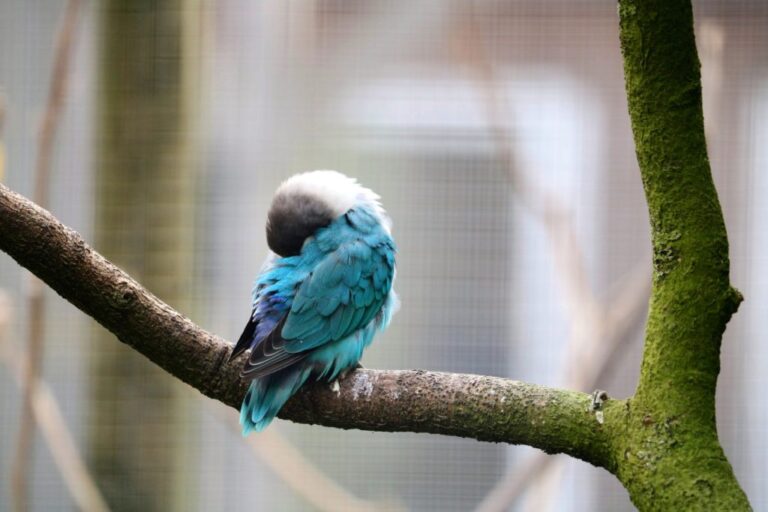
A safe sleep site does not always look comfortable to people. A small bird may tuck its head under its wing and puff up its feathers. Fluffed feathers trap warm air near the body. This helps reduce heat loss.
Some birds also lower their body temperature at night. This state is called torpor. Torpor is deeper than ordinary sleep and helps save energy during cold periods or when food is scarce. Not every bird uses torpor, and it should not be confused with illness.

Do Birds Sleep With Their Eyes Open?
Some birds can sleep with one eye open. This ability is called unihemispheric slow-wave sleep. One side of the brain sleeps while the other side remains more alert.
The open eye is linked to the more active brain side. Birds may use this skill when they sleep near predators or in exposed places. A bird can monitor its surroundings while still getting some rest.
Birds may also sleep with both eyes closed when they feel safe. A bird resting in a protected cavity or a secure home may not need to stay as alert.
This ability does not mean a bird gets perfect sleep with no cost. One-sided sleep may be lighter than full sleep. It may help a bird balance rest and safety, but it does not remove the need for normal sleep.
Some birds sleep while floating or standing. Their body can maintain balance through automatic muscle control. Ducks and other water birds may rest on water, while some birds grip a branch with specialized foot tendons. The bird does not need to hold the branch by conscious effort.

Where Do Birds Sleep?
Birds sleep in places that match their body size, habits, and risk of attack. A robin may choose a thick shrub, while a woodpecker may use a tree cavity. A duck may sleep on water or near the edge of a pond.
Common bird sleeping places include:
- Tree branches: Many songbirds settle on branches and grip them while resting.
- Tree cavities: Woodpeckers, owls, and other cavity users may sleep inside holes.
- Dense plants: Thick shrubs offer cover from wind and predators.
- Nest boxes: Some birds use nest boxes for roosting outside the breeding season.
- Water: Ducks, geese, and other water birds may rest while floating.
- Cliffs or ledges: Some seabirds and raptors use high, sheltered spots.
- The ground: Quail and other ground birds may sleep in grass or low cover.
Birds do not always sleep in the same place every night. Weather, predators, competition, and human activity can change their choice.
A bird’s sleeping site is called a roost. Roosting differs from nesting. A nest is mainly used for eggs and young. A roost is a place where a bird rests, often outside the breeding period.
Do not disturb a wild bird that appears to be sleeping. Shining a flashlight at it, touching it, or forcing it to fly can waste energy and expose it to predators.

How Much Sleep Do Pet Birds Need?
Most pet birds need about 10 to 12 hours of uninterrupted sleep each night. Parrots often become stressed or irritable when they do not get enough rest. Long-term sleep loss may also affect behavior, immune function, and normal activity.
A pet bird’s sleep area should be:
- Dark or close to dark
- Quiet
- Free from sudden movement
- Kept at a stable, safe temperature
- Separate from late-night household activity
A regular schedule helps. For example, a bird may sleep from 7:30 p.m. to 6:30 a.m. The exact hours can differ, but the routine should remain steady.
Many homes are too bright and noisy for a bird to sleep in a busy living room. Television, lamps, conversations, and kitchen activity can interrupt rest. If the cage must stay in a common room, a separate sleep cage or a quiet sleeping area may help.
Do not cover a cage as a substitute for a safe sleep space. A cover can reduce light, but it may also limit airflow or cause stress if the bird dislikes it. Avoid scented products, smoke, aerosols, and strong cleaning fumes near the bird’s sleeping area. Birds have sensitive respiratory systems.
If a pet bird sleeps much more than usual, sits low, stops eating, breathes with effort, or looks weak while awake, contact an avian veterinarian. A healthy bird should be alert and active during its normal waking period.

Do Birds Sleep During the Day?
Yes. Birds may sleep or nap during the day, especially after feeding, during cold weather, or after demanding activity. A short daytime rest is not always a problem.
Night birds, such as owls, sleep mainly during the day. Many birds that migrate or feed for long periods also take brief rests. Young birds may sleep more often because growth requires a great deal of energy.
Daytime sleep becomes more concerning when it is new, prolonged, or paired with other symptoms. Watch for:
- A bird that stays fluffed up for hours
- Closed eyes during most of the day
- Little interest in food or water
- Sitting on the cage floor
- Loss of balance
- Changes in droppings
- Labored breathing
- Unusual silence or weakness
These signs can point to illness, cold stress, injury, poor nutrition, or another problem. Birds often hide illness until they are seriously unwell. A sudden change deserves prompt veterinary advice, especially in a pet bird.
For wild birds, observe from a distance. A bird that briefly closes its eyes in a sheltered spot may simply be resting. A bird that cannot fly, remains on the ground, or allows close approach may need help from a licensed wildlife rehabilitator.

Do Birds Sleep While Flying?
Some birds can sleep during migration, but this behavior is not the same across all species. Research on great frigatebirds found that they can sleep for short periods during long flights, including brief periods of one-sided sleep and, less often, deeper sleep.
Migrating birds may also sleep during stopovers. Their sleep pattern depends on wind, food, predators, distance, and the demands of the journey.
This does not mean most birds can safely sleep while flying. A pet bird should never be deprived of normal sleep because wild birds sometimes rest in flight. Birds need a suitable daily sleep period even when they are active, social, or noisy.
Migration can reduce total sleep for some birds. The body may adapt by using short naps, one-sided sleep, or rest during stops. These changes are specialized survival strategies, not a normal sleep plan for domestic birds.

Do Birds Sleep in Winter?
Birds still sleep in winter, but cold weather can change where and how they rest. Some birds choose sheltered roosts, gather near other birds, or use torpor to save energy.
Winter nights are often longer, so birds may spend more time roosting. They also need to protect their energy reserves. Finding food takes more effort when snow, ice, or frozen ground limits access.
You can help backyard birds by providing:
- Native shrubs or dense evergreen cover
- Clean water that does not freeze, when safe to maintain
- Suitable food for local species
- Nest boxes that also offer proper shelter
- Protection from outdoor cats and other predators
Keep feeders and birdbaths clean. Do not place them where birds are easy targets for cats. If you use a heater for a birdbath, follow the product’s safety instructions and keep electrical parts away from water.
Never bring a wild bird indoors simply because it is sitting quietly in winter. If it appears injured, cannot fly, or shows signs of severe cold stress, contact a wildlife rehabilitator or state wildlife agency.

How to Tell Whether a Bird Is Sleeping Normally
A sleeping bird usually has relaxed body language. It may close its eyes, tuck its head into its feathers, stand on one leg, or remain still in a chosen roost.
Normal sleep is followed by normal activity. After waking, the bird should usually:
- Move with good balance
- Respond to nearby sounds
- Eat and drink normally
- Groom its feathers
- Show interest in its surroundings
- Produce normal droppings
For a pet bird, track changes rather than counting every minute of sleep. A consistent schedule is more useful than a single observation.
If you are worried, record the time the bird sleeps, eats, drinks, and becomes active. A short video can also help an avian veterinarian understand the change. Do not give human medicine or try to force-feed a weak bird unless a qualified professional tells you to do so.

Frequently Asked Questions About Bird Sleep
How long do birds sleep at night?
Many birds sleep for about 8 to 12 hours at night. Pet parrots commonly need 10 to 12 hours of quiet, dark sleep. The exact amount depends on species, age, season, light, and health.
Do birds sleep in their nests?
Sometimes, but not always. Birds often use nests while raising eggs or young. Outside the breeding period, many sleep in tree cavities, shrubs, branches, reeds, or other roosting sites.
Why does my bird sleep so much?
A bird may sleep more after activity, during a dark or cold period, or while recovering from stress. However, excessive sleep can signal illness. Contact an avian veterinarian if extra sleep comes with poor appetite, weakness, fluffed feathers, breathing changes, or unusual droppings.
Should I cover my bird’s cage at night?
A cage cover may help reduce light, but it is not required for every bird. The key needs are darkness, quiet, safe air quality, and a steady schedule. Use a cover only if the bird remains calm and has good airflow.
Can birds sleep standing up?
Yes. Many birds can sleep while standing on one leg or gripping a branch. Their foot and leg structure helps them stay attached to a perch without constant conscious effort.
Do baby birds sleep more than adult birds?
Often, yes. Young birds need frequent rest for growth and development. Nestlings may sleep between feedings, while recently fledged birds alternate activity with rest. A baby bird found alone may not be abandoned; observe from a distance before taking action.
Conclusion
Birds usually sleep for about 8 to 12 hours, while many pet birds need 10 to 12 hours of quiet, dark rest each night. Wild birds adjust their sleep to light, weather, food, predators, and migration.
The most useful rule is to judge sleep in context. A bird that rests in a safe place and acts normally after waking is usually following a healthy pattern. A sudden increase in sleep, weakness, breathing trouble, or loss of appetite calls for help from an avian veterinarian or licensed wildlife rehabilitator.