How Does Bird Migration Work: A Simple Guide
Introduction
Bird migration is the seasonal movement of birds between breeding and nonbreeding areas. In the United States, millions of birds move north in spring and south in fall along routes that span backyards, wetlands, forests, deserts, and coastlines. They migrate to find food, raise young, avoid harsh weather, or reach places with better nesting conditions.
Migration works through a mix of internal clocks, seasonal cues, inherited behavior, memory, navigation skills, weather, and access to food. Young birds may begin with an instinct to travel in a certain direction, while older birds improve their routes through experience.
What Is Bird Migration?
Bird migration is a repeated movement tied to the seasons. It may cover a few miles or thousands of miles. The distance depends on the species, its food needs, its breeding range, and the climate it can tolerate.
Migration is different from random movement. A migrating bird usually follows a broad pattern:
- It prepares by eating more and storing body fat.
- It leaves when seasonal cues and local conditions align.
- It travels through a route with useful stopover sites.
- It reaches a breeding or wintering area.
- It reverses the journey during another season.
Not every bird migrates in the same way. Some species make long trips between Canada and South America. Others move only from the northern United States to the southern states. Some birds stay in one region but shift from high ground to low ground when winter arrives.
Complete, partial, and short-distance migration
Bird migration falls into several broad patterns:
- Long-distance migration: A bird travels between North America and Central or South America. Many warblers, vireos, flycatchers, and shorebirds do this.
- Short-distance migration: A bird moves a limited distance to find food or milder weather.
- Partial migration: Some members of a species migrate while others stay in place. This pattern is common when food and weather vary across a species’ range.
- Irruptive movement: A bird moves in unusually large numbers when its normal food supply fails. Red crossbills and snowy owls can show this pattern.
- Altitudinal migration: A bird moves up or down a mountain rather than traveling across a continent.
Migration is not always a simple trip from point A to point B. A bird may use different routes in spring and fall. It may also stop for days or weeks at several key locations.
Why Do Birds Migrate?
Birds migrate because seasonal conditions change the balance between food, shelter, competition, and reproduction. Migration is costly, but staying in one place can be even more costly when food disappears or winter becomes severe.
Food drives much of migration
Many birds eat insects, nectar, fruit, fish, or small animals. These foods often become more available during warmer months. A bird may fly north in spring because insects become abundant there and daylight lasts longer.
The breeding season also creates a strong food demand. Parent birds need enough food to feed their young. A northern forest may support a large insect population for a short period. Birds that arrive at the right time can use that temporary food boom.
In fall, food may decline in the north. Birds then move south to areas where insects, fruit, seeds, or aquatic prey remain available.
Breeding space matters
Migration can give birds access to more nesting space. Northern regions often have fewer competing birds during the breeding season. Longer daylight can also give parents more time to find food and feed their young.
This benefit comes with risks. A bird may travel thousands of miles, cross bad weather, and compete for food at stopover sites. The advantage is greatest when the breeding area provides enough food to support many young birds.
Weather and temperature influence timing
Temperature affects insects, flowers, water, and plant growth. Storms and strong winds can delay migration or push birds off course. A warm spring may bring some insects out early, while a late cold snap can reduce food after birds arrive.
Weather often changes the timing of migration by days or weeks. Climate trends can also shift long-term timing, but the effect differs by species and region. Earlier arrival does not always mean better survival if food peaks before the birds need it.

How Do Birds Know When to Migrate?
Birds use several seasonal signals. No single cue explains migration for every species.
Daylight activates an internal clock
Changing day length is one of the most reliable migration signals. Birds can detect changes in daylight through their eyes and biological systems. Longer days in spring can trigger hormones linked to breeding and migration.
This response is called zugunruhe, a German term for migratory restlessness. Birds may become more active at night or show a strong urge to move in the expected direction.
Day length remains useful even when local weather changes. A warm week in winter does not normally convince a bird that spring has arrived. The bird combines daylight with temperature, food, and other signals.
Hormones prepare the body
Before migration, birds often enter a state of physical preparation. They may:
- Eat more food.
- Store extra fat.
- Build flight muscles.
- Change their sleep and activity patterns.
- Adjust their digestive organs.
- Become more restless at the normal migration time.
Fat is a key fuel. It stores much more energy per unit of weight than protein or carbohydrates. A bird must balance fuel against the cost of carrying extra weight, so it may gain and use fat in cycles during the journey.
Young birds may inherit a travel program
Many birds are born with part of their migration plan already set. Their genes may influence:
- The season when they migrate.
- The direction they first travel.
- The length of the journey.
- The daily time spent flying.
- The distance they attempt to cover.
This inherited program is not always a detailed map. It may act more like a basic rule, such as “fly southwest for several weeks.” Older birds can then improve their route through learning.

How Do Migrating Birds Navigate?
Birds use more than one navigation system. If one signal becomes weak or unavailable, another may help.
The sun provides a direction and time cue
During the day, birds can use the sun as a compass. Because the sun moves across the sky, birds need an internal clock to correct for that movement.
A bird does not simply fly toward the sun. Instead, it uses the sun’s position and the time of day to estimate direction. This system is most useful when the sky is clear.
Stars guide many night migrants
Many songbirds migrate at night. They can use the night sky for orientation, especially when they can see stars. Young birds may learn the pattern of the sky early in life.
Artificial light can confuse night migrants. Bright city lights may draw birds into built-up areas, where they can collide with glass or lose energy while circling.
Earth’s magnetic field acts like a compass
Birds can sense Earth’s magnetic field. This ability helps them determine direction, even when clouds block the sun or stars.
The magnetic system is complex. Research suggests that birds may detect magnetic information through light-sensitive processes in the eye and through sensory structures in the body. The exact mechanisms can differ among species and remain an active research topic.
Magnetic navigation gives birds a broad directional guide. It does not necessarily provide a street-level map of the entire route.
Smells, landmarks, and sound add local detail
Birds can use environmental information near the ground. Helpful cues may include:
- Coastlines and rivers.
- Mountain ranges.
- Forest edges.
- Wetlands and open fields.
- Wind patterns.
- Regional smells.
- Familiar feeding and nesting sites.
Experienced birds often perform better on routes they have traveled before. They may remember reliable stopover locations and avoid areas where food has repeatedly failed.
Social information can improve route choice
Some birds travel in groups. Young birds may gain useful information by following adults or other experienced birds. Group travel can also help birds find food and respond to predators.
However, social travel is not required for every species. Many birds migrate alone, especially at night. In these cases, inherited direction, environmental cues, and individual learning play larger roles.

What Route Do Migrating Birds Follow?
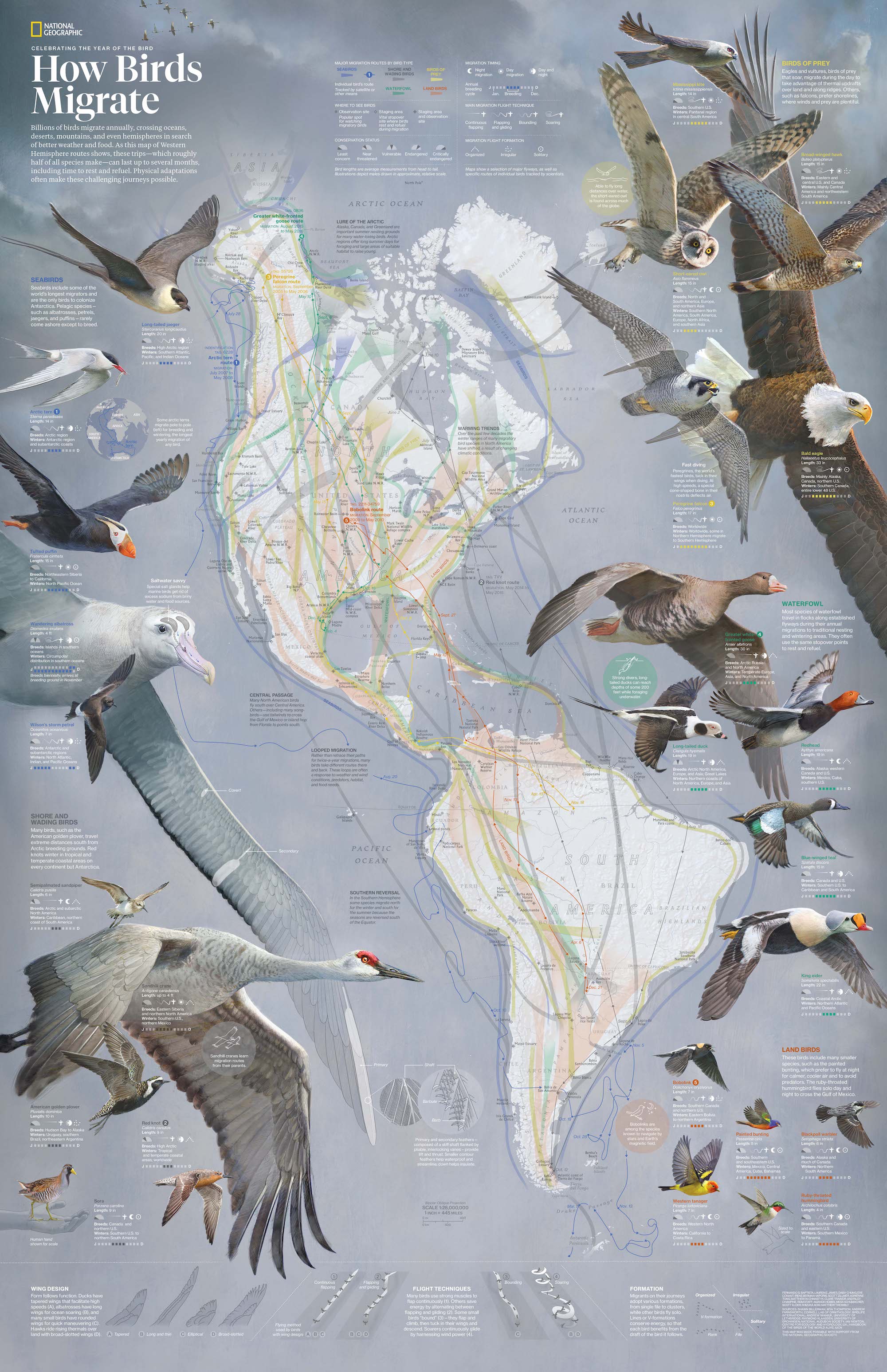
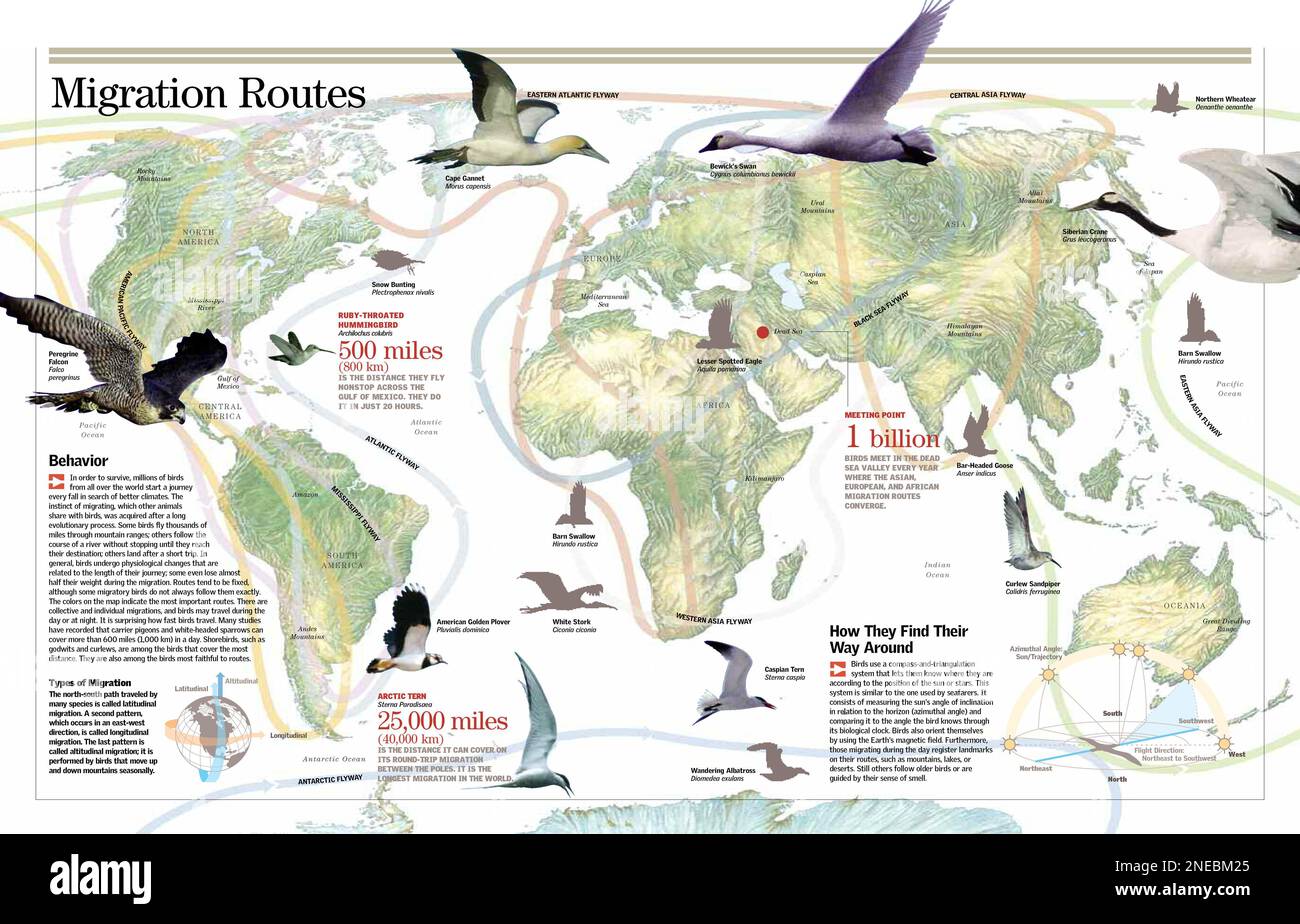
Most birds use broad migration corridors rather than one narrow line. These corridors are often called flyways.
In the United States, the main North American flyways are:
| Flyway | General path | Important features |
|---|---|---|
| Pacific Flyway | Western North America | Pacific coast, Central Valley, Great Basin, and western mountain ranges |
| Central Flyway | Great Plains and central states | Prairies, rivers, wetlands, and the Gulf Coast |
| Mississippi Flyway | Central and eastern North America | Mississippi River, Great Lakes, Gulf Coast, and coastal wetlands |
| Atlantic Flyway | Eastern United States | Atlantic coast, Appalachian region, bays, marshes, and coastal islands |
These names describe broad management regions. A bird does not always stay within one flyway. Routes can overlap, shift with weather, or change during spring and fall.
Stopover sites are essential
A stopover site is a place where a bird rests and refuels during migration. These locations can be more important than the final destination because a bird may need many stops to complete a long journey.
Good stopover habitat may include:
- Native plants that support insects.
- Berry-producing shrubs.
- Mudflats and shallow water.
- Freshwater wetlands.
- Coastal marshes.
- Mature forests.
- Dark, safe areas for night rest.
The loss of one stopover site can affect birds that breed and winter far away. A small wetland in the United States may support birds that later travel to Canada, Mexico, or South America.
Birds often choose routes that reduce risk
A route may offer food, shelter, or favorable winds. Birds may follow coastlines because they provide visible landmarks and feeding areas. Waterfowl may use wetlands and rivers. Soaring birds may seek mountain ridges where rising air reduces the need for powered flight.
No route removes all danger. Birds may still face storms, predators, dehydration, exhaustion, and human-made hazards.

How Do Birds Survive Long Migration?
Birds survive migration by managing energy, timing, and risk. Their bodies are built for efficient flight, but the journey still demands careful preparation.
Birds fuel flight with stored fat
Before a long flight, a bird may increase its food intake and store fat. During flight, muscles use this fat for energy. After landing, the bird must feed again before it can continue.
A useful way to understand this process is as an energy budget:
Energy available from food and stored fat − energy used for flight, rest, and body functions = energy remaining
If a bird reaches a stopover site with little fat, it may need to remain there longer. If the site lacks food, the bird may be forced to continue while weakened.
Wind can help or hurt
Tailwinds push a bird toward its destination and reduce travel time or energy use. Headwinds do the opposite. Birds may wait for favorable winds before beginning a major crossing.
Weather radar has shown that bird migration often rises on nights with helpful winds. Birds may also change altitude to find better air flow.
Birds rest in short and long periods
Some birds fly for hours or days with limited rest. Others make shorter flights and stop often. Night migrants may feed during the day and travel after sunset.
Long-distance migrants must also avoid overheating and dehydration. Flying over open water or dry land can be dangerous when no safe landing or food is available.
Some birds use unusual sleep strategies
Certain birds can sleep while flying, but this ability is not universal. Alpine swifts, for example, are known for spending long periods in the air. Many other species must land to rest.
A bird’s sleep strategy depends on its body, route, weather, and migration style. It is unsafe to assume that every migrating bird can fly continuously.

When Do Birds Migrate in the United States?
Spring migration usually moves north, while fall migration usually moves south. The exact timing varies by species, latitude, weather, age, and food supply.
Spring migration
In spring, birds generally move toward breeding grounds. Many species arrive in the southern United States first and then spread north. Some cross the Gulf of Mexico, while others follow land routes through Mexico and the Southwest.
Early migrants may include waterfowl, blackbirds, and some shorebirds. Many songbirds arrive later, when insects and plants become available farther north.
Fall migration
In fall, birds leave breeding areas after raising young. The route may differ from the spring route. Birds may use different winds, food sites, and coastal paths.
Young birds often migrate for the first time without having completed the route before. In some species, they travel with adults. In others, they rely more heavily on inherited direction and environmental cues.
Migration timing can change
Bird migration is not controlled by a calendar date alone. A bird responds to several conditions at once. These include daylight, temperature, food, body condition, wind, and breeding status.
Birdwatchers can track migration through tools such as the Cornell Lab of Ornithology’s eBird data platform and the U.S. Geological Survey’s Bird Banding Laboratory. These sources help researchers study timing, routes, survival, and population change.

What Threats Do Migrating Birds Face?
Migration is dangerous because birds travel through many habitats and human environments. A problem at one point in the route can affect the entire annual cycle.
Major threats include:
- Habitat loss at breeding, stopover, or wintering sites.
- Glass collisions near buildings.
- Outdoor cats.
- Pesticides and reduced insect populations.
- Light pollution.
- Extreme storms and heat.
- Drought and wildfire.
- Oil spills and water pollution.
- Tall structures placed along major routes.
- Food shortages caused by habitat change.
How people can help
People in the United States can reduce common risks in practical ways:
- Keep cats indoors, especially during peak migration.
- Use window screens, exterior shades, or bird-safe window patterns.
- Turn off unnecessary lights at night during migration periods.
- Plant native flowers, shrubs, and trees that provide food and cover.
- Avoid removing dense vegetation during peak nesting periods when possible.
- Keep fresh water clean and change it often.
- Report unusual bird deaths or large collision events to local wildlife authorities.
Birds do not need a perfect yard. A few native plants, dark windows, and safe cover can make a useful difference when many small actions occur across a region.

Key Takeaways
- Bird migration is a seasonal movement driven by food, breeding, weather, and survival.
- Birds use daylight, hormones, inherited behavior, the sun, stars, magnetic fields, landmarks, smells, and social cues.
- Most birds travel through broad flyways with important stopover sites.
- Stored fat provides much of the energy for long flights.
- Wind, storms, habitat loss, light pollution, and glass can change migration success.
- Migration timing differs by species and can shift with local conditions and long-term environmental change.
Frequently Asked Questions
Do all birds migrate?
No. Some birds stay in the same area all year. Others move short distances, migrate only part of the population, or travel only when food becomes scarce.
How do birds know where to go the first time?
Many birds inherit a basic migration direction and schedule. They can then use the sun, stars, magnetic information, landmarks, weather, and other cues. Older birds may improve their routes through experience.
Do birds migrate at night or during the day?
Both. Many songbirds migrate at night, while hawks and other soaring birds often migrate during the day. The choice depends on the species, route, body design, and energy strategy.
How far can a bird migrate?
The distance ranges from a few miles to tens of thousands of miles in a year. The Arctic tern is famous for an exceptionally long annual migration, while many resident or short-distance migrants travel much less.
Why do birds sometimes appear in unusual places?
Storms, strong winds, food shortages, navigation errors, and population changes can move birds outside their usual range. These events may be temporary, especially after severe weather.
What is the best way to see migrating birds?
Use a local birding checklist, visit wetlands, parks, forests, and shorelines, and go during peak migration for your region. Keep a respectful distance, avoid playback around sensitive birds, and use eBird or local conservation groups to find current sightings.
Conclusion
Bird migration works because birds combine biology with information from the world around them. Their internal clocks and inherited behavior set the process in motion, while food, weather, winds, landscapes, and past experience shape the journey.
For birds, migration is a chain of connected habitats rather than one flight. Protecting breeding grounds, stopover sites, and wintering areas gives them a better chance to complete that chain. In the United States, reducing window collisions, outdoor light, habitat loss, and other local threats can help birds along the entire route.