How Does A Magnificent Bird Of Paradise Attract A Mate: Why
Introduction
For readers in the United States, the magnificent bird of paradise (Cicinnurus magnificus) offers a clear look at how sexual selection shapes animal behavior. This small bird lives in the forests of New Guinea and nearby Indonesian islands, not in the United States. Its survival depends on tropical forest habitat, but its mating success depends on something more specific: whether a female chooses its display over those of other males.
A male attracts a mate with a mix of bright feathers, body posture, movement, sound, and a carefully chosen display site. He cleans the area, calls to females, spreads his colorful feathers, and performs a fast, precise courtship routine. The female watches from close range and decides whether the male is worth mating with.

What Is a Magnificent Bird of Paradise?
The magnificent bird of paradise is a small bird in the family Paradisaeidae, also known as the bird-of-paradise family. Its scientific name is Cicinnurus magnificus. It is found in forest habitats across parts of New Guinea and nearby islands.
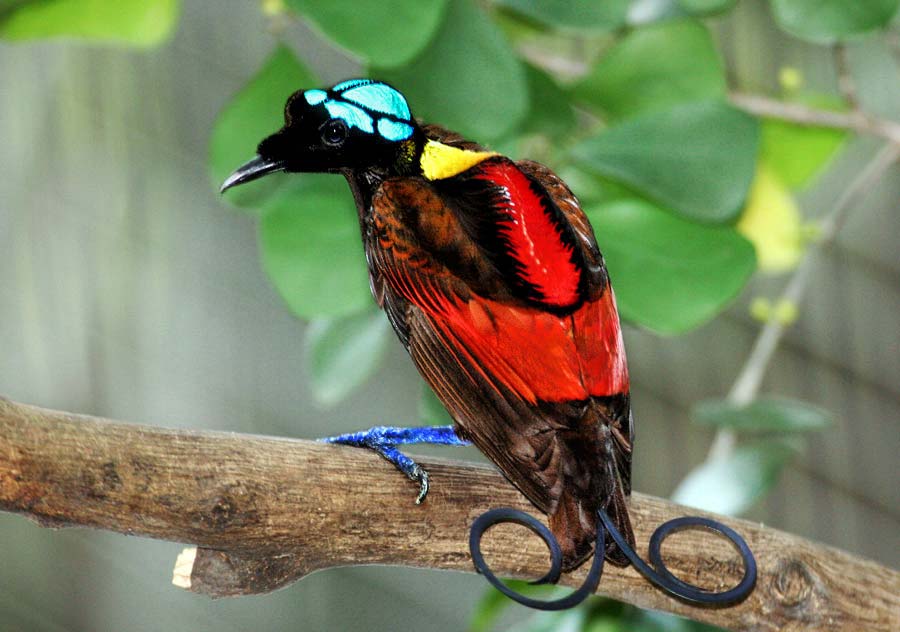
The male and female look very different. This difference is called sexual dimorphism. The male has vivid colors and special feathers used in courtship. The female is usually less colorful, with plumage that helps her blend into the forest while she feeds and raises young.
A male’s display feathers may include:
- Bright yellow flank plumes
- A blue or blue-green breast shield
- A green throat area
- Dark wings and body feathers
- Fine feathers that change shape as he moves
These colors do more than make the bird look attractive. They create visual signals that work best at close range, where the female can inspect the male’s feathers and movements.
The magnificent bird of paradise is also called the magnificent riflebird in some older or alternate naming systems, although common names can vary by region and source. For accuracy, the scientific name is the best way to identify the species.

How Does a Magnificent Bird of Paradise Attract a Mate?
A male magnificent bird of paradise attracts a mate by combining several courtship signals into one display. He first makes his display area suitable, then calls to females and performs a visual routine that reveals his most striking feathers.
The process usually includes these actions:
- Select a display site.
- Clear leaves and debris from the area.
- Call to attract or alert females.
- Raise and spread his decorative feathers.
- Expose his breast colors and body shape.
- Move in a controlled, rhythmic way.
- Pause so the female can inspect him.
- Repeat or change the display if she stays nearby.
This behavior is an example of courtship display. Courtship display means a set of actions used to attract a mate and show species identity, health, strength, or breeding condition.
The male does not simply flash his feathers once. The display works as a sequence. His posture, movement, color, and sound must all appear in the right setting. A female can leave at any point, so the male must hold her attention without frightening her.

The Male Uses a Clean Display Area
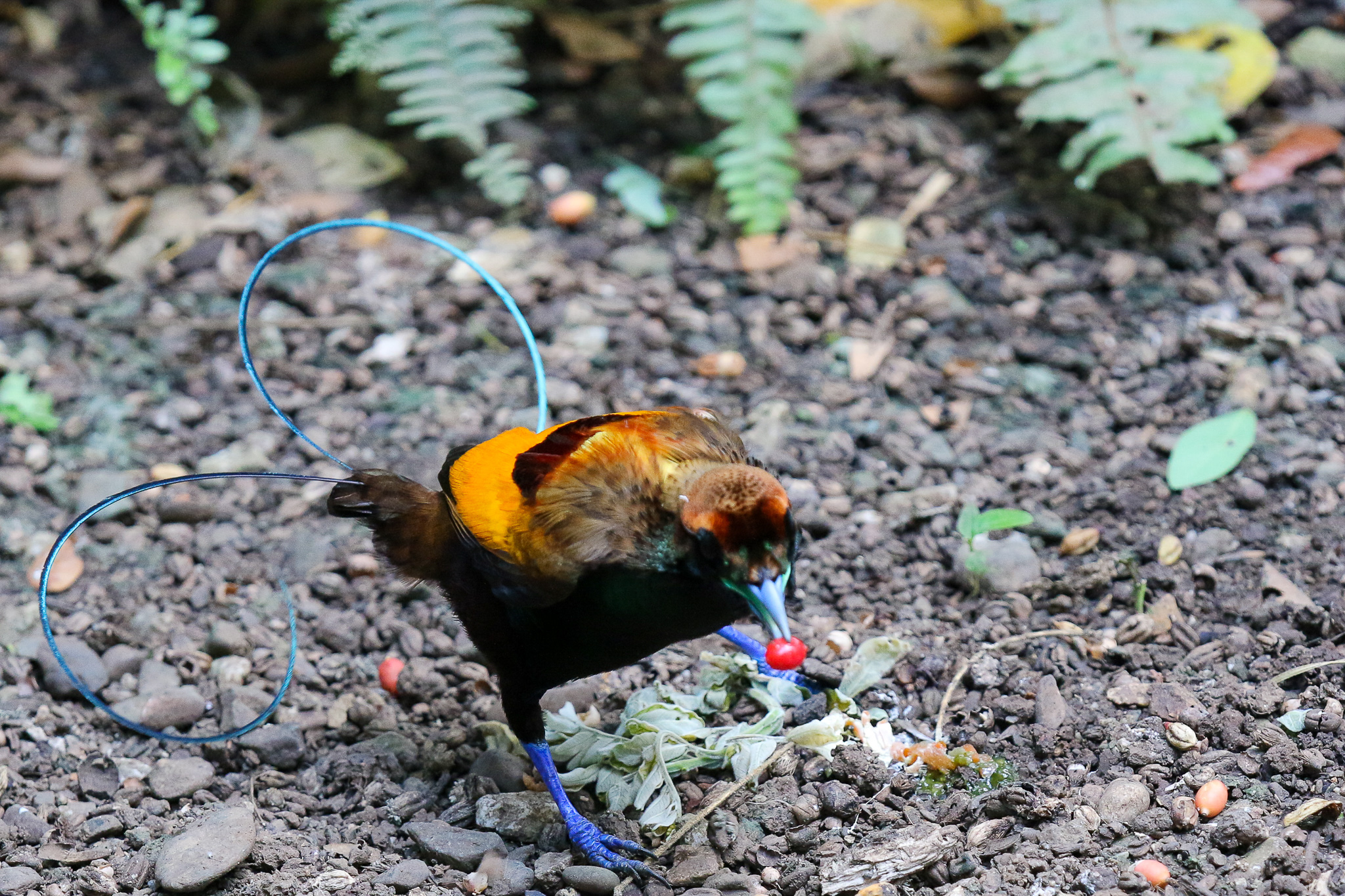
Before courtship begins, the male may prepare a small display site by removing leaves, twigs, moss, or other debris. This behavior makes the area easier to see and may improve the contrast between his dark body and bright feathers.
A clean site can also help the female judge the male’s behavior. Clearing a perch takes time and energy. It may show that the male can maintain a territory or repeatedly return to a preferred courtship area.
The exact role of site cleaning is not fully known for every magnificent bird of paradise population. Researchers should not treat every cleaned branch as proof of a formal lek or a fixed mating ground. Still, display-site preparation is important because many birds of paradise depend on a clear visual stage for courtship.
A good display site may offer:
- A stable branch
- Open space around the bird
- Suitable light
- Protection from heavy rain
- A clear view for visiting females
- A location where the male can call
Light matters because many bird-of-paradise colors come from both pigments and feather structure. Structural colors can look different as the viewing angle changes. The male’s movements therefore help him reveal the strongest flashes of blue, green, yellow, and black.

Bright Feathers Help the Female Judge the Male
The male’s feathers form the center of his courtship signal. When he raises his flank plumes and displays his breast shield, he changes his body shape. He can look much larger and more dramatic than he does while feeding or flying.
This transformation may help the female assess several traits at once:
- Feather condition
- Color intensity
- Symmetry
- Coordination
- Energy
- Species identity
- Willingness to invest in courtship
The display is not a simple beauty contest. It is a demanding performance. A male must control several feathers while moving with speed and accuracy. Damaged feathers, poor coordination, or weak timing may reduce the quality of the signal.
The female also sees the feathers at close range. This matters because a distant flash of color may attract her, but close inspection can reveal dirt, damage, or irregular shape. Courtship therefore has two stages: gaining attention and passing inspection.
Color alone does not prove that a male is healthier. Scientists need controlled studies to link each specific feather trait with health, age, or genetic quality. The safer conclusion is that the male’s plumage is a major visual signal that females use during mate choice.
Movement Turns the Display Into a Performance
The male’s movements make his feathers more visible. He may raise his wings, fan his flank feathers, tilt his body, and shift from side to side. These motions create changes in shape and color that a still bird could not produce.
A courtship display often includes:
- Quick body shifts
- Wing and feather lifts
- Sudden pauses
- Head movements
- Repeated postures
- Short bursts of activity
The rhythm matters. A display that is too slow may fail to hold attention. A display that is too fast may be difficult for the female to assess. The male must appear active and controlled at the same time.
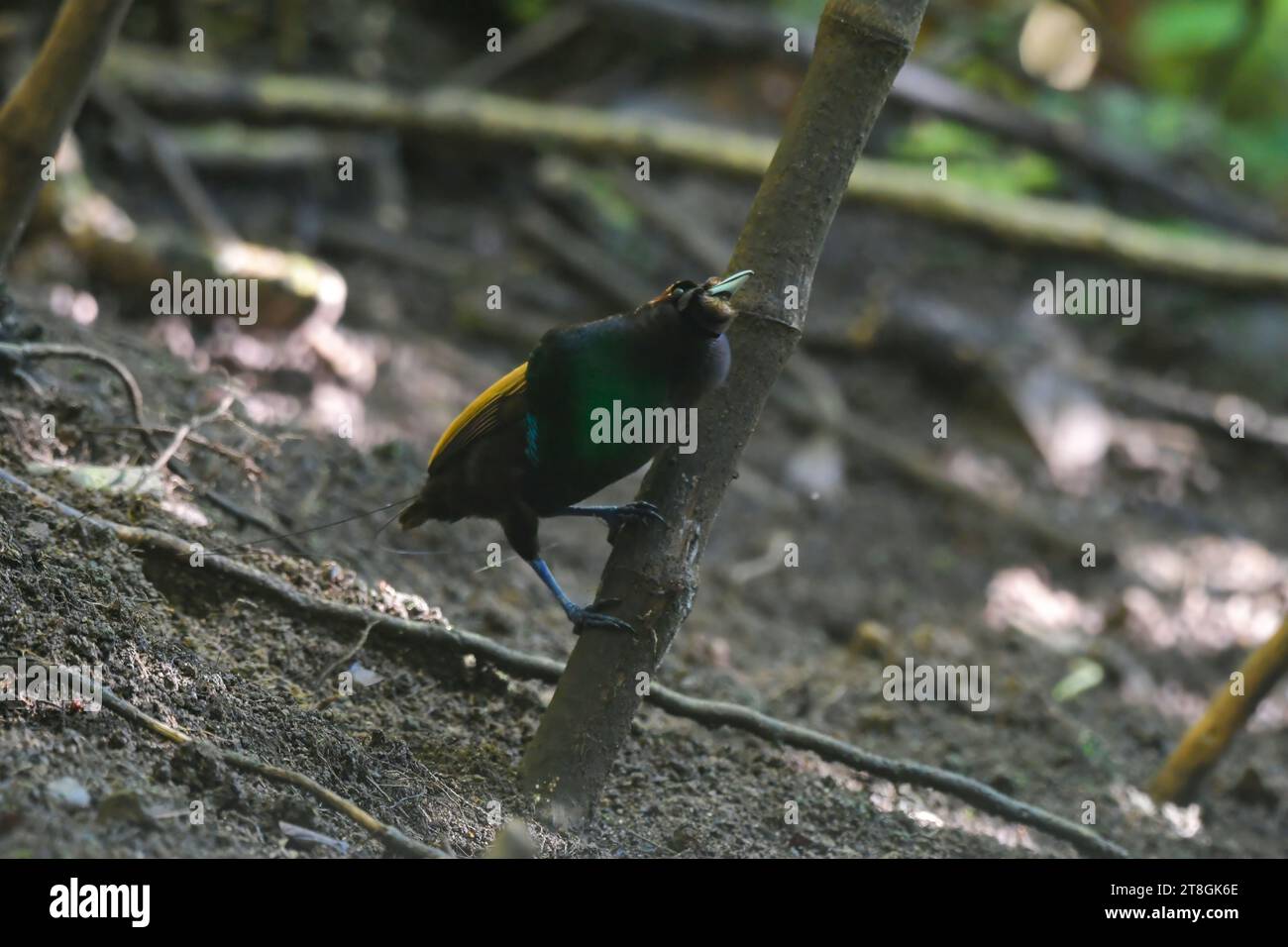
Some bird-of-paradise species use highly specialized poses, including upside-down or hanging displays. However, viewers should avoid assigning every famous bird-of-paradise behavior to the magnificent bird of paradise. The species has its own display pattern, and videos can make different species look more similar than they are.
The central idea remains the same: movement reveals the male’s feathers and tests his ability to perform a complex routine.

Calls Bring Females Toward the Display Site
Visual signals work only if a female comes close enough to see them. The male therefore uses calls to advertise his presence. These sounds may draw a female toward the display area or help her locate the male in dense forest.
A call can provide information that feathers cannot. It may help the female judge:
- Where the male is located
- Whether another male is present
- Whether the caller is the right species
- Whether the male is ready to court
- How confidently the male maintains his site
Sound travels through forest in complex ways. Leaves, trunks, rain, and distance can weaken or change a call. A male must call from a place where the sound can carry, then rely on his visual performance once the female arrives.
Researchers often study bird-of-paradise courtship with sound recordings and video. This approach helps separate the male’s call from the movement that follows. It also shows that courtship is not one signal but a combined system of sound and sight.

Female Choice Drives the Courtship
The female plays an active role in the mating process. She does not mate with the first male she sees. Instead, she may visit a male, watch his display, move closer, leave, or return later.
This is known as female choice, a major form of sexual selection. Sexual selection occurs when traits improve an animal’s chance of attracting a mate, even if those traits do not directly help it survive.
For the female, the choice has real costs. Producing eggs, building a nest, and raising chicks require energy. A careful choice may help her avoid a weak or poorly coordinated mate. Her decision may also favor males with attractive feathers, strong behavior, or reliable display sites.
The female may look for:
- Bright and even plumage
- Clean, undamaged feathers
- Smooth timing
- Strong posture
- Persistent but controlled behavior
- A suitable display site
- Correct species signals
Scientists cannot always identify the exact feature that makes a female choose one male over another. Courtship is influenced by the female’s experience, the viewing angle, weather, light, nearby males, and the condition of the forest.

Is the Display a Lek?
A lek is a place where males gather to display while females visit and choose among them. Many birds of paradise use lek-like mating systems, but the term should be used with care.
A magnificent bird of paradise may display from a favored site, and more than one male may occur within the same broad forest area. That does not automatically prove that the species forms a classic lek. Researchers must document male spacing, repeated site use, female visits, and mating patterns before making a firm classification.
For readers, the practical point is simple: the male’s display site gives a female a place to evaluate him. Whether the site is part of a formal lek or a more solitary territory depends on the population and the evidence available.
This distinction matters because mating systems affect conservation. If males depend on a few traditional display sites, the loss of those sites could reduce breeding success even when the wider forest remains.

Why Does the Male Have Such Elaborate Feathers?
The male’s elaborate feathers evolved because mating success can reward traits that survival alone would not favor. A large, bright feather can make a male easier to see by predators. It can also require extra energy to grow and maintain.
This creates a trade-off:
| Trait | Possible benefit | Possible cost |
|---|---|---|
| Bright color | Attracts female attention | Makes the male easier to see |
| Long or broad feathers | Creates a stronger display | Requires energy to grow |
| Frequent calling | Helps females find him | Reveals his location |
| Repeated dancing | Holds attention | Uses energy |
| Site cleaning | Improves visibility | Takes time and effort |
If females consistently prefer a trait, males with that trait may leave more offspring. Over many generations, the trait can become more pronounced. This is one reason male and female birds of paradise can look so different.
The display is therefore a biological trade-off, not a decoration without purpose. The male pays a cost, and the female may use the signal to judge whether he is worth choosing.
What Happens After the Female Chooses Him?
After a female accepts a male’s courtship, mating may occur at or near the display site. The pair does not usually form a lifelong bond in the way many people imagine when they hear the word “mate.”
In many birds of paradise, males invest heavily in display while females carry most of the work of nesting and caring for young. Species-specific details can vary, so it is best not to assume that every population follows the same pattern.
The male’s role is mainly to attract a female and complete mating. The female then needs safe habitat, food, nesting material, and protection from predators. This is why conserving only the male’s display branch is not enough. The wider forest also supports breeding.

What Can Interrupt the Courtship Display?
A male may fail to attract a mate even when he performs the correct behavior. Courtship depends on conditions that the bird cannot control.
Common problems include:
- Heavy rain that reduces visibility
- Poor light under a dense canopy
- Damaged or missing feathers
- A rival male nearby
- Predators in the area
- Human disturbance
- Loss of display trees
- Forest clearing
- Reduced food supplies
A female may also leave because the display does not meet her preference. Failure does not necessarily mean the male is unhealthy. It may reflect timing, competition, weather, or the female’s individual choice.
For people watching birds, the safest approach is to keep distance and avoid entering a display area. Loud voices, playback recordings, bright flashes, and repeated visits can disrupt courtship. Wildlife photographers should follow local park rules and never use bait or recorded calls unless regulations and conservation guidance clearly allow it.

How Scientists Study Magnificent Bird of Paradise Courtship
Researchers study courtship with a combination of field observation, video, audio recording, museum specimens, and habitat surveys. Each method answers a different question.
Video can show:
- Feather positions
- Body angles
- Timing
- Female responses
- Interactions with rival males
Audio recordings can show:
- Call type
- Call rate
- Distance between males
- Responses from females or other males
Field surveys can show:
- Display-site locations
- Forest structure
- Repeated site use
- Population distribution
- Habitat threats
Museum specimens help researchers compare plumage, sex, age, and geographic variation. They cannot show live movement, so they must be combined with field evidence.
The strongest conclusions come from several methods together. A short wildlife video can reveal the beauty of the display, but it may not show how often the behavior occurs, whether a female accepted the male, or how the display changes across seasons.
Common Misconceptions About the Magnificent Bird of Paradise
“The male dances only to show off.”
The display does attract attention, but it also carries information about the male’s condition, coordination, species, and persistence. “Showing off” is a useful casual phrase, but it does not explain the biological process.
“The brightest male always wins.”
Female choice is not a simple contest with one fixed winner. Display quality, feather condition, timing, location, competition, and female preference can all affect the result.
“Every bird of paradise uses the same dance.”
Birds of paradise are a diverse group. Their displays differ greatly. A behavior seen in the superb bird of paradise, Wilson’s bird of paradise, or king of Saxony’s bird of paradise should not automatically be assigned to the magnificent bird of paradise.
“The bird changes its feathers instantly.”
The male changes his appearance by lifting and arranging feathers that are already present. He does not grow new feathers during the display.
“The female has dull feathers because she is less important.”
The female’s less conspicuous plumage may help her avoid predators while nesting. Her role in choosing a mate and raising young is biologically important even if her feathers are less dramatic.

Frequently Asked Questions
Where does the magnificent bird of paradise live?
It lives in forest habitats in New Guinea and nearby Indonesian islands. Its range includes parts of western New Guinea and surrounding island regions, although exact distribution can vary by taxonomic source.
What does the male magnificent bird of paradise look like?
The male has dark body feathers with bright yellow flank plumes and vivid blue-green areas around the breast and throat. His display feathers become much more visible when he raises and spreads them.
Does the female magnificent bird of paradise perform the same display?
No. The elaborate display is mainly a male courtship behavior. The female has more subdued plumage and evaluates the male’s performance.
Does the magnificent bird of paradise mate for life?
There is no good basis for treating it as a lifelong pair-bonding species. Like many birds of paradise, the male’s main reproductive investment appears to center on courtship, while the female provides much of the nesting and parental work.
Is the magnificent bird of paradise endangered?
Conservation status can differ by assessment and may change as new information becomes available. Habitat loss is a major concern for forest birds in New Guinea. Check the current IUCN Red List entry and local conservation records for the most recent status.
Can people keep or approach these birds?
These are wild forest birds, not suitable pets. People should not approach display sites, play recorded calls, feed them, or disturb them for photographs. Observe only under local wildlife rules and with enough distance to avoid changing the bird’s behavior.
Key Takeaways
- The male attracts a mate with color, feathers, movement, calls, and site choice.
- He may clear a display area before beginning his courtship routine.
- His yellow flank feathers and blue-green breast colors become more visible as he changes posture.
- The female watches, evaluates, and chooses whether to remain.
- The display likely signals more than beauty; it also shows coordination, feather condition, and persistence.
- The species should not be confused with other birds of paradise that use different courtship dances.
- Protecting the bird requires protecting both display sites and the surrounding forest.
Conclusion
The magnificent bird of paradise attracts a mate through a carefully timed performance. The male calls from a suitable forest site, cleans his display area, lifts his bright feathers, and uses rapid movements to present his colors and body shape. The female then inspects the performance and decides whether to accept him.
This courtship shows how sexual selection can shape an animal’s appearance and behavior. The feathers catch the eye, but the full message comes from the entire routine: sound, motion, condition, location, and control. For this bird, attraction is not one flash of color. It is a demanding performance on a living forest stage.