How Do Birds Migrate At Night: Best Guide
Many birds in the United States migrate at night. They leave after sunset, fly for hours in dark skies, and use stars, Earth’s magnetic field, landforms, weather, and memory to stay on course. Songbirds, shorebirds, waterfowl, and some birds of prey all use nighttime travel during migration.
Night flight helps birds avoid heat, predators, and strong daytime winds. It also gives small birds a quiet window to cover long distances before stopping to rest and feed.

Why Do Birds Migrate at Night?
Birds migrate at night because darkness can offer safer air, cooler temperatures, and better travel conditions. Many small birds also face fewer predators after sunset than they would during daylight.
Night migration is common among North American songbirds, including warblers, thrushes, sparrows, vireos, and many flycatchers. Some shorebirds and waterfowl also migrate at night. By contrast, many hawks, eagles, vultures, and other soaring birds prefer daylight because they need rising air currents to save energy.
Birds may gain several advantages from flying after dark:
- Cooler air: Birds can reduce the risk of overheating during long flights.
- Lower water loss: Cool night air may help limit dehydration.
- Fewer visual predators: Some daytime predators are less active at night.
- More stable schedules: A bird can fly at night and feed during the day.
- Useful wind patterns: Weather systems can provide tailwinds after sunset.
- Less turbulence near the ground: In some conditions, nighttime air is smoother.
Night travel is not always safer. Clouds, storms, fog, bright city lights, and strong headwinds can make migration more difficult. Birds change their plans when conditions become poor.
Which birds migrate at night?
The birds most likely to migrate at night are small land birds and many shorebirds. Their wings and bodies suit long, direct flights rather than slow soaring.
Common nocturnal migrants in the United States include:
- Wood warblers
- Thrushes
- Sparrows
- Flycatchers
- Vireos
- Orioles
- Blackbirds
- Sandpipers
- Plovers
- Some ducks and geese
American robins may migrate by day or night, depending on location and conditions. Many geese migrate both day and night. Most hawks rely more on daytime thermals, so they usually migrate during daylight.
Bird behavior varies by species, season, age, and weather. A species that usually flies at night may land early if it meets a storm or strong headwind.

How Do Birds Navigate in the Dark?
Birds do not need a visible road or landmark to navigate at night. They combine several navigation systems, much like a traveler using a compass, map, clock, and weather report together.
Scientists have found that birds can use:
- The stars
- Earth’s magnetic field
- The setting sun and internal body clock
- Wind direction
- Coastal lines, rivers, mountains, and other landforms
- Memory and inherited migration routes
No single cue explains every migration flight. Birds appear to switch among cues when one becomes weak or unreliable.
Do birds use the stars to migrate?
Yes. Some birds learn the pattern of stars around the North Star and use it as a direction guide. Research on captive birds has shown that young migrants can develop a star-based compass after seeing the night sky.
The North Star, also called Polaris, stays close to true north in the northern sky. Other stars appear to circle around it. A bird does not need to recognize every star by name. Instead, it can learn the overall pattern and use that pattern to maintain a heading.
Clouds can block the stars. Birds then rely more on magnetic cues and other information. Artificial light can also make the sky harder to read, especially near large cities.
Do birds have a magnetic compass?
Evidence indicates that many birds can sense Earth’s magnetic field. This sense is called magnetoreception.
Earth’s magnetic field gives birds information about direction. In some species, it may also provide clues about location, such as changes in magnetic intensity or inclination as a bird moves north or south.
Researchers are still studying the exact biological process. One proposed system involves light-sensitive proteins in the eye. Another may involve iron-containing structures in the body. The available evidence suggests that birds may use more than one magnetic sensing system.
A magnetic compass does not give a bird a complete map. It mainly helps the bird hold a direction. Birds still need other cues to correct for wind, recognize places, and decide where to stop.
Can birds see at night?
Yes. Birds can see in low light, but night vision differs by species. Many nocturnal migrants have eyes suited to dim conditions. Their eyes can collect enough light to detect the horizon, stars, and nearby features.
Birds do not see in total darkness. On moonless nights under heavy clouds, visual information becomes limited. That is when magnetic sensing, memory, and wind cues become more important.

How Do Birds Know When to Migrate?
Bird migration begins when internal biology and outside conditions work together. Birds do not simply decide to leave because the calendar reaches a certain date.
Their timing is shaped by:
- Day length
- Hormone changes
- Temperature
- Food supply
- Fat stores
- Weather
- Age and experience
- Breeding or wintering needs
Day length and biological clocks
Changing day length is one of the strongest seasonal signals. As spring or fall approaches, the amount of daylight changes in a predictable way. This shift affects hormones and behavior.
Many birds develop zugunruhe, a German term that means “migratory restlessness.” A caged bird showing this behavior may become active at night and face in the direction it would normally travel.
This behavior does not prove that every bird follows a fixed schedule. It shows that migration is partly controlled by an internal program. Weather and food can still change the exact departure date.
Fat gives birds flight energy
Migrating birds often build fat reserves before a long flight. Fat is a dense source of energy. A bird may nearly double its body mass before crossing a large distance, although the amount varies by species and route.
A bird must balance two needs:
- Carry enough fuel to reach a safe stop.
- Avoid carrying so much weight that flight becomes inefficient.
This is why healthy stopover habitat matters. After landing, birds need insects, berries, seeds, nectar, or other food to refuel.
Young birds may inherit a route but learn details
Some migration direction is inherited. Young birds can possess a built-in tendency to fly south, north, east, or west during a certain season.
They also learn from experience. Older birds are often better at choosing stopovers, handling weather, and correcting for wind. In a few species, young birds follow adults or family groups. In others, they migrate alone and rely more on inherited direction and environmental cues.

How Far and How Fast Do Birds Fly at Night?
Birds may fly for a few hours or continue through most of the night. The distance depends on species, body size, wind, fat reserves, route, and whether the bird needs to cross a large barrier.
A small songbird may travel hundreds of miles during one overnight flight. Some shorebirds can fly much farther over open water. Other birds make short movements between nearby feeding and resting sites.
Flight speed also varies. A bird’s airspeed is its speed through the air. Its ground speed is how fast it moves across the land. A tailwind increases ground speed. A headwind reduces it.
A simple wind example
Consider a hypothetical bird with an airspeed of 25 miles per hour:
| Wind condition | Bird airspeed | Wind effect | Approximate ground speed |
|---|---|---|---|
| Still air | 25 mph | 0 mph | 25 mph |
| Tailwind | 25 mph | +10 mph | 35 mph |
| Headwind | 25 mph | −10 mph | 15 mph |
This is a simple example, not a rule for every species. Birds may change their heading to compensate for crosswinds. They may also climb, descend, slow down, or stop migrating when conditions worsen.
Do birds fly in a straight line?
Often, but not always. A bird may point slightly into a crosswind so that the wind pushes it toward its intended route. This is called wind compensation.
Birds also follow curved routes around mountains, deserts, large bodies of water, and dangerous weather. Migration pathways in North America often concentrate along major flyways rather than forming one straight line.
The four commonly recognized North American flyways are:
- Atlantic Flyway
- Mississippi Flyway
- Central Flyway
- Pacific Flyway
These flyways are broad movement zones, not narrow highways. Birds within the same flyway may use different routes and stopover sites.

How Do Scientists Detect Birds Migrating at Night?
Weather radar provides some of the clearest evidence of nighttime migration. The same radar systems used to track rain can also detect large groups of birds and insects moving through the air.
On radar, migrating animals can create patterns that spread outward after sunset and weaken near dawn. Scientists compare radar images with weather data, field observations, acoustic recordings, and bird banding records.
The Cornell Lab of Ornithology’s BirdCast project uses weather radar and other data to estimate bird migration across the United States. Its tools can show when migration is likely to be heavy in a region.
Radar has limits. It may detect movement without identifying every species. Rain, insects, dust, and unusual wind patterns can also affect the signal. Researchers often need several types of evidence before making a species-level conclusion.
How do birders know when night migration is happening?
People can detect night migration through:
- Weather radar maps
- Automated recording devices
- Bird-call reports
- Morning observations at parks and coasts
- Banding stations
- Birding networks such as eBird
Birds often call while flying at night. These short flight calls can help researchers estimate which species are passing overhead. However, not every bird calls, and some calls are difficult to identify in a noisy recording.

What Makes Night Migration Dangerous?
The main threats to nighttime migrants include storms, habitat loss, glass buildings, artificial light, and poor stopover conditions. A bird that survives a long flight may still struggle if it cannot find food or shelter after landing.
Artificial light and light pollution
Bright lights can attract or disorient migrating birds. A bird may circle a lit building, lose energy, or collide with glass. Light can also pull birds into cities and away from safer habitat.
Programs such as Lights Out encourage building owners and residents to turn off or reduce unnecessary lights during peak migration. In the United States, many local programs focus on spring and fall migration in major cities.
Practical actions include:
- Turn off nonessential outdoor lights at night.
- Use window coverings during migration.
- Point outdoor lights downward.
- Use motion sensors instead of lights that stay on.
- Reduce blue-rich or overly bright lighting when possible.
- Keep indoor lights from shining through large windows.
Bird-safe window treatments and exterior screens can also reduce collisions. Decals placed in only a few spots usually do not work well because birds can fly through the open spaces.
Weather hazards
Thunderstorms, heavy rain, fog, and strong winds can force birds to land. Birds may also become concentrated along coastlines or near sheltered habitats after a difficult flight.
A weather front can help migration if it produces tailwinds. The same front can become dangerous if it brings strong storms. Birds often delay departure when weather information signals high risk.
Habitat loss at stopover sites
Migrants need places to rest and feed. A city park, wetland, forest patch, beach, or hedgerow may provide a critical stopover.
When these places disappear, birds must spend more energy searching for food. A route may remain open, but the journey can still become less successful because the refueling sites are gone.

When Is Night Migration Strongest in the United States?
Night migration is usually strongest during spring and fall, but the peak varies by region and species.
In the eastern United States, heavy spring migration often occurs from April through May. Fall migration commonly increases from August through October. Along the Gulf Coast and in the southern United States, timing can begin earlier. In the northern United States, major movements may peak later.
The exact night depends on weather, temperature, wind, moonlight, and recent migration conditions. A calm night after a favorable cold front may produce a large movement. A stormy night may produce little visible activity because birds remain on the ground.
Does the moon affect migration?
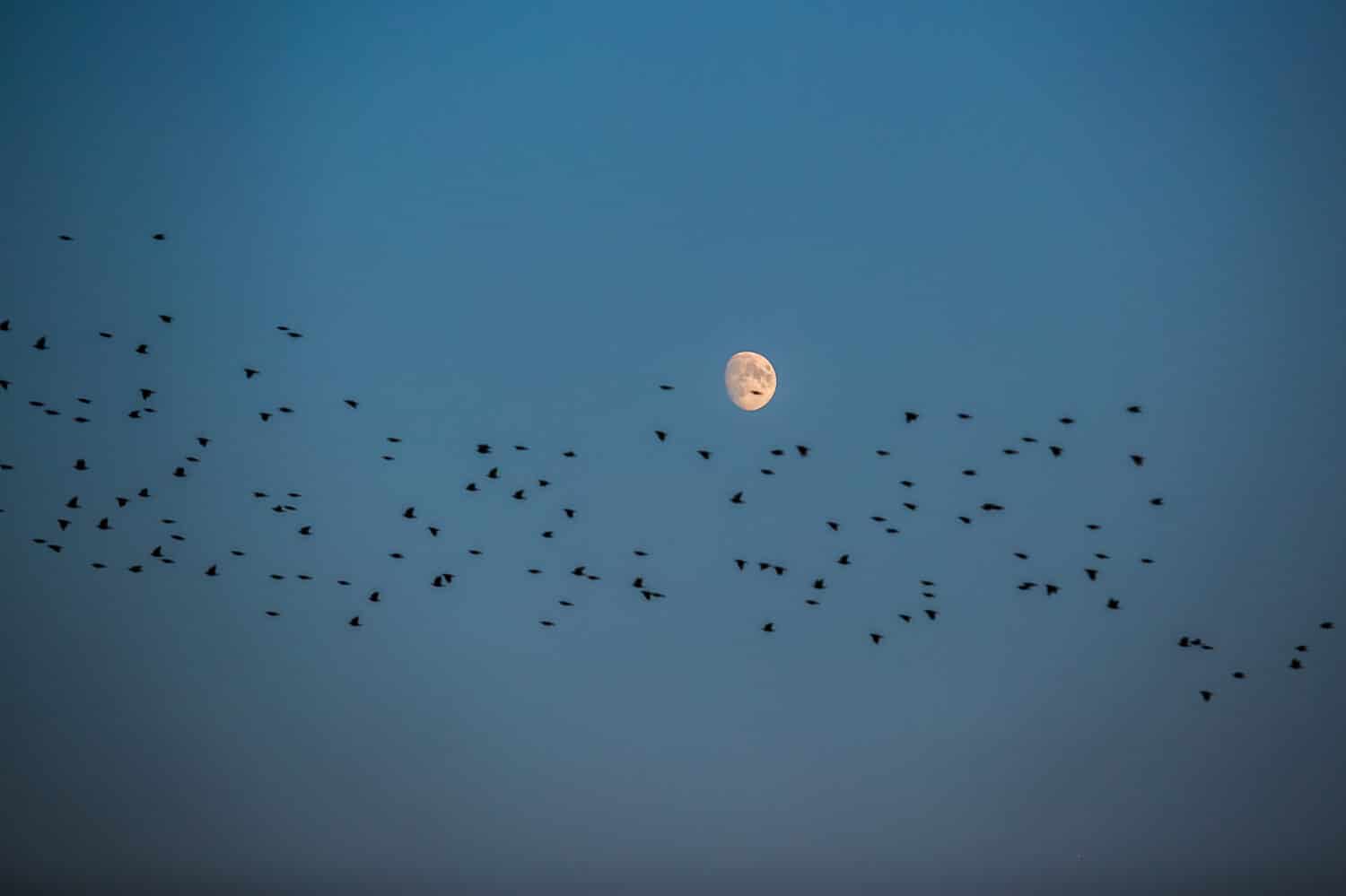
Moonlight may affect some species, especially birds that cross open water or use visual cues. But the effect is not simple.
Birds can migrate on dark, cloudy nights. A full moon may help some birds see landmarks but may also change predator behavior or alter flight activity. Weather and wind often matter more than moon phase for the total number of migrants in a given area.
What is a “fallout”?
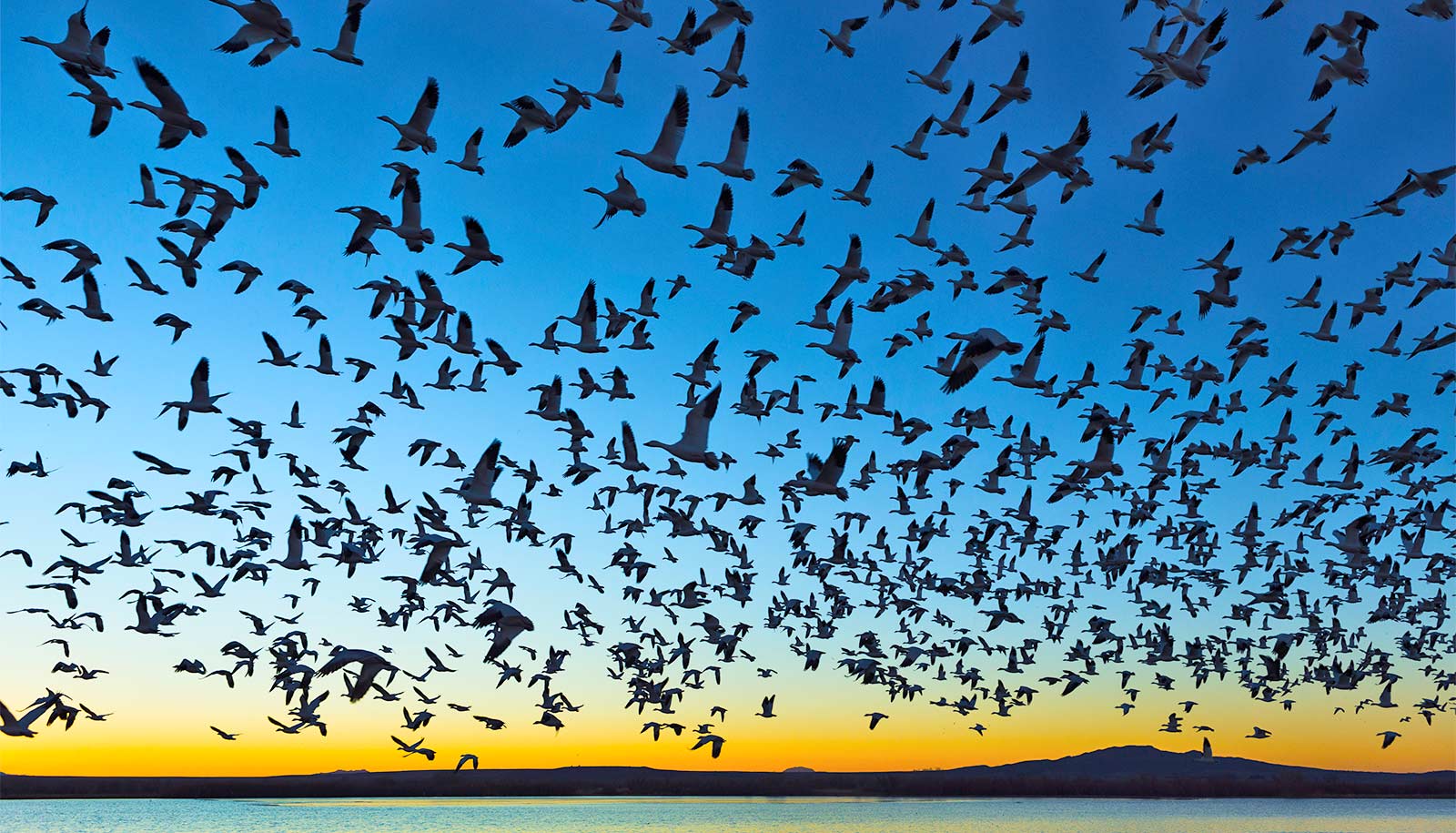
A fallout occurs when many migrating birds land in one area after a difficult flight or when weather pushes them toward a suitable stopover. Fallouts are common along the Gulf Coast and other coastal regions, but they can happen inland too.
During a fallout, birders may see many tired migrants in trees, shrubs, wetlands, and parks. The birds need quiet cover, food, and water. Observers should keep a respectful distance and avoid flushing them repeatedly.
How Can You Watch or Listen for Night-Migrating Birds?
You can study night migration without disturbing the birds. The best tools are radar, sound recordings, and careful morning observation.
Use migration forecasts
BirdCast and local weather radar can help show when migration may be active. Look for:
- A clear or partly clear night
- Favorable winds
- Low storm risk
- A recent weather front
- A forecast for moderate or heavy migration
Radar estimates are regional. They do not guarantee that a particular park will have many birds.
Listen for flight calls
A quiet outdoor space can reveal short calls overhead. The best listening conditions are usually away from roads, air conditioners, and other steady noise.
Use a recording app or a dedicated audio recorder if you want to review calls later. Do not play calls loudly to attract birds. Playback can stress birds and disrupt feeding or rest.
Watch birds the next morning
Migrants often stop at:
- Native plant gardens
- Woodlots
- River edges
- Wetlands
- Coastal parks
- City parks with dense shrubs
Arrive soon after sunrise, when birds are active and natural light makes identification easier. Stay on paths where required, keep dogs controlled, and avoid pushing birds from cover.
Reduce hazards around your home
The most useful home action is to reduce light and glass collisions. Turn off lights, close blinds, and add proven bird-safe window treatments during migration. If you find a stunned bird, place it in a ventilated cardboard box in a dark, quiet location and contact a licensed wildlife rehabilitator. Do not give it food or water unless a rehabilitator instructs you to do so.
Common Myths About Bird Migration at Night
Myth: All birds migrate at night
Many birds migrate during the day. Hawks and eagles often use daytime thermals. Swallows, swifts, cranes, and some waterfowl may also travel in daylight.
Myth: Birds blindly follow the stars
Stars are one navigation cue, not the only one. Birds can combine star patterns with magnetic information, wind, landmarks, and memory.
Myth: Birds cannot migrate when the sky is cloudy
Birds can migrate under cloud cover. Their magnetic sense and other cues can help them maintain direction. Heavy storms and strong winds are more likely to stop or redirect migration.
Myth: City lights always attract every bird
Artificial light can affect many migrants, but responses differ by species and conditions. Light pollution remains a major collision risk because it can alter flight paths and draw birds toward buildings.
Myth: A loud noise will stop a migration flight
Noise usually does not provide a safe solution. Birds respond to many environmental signals, and a loud sound may add stress without changing their route. Reducing light and making windows safer is more useful.

Frequently Asked Questions
How do birds breathe while flying at night?
Birds breathe through lungs connected to air sacs. This system moves air efficiently through the body and supports the high oxygen needs of sustained flight. Nighttime flight does not require a special breathing method.
Do birds sleep during migration?
Most birds do not sleep during a long nonstop flight in the same way they sleep on land. Some species may use brief rest states, but the details vary and remain an active research topic. Birds usually recover by resting and feeding at stopover sites.
Do birds migrate alone or in groups?
Both. Some birds migrate in flocks, while many small songbirds travel alone or in loose groups. A bird may use the calls and movement of nearby birds without staying in a tight flock.
Can birds get lost during migration?
Yes. Young birds, storms, strong winds, magnetic disturbances, light pollution, and habitat changes can all lead birds off course. Many birds correct their route, but some become displaced or appear far outside their normal range.
What should I do if I find a bird that hit a window?
Approach slowly and place the bird in a small ventilated cardboard box lined with a smooth towel. Keep the box dark, quiet, and away from pets. Contact a licensed wildlife rehabilitator as soon as possible, even if the bird appears to recover, because internal injuries may not be visible.
Key Takeaways
- Birds migrate at night to save energy, avoid heat, and reduce some predator risks.
- Small songbirds, shorebirds, and some waterfowl are common nighttime migrants.
- Birds use stars, Earth’s magnetic field, wind, landmarks, memory, and internal clocks.
- Weather strongly affects when birds leave, how far they fly, and where they land.
- Weather radar, flight calls, and morning bird counts help scientists track migration.
- Turning off unnecessary lights and treating windows can reduce bird deaths in the United States.
Conclusion
Birds migrate at night by combining several natural navigation tools rather than following one fixed signal. Their internal clocks help set the season, while stars, magnetic fields, wind, landmarks, and memory help guide each flight.
For people in the United States, the most helpful actions are simple: reduce outdoor light, make windows safer, protect stopover habitat, and use radar or audio tools to observe migration without disturbing birds. A dark sky gives these travelers a better chance to complete one of nature’s most demanding journeys.