How Do Birds Fly In Unison: The Science Of Flocking
Across the United States, people often see flocks of starlings twist over farms, parks, and city edges. These moving clouds may look like one giant animal. In fact, each bird makes its own flight choices while reacting to nearby birds.
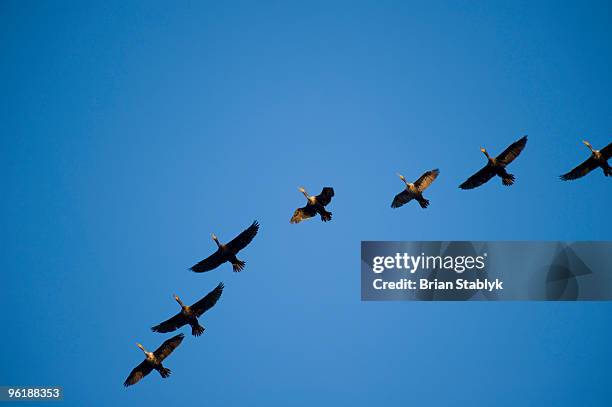
Birds fly in unison through local rules. Each bird watches nearby flockmates, keeps a safe distance, matches their direction and speed, and turns when the group turns. Sight, fast reactions, body control, and flock structure help create the smooth motion we see from the ground.
A flock does not usually need one leader. A small change made by one bird can pass through the group in a wave. This is why a flock can turn, split, or rise almost at once.

What does “flying in unison” mean?
Flying in unison means that many birds move as a coordinated group, even though they do not act as one body. The birds may share a direction, speed, height, or turn. They do not always flap at the same time.
Several types of group flight can look similar:
- Flocking: Birds move together with loose spacing and shared direction.
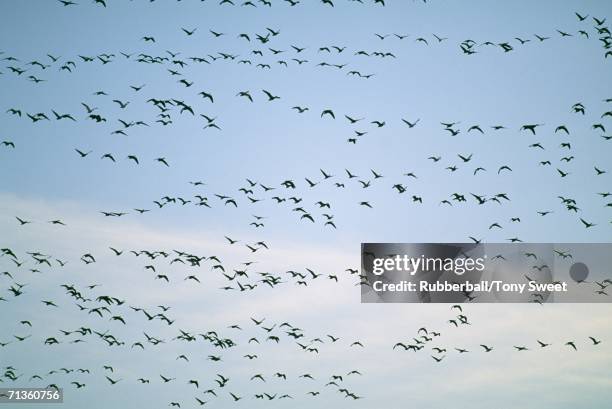
- Murmuration: A dense, fluid flock, often linked with European starlings.
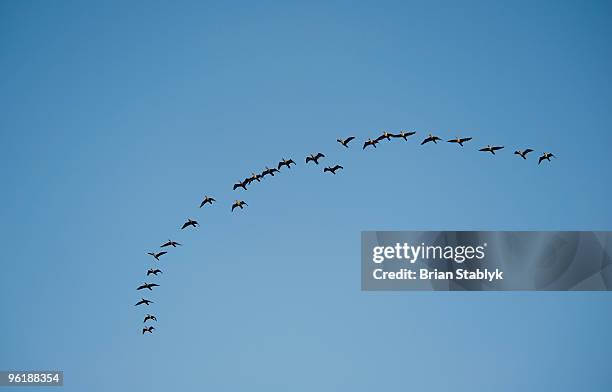
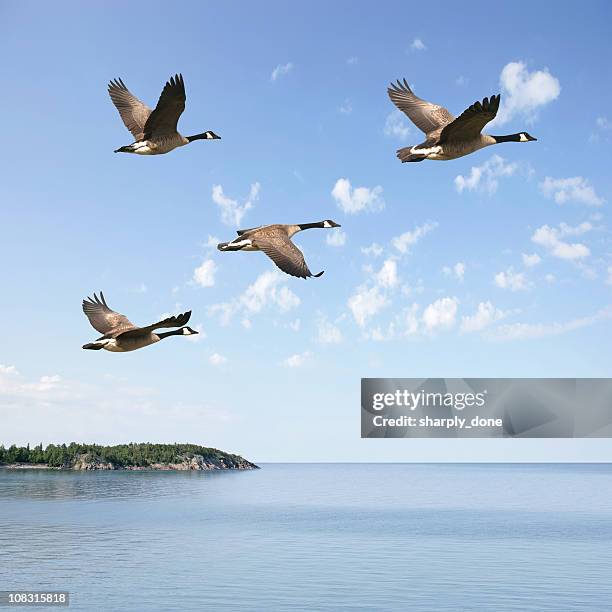
- V formation: Birds fly in a set pattern, as seen in geese and some ducks.
- Swarming: Birds make rapid, changing turns in a dense group.
- Synchronized flight: Birds match some part of their motion, such as direction or wingbeats.
A starling murmuration is not the same as a goose V formation. Starlings use many short-range reactions. Geese often follow a more stable route and formation.
The key point is simple: group flight comes from many small decisions, not from one bird controlling every other bird.
How do birds coordinate their movements?
Birds coordinate movement by following a few basic rules. Researchers often compare these rules with those used in computer flocking models.
1. They avoid collisions
Each bird keeps a personal safety zone around its body. If another bird gets too close, it changes speed or direction.
This rule has the highest priority. A bird must avoid a collision before it can match the flock’s direction.
2. They match nearby birds
Birds tend to copy the direction and speed of nearby flockmates. If several birds turn left, the birds around them may turn left as well.
This creates a traveling movement. One turn spreads across the flock, much like a wave moving across water.
3. They stay near the group
A bird that drifts too far from the flock may turn back toward it. Staying close offers social contact and may reduce the risk of being isolated.
These three rules are often called:
- Separation: Do not get too close.
- Alignment: Match nearby birds.
- Cohesion: Stay with the group.
The birds also respond to predators, food, wind, terrain, and other environmental cues.
4. They react to a limited number of neighbors
A bird does not need to track every member of a large flock. Research on European starlings found that each bird may respond mainly to a small group of nearby birds, often around six or seven.
This type of response is called topological interaction. It means a bird responds to a set number of neighbors rather than to every bird within a fixed distance.
That system can work well when the flock stretches or compresses. A bird still has a useful set of neighbors even when the spacing changes.
5. They use vision and rapid body control
Birds have wide fields of view. Many species can see several flockmates at once. They also use fast changes in wing position, tail angle, and body roll to steer.
A bird may not need to understand the whole flock. It only needs to detect nearby movement and respond quickly.
Why do bird flocks turn at the same time?
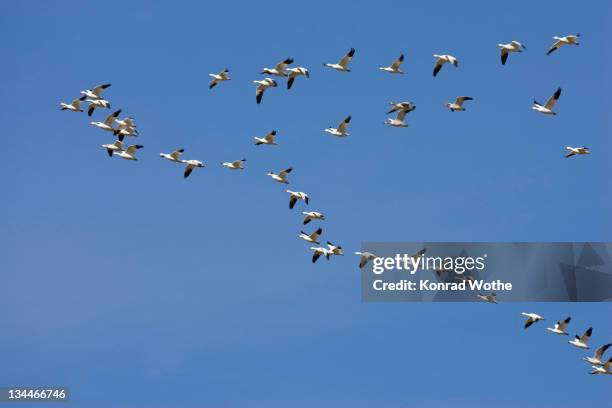
Bird flocks appear to turn at the same time because a movement travels quickly from bird to bird. The turn may begin with one bird, a few birds, or a response to a predator.
Imagine a line of people passing a hand signal. The first person moves. The next person sees the movement and follows. The signal then travels down the line. A flock uses a similar process, but in three dimensions and at much higher speed.
A flock can turn quickly because:
- Birds watch nearby flockmates.
- Their reactions happen in fractions of a second.
- Birds copy direction changes.
- The flock has many overlapping connections.
- No single bird needs to see the whole group.
This process creates collective motion. The group has properties that no single bird has, such as a smooth wave-like turn.
The movement is not perfectly simultaneous. Video recordings often show that turns spread through the flock. Human vision combines these fast changes into one fluid event.
Why does the flock seem to split and join?
A flock may split when birds receive different signals or when a predator enters one part of the group. Birds farther from the threat may keep moving while nearby birds turn away.
The two sections can later join when the birds regain visual contact and return to the rules of alignment and cohesion.
This behavior can confuse a predator. A dense flock can change shape before the predator reaches its target. The predator may also struggle to focus on one bird among many moving birds.
Do birds have a leader?
Most large, fast-moving flocks do not need a permanent leader. A bird at the front may influence nearby birds, but its role can change from moment to moment.
Leadership can still occur in some situations. For example:
- Geese may follow experienced birds during migration.
- A flock may follow a bird that finds food.
- Birds may respond to a bird that spots danger first.
- Social rank may affect who moves first.
- A route may be learned and repeated by the group.
A V formation is often described as leader-led, but the lead bird does not do all the work. The front position can be tiring because it meets undisturbed air. Birds behind may rotate into the lead.
For a murmuration, however, the evidence supports a more distributed system. Each starling mainly responds to nearby birds rather than waiting for commands from one central bird.
So the best answer is: some flocks may use leaders for certain tasks, but rapid flock turns usually emerge from local responses.

How does a V formation help birds fly?
A V formation helps some birds save energy during long flights. Each bird can position itself near the wingtip of the bird ahead and use the rising air created by that bird’s wings.
This rising air is called an upwash. It can help the following bird produce lift with less effort. The exact benefit depends on spacing, timing, wing shape, wind, and flight speed.
Birds in a V formation also keep visual contact with flockmates. This helps them maintain the shape and stay on course.
A simple V formation does not mean every bird receives the same benefit. Birds must adjust their position. If one bird flies too close, it may encounter downward-moving air instead of helpful upwash.
Why do geese change positions?
Lead birds may tire faster because they face the strongest airflow. Other birds can move forward and take a turn at the front.
This rotation spreads the physical cost across the flock. It also lets the group maintain a long-distance route without forcing one bird to lead the entire way.
Birds still need to land, feed, rest, and respond to weather. A V formation helps with flight efficiency, but it does not remove the costs of migration.

Why do birds fly together?
Birds fly together for several possible reasons. The reason can change by species, season, time of day, and location.
Protection from predators
More birds create more eyes and ears. A flock may detect a hawk or falcon sooner than a lone bird.
A large group can also make it harder for a predator to target one individual. Rapid turns may reduce the predator’s chance of making a successful attack.
This protection is helpful, but it is not perfect. Predators have also adapted to hunt flocking birds.
Better access to information
A flock can help birds locate food, water, and safe resting places. When one bird finds a useful site, others may follow.
This does not mean that all flockmates know where to go in advance. Social learning can spread information through the group.
Social contact
Many bird species are social outside flight as well. Flying together helps birds stay with mates, young birds, or members of their group.
Migration and travel
Birds may form groups during migration because group travel can improve navigation and reduce energy costs. Species differ widely, though. Some migrate alone, while others travel in large groups.
Evening roosting
European starlings often gather before settling into a shared night roost. Their murmurations may help the birds assemble and may reduce individual risk near the roost.
Scientists do not treat one explanation as the answer for every murmuration. Predator defense, social contact, and roost formation may all play a role.

Do birds flap their wings in perfect sync?
Usually, no. Birds can fly in unison without flapping in perfect rhythm.
In a dense flock, wingbeats may look synchronized from far away. This can happen because the birds match speed, direction, and spacing. Their wings may also appear to beat together when the flock moves as one visual pattern.
Some species do show more direct wingbeat coordination. Birds in a V formation may adjust their wingbeats to use helpful air currents. Even then, exact timing can vary.
It helps to separate three kinds of coordination:
| Type of coordination | What birds match | Common example |
|---|---|---|
| Directional | Heading and turns | Starling murmuration |
| Spatial | Distance and position | Goose V formation |
| Rhythmic | Wingbeat timing | Some birds flying in close formation |
The main feature of a murmuration is not perfect wingbeat timing. It is the fast spread of changes in direction and spacing.

How do birds avoid crashing in a dense flock?
Birds avoid crashes by combining visual tracking, spacing rules, and rapid steering. They monitor the motion of nearby birds instead of trying to calculate the path of every bird in the flock.
A bird can use several cues:
- The angle and distance of nearby bodies
- Changes in wing position
- A bird’s direction of travel
- The movement of the flock around it
- Sudden changes caused by a predator
Birds also have strong flight control. They can roll, bank, brake, climb, and change direction quickly.
Still, collisions can happen. Young birds may have less flight skill. Poor light, strong wind, panic, and crowded roosts can increase risk.
A flock is coordinated, not flawless.

What is the difference between a murmuration and a flock?
A flock is a general term for a group of birds. A murmuration usually describes a large, moving flock that makes fluid shapes in the sky.
European starlings are the species most strongly associated with murmurations in the United States and Europe. Other birds can form dense, coordinated groups, but calling every flock a murmuration is less precise.
The word describes the movement, not a special organ or communication call. Starlings do not connect their bodies or use a single command signal. Their motion emerges from many local interactions.
Researchers have studied these flocks using field observations, high-speed video, mathematical models, and computer simulations. Work by Giorgio Parisi and colleagues on starling flocks helped show how local neighbor interactions can produce large-scale order.
Can humans copy the way birds fly in unison?
Yes. Computer scientists and roboticists can model flocking with simple rules. A virtual agent can:
- Move away from nearby agents.
- Match their direction.
- Move toward the group.
- Avoid obstacles.
- Follow a target or route.
Craig Reynolds’ “boids” model made this idea widely known in computer graphics. It showed how realistic flock movement could emerge from simple local rules.
Modern research also studies these ideas for:
- Drone coordination
- Robot teams
- Traffic flow
- Search systems
- Crowd movement
- Autonomous vehicles
The model is useful, but birds are more complex than software agents. Real birds have vision, memory, muscles, nerves, social behavior, and survival needs. A simulation can copy a pattern without fully explaining the animal’s biology.

Common myths about birds flying in unison
Myth: One bird controls the entire flock
Large flocks usually do not depend on one central commander. Local reactions can create group-wide movement.
Myth: Every bird sees every other bird
A bird mainly needs information from nearby flockmates. It does not need a complete view of the flock.
Myth: All birds in a flock are related
A flock can contain unrelated birds. Social bonds may matter, but flock membership does not mean that every bird is family.
Myth: Birds always fly together for safety
Safety is one reason. Food, social contact, migration, and roosting can also matter.
Myth: A murmuration is perfectly synchronized
The flock looks unified, but each bird still makes small independent adjustments. The movement contains variation.

Where and when can people see murmurations in the United States?
People in the United States may see murmurations near winter roosts, open fields, wetlands, farms, and city edges. European starlings are common in many parts of the country, but the best viewing site changes by season and local food or roost conditions.
To watch responsibly:
- Keep a respectful distance.
- Avoid shining bright lights at birds.
- Do not use drones near a flock.
- Stay on public land or obtain permission.
- Avoid blocking roads or paths.
- Follow local wildlife rules.
- Leave if birds show repeated alarm behavior.
A good viewing time is often near sunset, when some species gather before roosting. Weather, predators, food, and disturbance can change the timing.
Do not assume that every dark mass of birds is a murmuration. Ducks, blackbirds, grackles, shorebirds, and other species can also form large groups.
What research tells us—and what remains uncertain
Research supports the idea that flock motion emerges from local interactions. Studies of European starlings have found that birds can coordinate with a limited number of nearby neighbors. Mathematical models show how separation, alignment, and cohesion can create organized motion.
Research also suggests that flock responses can spread quickly through the group. This helps explain why a flock can turn as if it were one body.
Some questions remain open. Scientists continue to study how birds combine visual information, sound, memory, social rank, predator threats, and environmental cues. The reason for a specific murmuration may not be clear from a video alone.
A careful explanation should therefore avoid saying that every flock has one proven purpose. The flight pattern is well documented; the exact cause can vary.
Frequently asked questions
How do birds know when to turn?
They see nearby birds change direction and respond with their own wings and bodies. The turn then spreads through the flock.
Do birds communicate while flying?
They can use visual signals and, in some species, calls. The visible movement of nearby birds is often enough to coordinate short-range changes.
Why do starlings make murmurations?
Murmurations may help starlings gather at a roost, respond to predators, and maintain social contact. The exact purpose can differ by place and situation.
Can one bird start a murmuration?
One bird may start a local movement, but several birds can also react at once. A flock-wide pattern emerges as the motion spreads.
Are murmurations dangerous for birds?
They are not risk-free. Birds can collide, especially in poor conditions. However, coordinated flocking can also help birds detect and evade predators.
Conclusion
Birds fly in unison through simple local responses that create complex group behavior. They avoid nearby birds, match direction and speed, stay connected to the flock, and react to danger or changing conditions.
This explains why a starling murmuration can bend, split, and reform without a visible leader. It also explains why geese can maintain a V formation during long travel. The birds do not need one shared mind. Each bird follows its neighbors, and the group becomes coordinated.
The next time you watch a flock over a U.S. field, wetland, or city park, look for the wave of motion. The flock is not moving as one creature. It is a living network of many fast, small decisions.
Selected evidence
- Ballerini et al., “Interaction Ruling Animal Collective Behavior Depends on Topological Rather Than Metric Distance,” Proceedings of the National Academy of Sciences
- Cavagna et al., “Scale-Free Correlations in Starling Flocks,” Proceedings of the National Academy of Sciences
- Giorgio Parisi, Nobel Prize background on collective motion in starling flocks
- Craig Reynolds, Boids: Background and Original Model
- Cornell Lab of Ornithology, Bird Migration and Bird Behavior Resources